Iowa Faith: From Common Belief to Contested Territory
Iowa has long been more than cornfields and quiet towns. It’s been a spiritual landscape: Sunday worship, small-town congregations, and the quiet confidence that faith undergirds civic life. The phrase “Iowa Friendly” isn’t just about smiles and open doors – it’s about a culture shaped by congregations and mutual care.
Yet in recent years that faith has been bent and twisted by power: turned into a tool of identity, a cloak for exclusion, a weapon in partisan contests. It is time we look closely at how faith in Iowa is changing, and how we might reclaim it.
Roots: A State of Many Beliefs
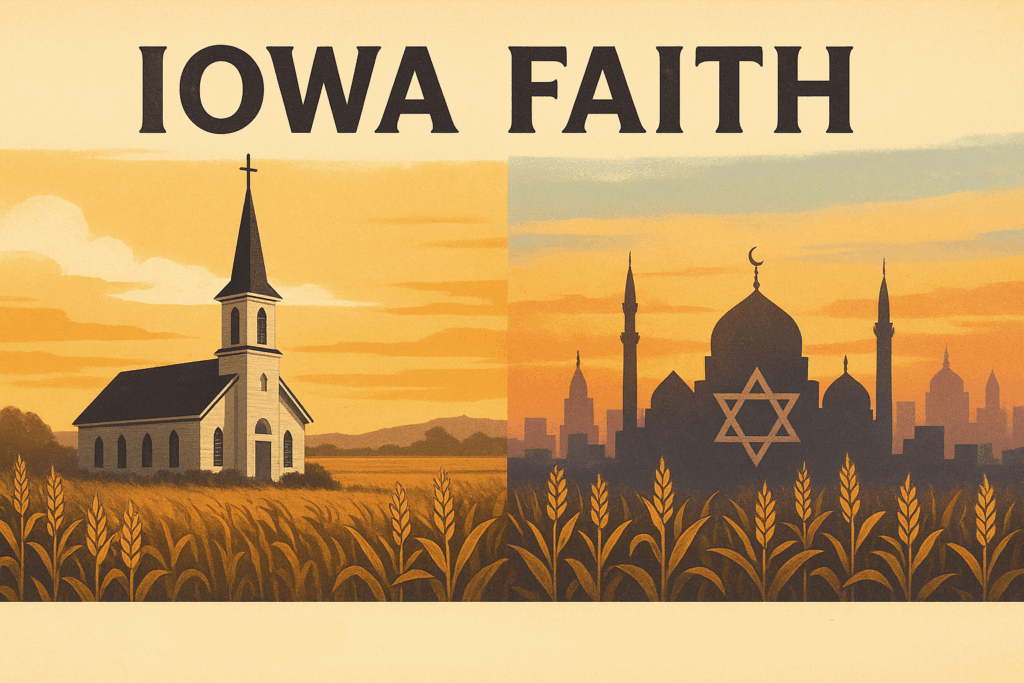
Iowa’s religious fabric has always been diverse, even if some stories are more told than others.
Mainline Protestantism & Evangelicalism have historically held cultural influence, especially in rural and small-town areas.
Catholic communities, especially among descendants of European immigrants, remain deeply rooted in places like Dubuque and Fort Dodge.
Migrant and refugee congregations, such as Latino Catholic and evangelical churches, Somali Muslim communities, and others, have enriched Iowa’s religious life.
The Iowa Interfaith Alliance (and its Interfaith Council) reflects that pluralism – bringing together Christian, Muslim, Jewish, and other faith leaders to promote religious liberty and mutual respect. Their recent public assertion is stark: “Christian nationalism is not Christianity. It is an ideology … a threat to democracy.”
Faith in Iowa, at its best, has been about shared values: caring for the vulnerable, welcoming the stranger, and helping neighbors in need.
When Faith Becomes Politics
In recent times, the lines between religious conviction and political agenda have blurred – often dangerously so. A few ways that distortion has occurred.
Christian Nationalism. An ideology that equates the identity of the nation with Christianity, and positions dissenting beliefs as unpatriotic or dangerous. The Interfaith Alliance Iowa’s resource guide frames Christian nationalism as an ideology that uses religion to gain power, not a true expression of faith.
Religious symbolism weaponized. Flags in sanctuaries, sermons turned into campaign pitches, “faith and family” deployed as dog whistles.
Exclusion in the name of purity. Laws and rhetoric that define “true believers” – and exclude Muslims, Jews, LGBTQ+, and other dissenting voices – all cloaked in the claim of divine endorsement.
Moral panic as political control. The trio we’ve discussed – populist grievance, Project 2025’s architecture, and Christian Nationalist rhetoric – combine to present difference not as diversity but as threat.
When faith is held hostage by partisan power, it loses what made it sacred — compassion, humility, critique, and conscience.
The Damage Done
What is the cost of this merging of religion and ideology in Iowa?
Social fracture. Friends, neighbors, congregations become divided over doctrine or identity politics rather than fellowship.
Silence and fear. Minority faith communities, or religious liberals, may hold back their voices for fear of being labeled “un-American.”
Reduced moral authority. When faith leaders align closely with political power, the Gospel’s critique of power loses legitimacy.
Erosion of trust. For people whose lives are harmed by policies – immigrants, the vulnerable, LGBTQ+ – seeing churches as part of the machinery deepens cynicism and betrayal.
Paths Forward: What Faith Could Look Like Again
I believe Iowa can have a common faith life that lifts rather than divides. Some possibilities:
Interfaith solidarity. Partnerships among diverse religious communities (Muslim, Jewish, Christian, Buddhist) doing joint work for justice, care, mutual support.
Prophetic witness. Faith leaders speaking truth to power – e.g. condemning policies that separate families, criminalize immigrants, or degrade the vulnerable.
Reclaimed pulpit. Preaching that recognizes complexity, encourages critical thinking, and centers the demands of justice over partisan loyalty.
Congregational openness. For churches to cultivate the experience of true welcome – for people of other faiths or no faith, not just those who look or believe like them.
Education & resources. Sharing tools like the Interfaith Alliance’s Christian Nationalism Resource Guide widely, so congregations can understand the difference between faith and ideology.
What the Future Might Hold
If Iowa’s faith communities can resist co-optation – if they reclaim the moral imagination from the Golden Triad – then we may see:
- Renewed trust in religious institutions as places of refuge, not exclusion.
- More alliances between congregations and civic organizations working on housing, health, racial justice, immigrant inclusion.
- A more gracious public discourse shaped by humility, disagreement, but commitment to neighbor.
- Younger generations drawn to faith not as identity badge but as spiritual grounding in a fractured world.
Conclusion: Iowa’s Faith, Iowa’s Future
In the heart of Iowa, faith once whispered across fields and pews and whispered “welcome.” Today, portions of it shout, “us versus them.” That is not what our temples, synagogues, mosques, or meetinghouses were built for.
Iowa is not a monolith of Evangelical identity. It is a patchwork of beliefs, hopes, and dreams. If we are to renew Iowa’s moral soul, we must disentangle faith from fear, restore confusion’s dignity, and place love – not division – back at the center.
Iowa still has “friendly” in its bones. And Iowa faith, reimagined, could do more than remember – it could lead the way.