The Iowa Legislature’s Disdain for Iowa Public Education
And what it means for Iowa’s future
Iowa lawmakers are once again proposing what they will call a “responsible” increase in public school funding, a 1.75% per-pupil bump that doesn’t even pretend to keep pace with inflation, rising operating costs, staffing shortages, or the basic reality of what it costs to educate children in 2026. They will insist it’s a “start,” a “conversation,” and a “compromise.”
It is none of those things. It is a choice.
And it is a choice that reveals Iowa’s governing philosophy with uncomfortable clarity: public schools will be funded just enough to stay open, but not enough to thrive. Because thriving public schools are not part of the long-term plan.
A “Pittance” Is Still a Policy
When lawmakers underfund schools year after year, it is not a clerical error. It is not a misunderstanding. It is not an unfortunate byproduct of “tight budgets.” It is a policy decision that produces predictable results: larger class sizes, fewer teachers, fewer support staff, reduced programming, delayed building repairs, older textbooks, and fewer resources for students with disabilities or mental health needs.
This is not hypothetical. It is what school districts have been warning about for years. And it is what school boards are forced to manage when the state’s per-pupil formula becomes a slow-motion austerity program.
Iowa Republicans often argue that local school boards can “solve” the problem by adjusting local property taxes.
But this argument is as cynical as it is convenient. It shifts the burden from the state to local communities and then allows the same lawmakers to blame local officials for tax increases that were made inevitable by state underfunding.
Real Money Is Going Somewhere Else
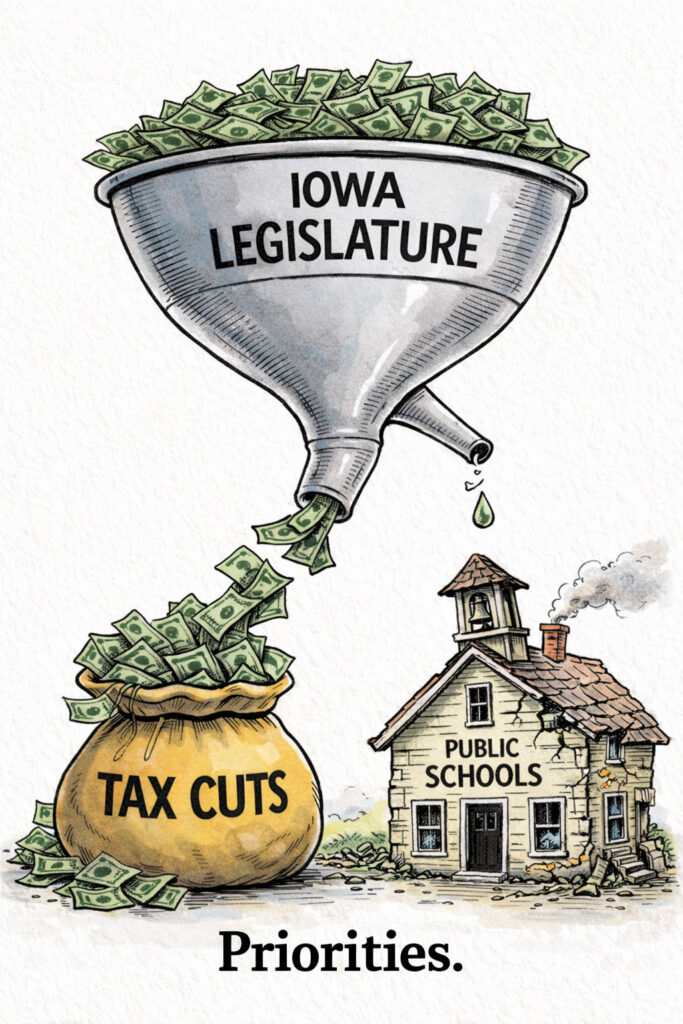
It’s worth asking a blunt question: If Iowa is facing a budget shortfall, why is the legislature still determined to cut taxes?
The answer is not complicated.
The state is starving public institutions to preserve and expand tax cuts, especially tax cuts that disproportionately benefit property owners and higher-income households. Iowa’s political leadership has treated tax reduction as an ideological mission, even when it requires dismantling the very services that made Iowa a strong state in the first place.
Education is not the only casualty. But it is the most consequential.
Because you can underfund many things and recover later. You cannot underfund a generation of children and pretend it won’t matter.
“School Choice” Requires Weak Public Schools
Iowa’s funding decisions cannot be separated from the state’s aggressive push toward privatization.
If lawmakers genuinely wanted to improve outcomes for students, they would strengthen the public system that educates the vast majority of Iowa children. Instead, they have spent years promoting vouchers, expanding private and religious schooling subsidies, and framing public schools as ideological enemies.
This is not about parental freedom. Parents already have choices.
This is about shifting public dollars away from public accountability.
The political logic is straightforward: the weaker public schools become, the easier it is to argue that families should leave them. And the more families leave, the easier it is to justify further funding cuts. It becomes a self-fulfilling decline. Not an accident, but a strategy.
The Workforce Consequences Will Not Be Theoretical
Iowa’s lawmakers talk constantly about “workforce needs.” They hold hearings. They commission reports. They cite shortages in trades, nursing, manufacturing, IT, and education itself.
But workforce development is not something you can purchase later like a new fleet of snowplows. Workforce readiness begins in classrooms. It begins with literacy, numeracy, critical thinking, science, civics, and technical skills. It begins with students having stable environments, support services, and teachers who are not burned out or leaving the profession in droves.
Underfunding public schools will not simply harm children. It will harm Iowa’s economy.
It will shape what companies choose to invest here, what professionals choose to relocate here, and what young people decide when they look at Iowa and ask whether this is a state that values their future.
Iowa’s Reputation Is Being Traded Away
For decades, Iowa’s identity included a simple pride: we invest in education.
That pride is being quietly dismantled.
A state does not lose its reputation overnight. It loses it gradually. One underfunded year at a time, one teacher resignation at a time, one closed rural school at a time, one “budget guarantee” property tax hike at a time.
And the worst part is that this decline is entirely avoidable.
It is not caused by a natural disaster, or a recession, or an unavoidable economic collapse. It is being legislated.
This Is What Control Looks Like
There is one more uncomfortable truth behind this fight: education is power.
The Iowa legislature is not merely underfunding schools. It is simultaneously attempting to tighten control over curriculum, university governance, teacher discretion, and what ideas are considered acceptable in educational settings.
In other words, the same lawmakers who claim to champion “freedom” are also constructing a system in which schools are weakened financially and constrained politically. That combination is not accidental.
A well-funded, confident, locally governed public education system is harder to control.
A weakened system, one constantly scrambling to survive, is easier to bully, reshape, and redirect.
Iowa’s Future Is Not a Line Item
Iowa lawmakers can call this a “start.” They can call it a “reasonable increase.” They can call it “fiscal responsibility.”
But Iowa families know what it is: a deliberate underinvestment in their children.
And Iowa’s students will pay the price long after today’s legislators have moved on to their next political project.
The state cannot claim to care about workforce development, economic growth, or Iowa’s long-term competitiveness while it treats public education as a budgetary inconvenience.
You do not build a future by starving it.