The Devil’s Playbook: An Interview from the Bottom Floor
Note: this is the second article in a two-part series to document my interview with the fallen angel who sits on the throne of evil – Satan. Read the first installment here.
The elevator rattled like a loose hymnbook flapping in a storm. A single button blinked red: B. As it sank, the walls lit with headlines that pulsed like embers – “Patriot Pastor Pack Forms Political Coalition,” “Parents’ Rights Group Drives School Board Sweep,” “Policy Playbook Promises ‘Biblical Citizenship.’” Somewhere below, a brass band practiced “Onward, Christian Soldiers” in a minor key.
The doors parted to a quiet lobby designed by a minimalist who had learned restraint the hard way. Black stone. A solitary fern – plastic, of course. A receptionist with a smile that understood every compromise ever made.
“You’re the interview,” she said, not asked. “He’s expecting you.”
The Devil’s office resembled a corner suite on K Street: glass, leather, and a view that wasn’t of any city I recognized. He wore a plain charcoal suit, crisp white shirt, and a tie the color of crimson. No pitchfork. Those had been retired with powdered wigs.
“Welcome,” he said, rising with impeccable manners. “I appreciate punctuality. It’s the first virtue people surrender when they start lying to themselves.”
We sat. He poured coffee that smelled like October – burnt sugar, bonfire, and a hint of mischief.
“I understand you want to talk about your… success,” I said.
“Please,” he waved, “let’s call it market share. ‘Success’ sounds so final. This is iterative.”
He gestured toward the glass, and images swam into view: a megachurch stage washed in patriotic spotlights; a school board meeting where the word indoctrination tumbled through the air like a thrown chair; a conference ballroom with banners promising “biblical worldview” governance; a policy manual bound in star-spangled leather.
“You targeted religion,” I said.
“I targeted vertical morality,” he corrected, pleased. “All I had to do was convince enough people that truth flows one way: God to prophet to leader to you. Very efficient. Then I made sure their prophets looked suspiciously like politicians, and their leaders talked like cable news.”
He steepled his fingers. “You would be amazed how quickly compassion can be rebranded as weakness once authority is made holy.”
“And you chose the United States… why?”
“Oh, I didn’t choose a nation. I chose a language: identity. I’d been studying revival tents and radio sermons for a century. The trick was to graft religious intensity onto partisan power without changing the tone of the hymns. Do you know how easy it is to replace ‘Savior’ with ‘Strongman’ if the choir is loud enough? You keep the volume and swap the verbs.”
He tapped the desk. The glass showed a montage of sermons spliced with stump speeches: the same cadence, the same call-and-response hunger. The captions scrolled through familiar phrases—take our country back, biblical citizenship, spiritual warfare, enemies within, vermin, crusade.
“Let’s talk methods,” I said.
He grinned. “My favorite part. I like a plan with bullet points.”
Phase One: Local Capture
“I started where habits are formed and attention is cheap: school boards.” He spoke with the easy pride of a franchiser rolling out a new market. “Curriculum is destiny. If you teach a child that disagreement is danger and complexity is corruption, you don’t need to censor every book – you just need to make them afraid of the library.”
He flicked his wrist; the window filled with flyers – parents’ rights, patriotic education, obscenity in schools. Volunteers knocked on doors. Candidates promised to protect children from ideas with long footnotes. The Devil nodded at their clipboards. “Nothing mobilizes like a threatened identity. Nothing.”
Phase Two: Pulpit Syndication
“I don’t invent doctrine,” he said, feigning humility. “I merely optimize distribution.” The glass shifted to a mega-sanctuary where an American flag swayed above the drum kit. “A few pastors realized that politics offers the performance highs of revival with the fundraising of a telethon. I whispered one simple proposition—bless the strongman and your flock will grow.”
He raised an eyebrow. “Many who once opened with the Beatitudes now open with border metaphors and battle metaphors. I encouraged a just-enough prosperity gospel, not the old velvet kind—this was tactical. Tie material success to divine election; call wealth a testimony and poverty a personal failing. You get donors who believe their tax deductions are sacraments.”
Phase Three: Think-Tank Theology
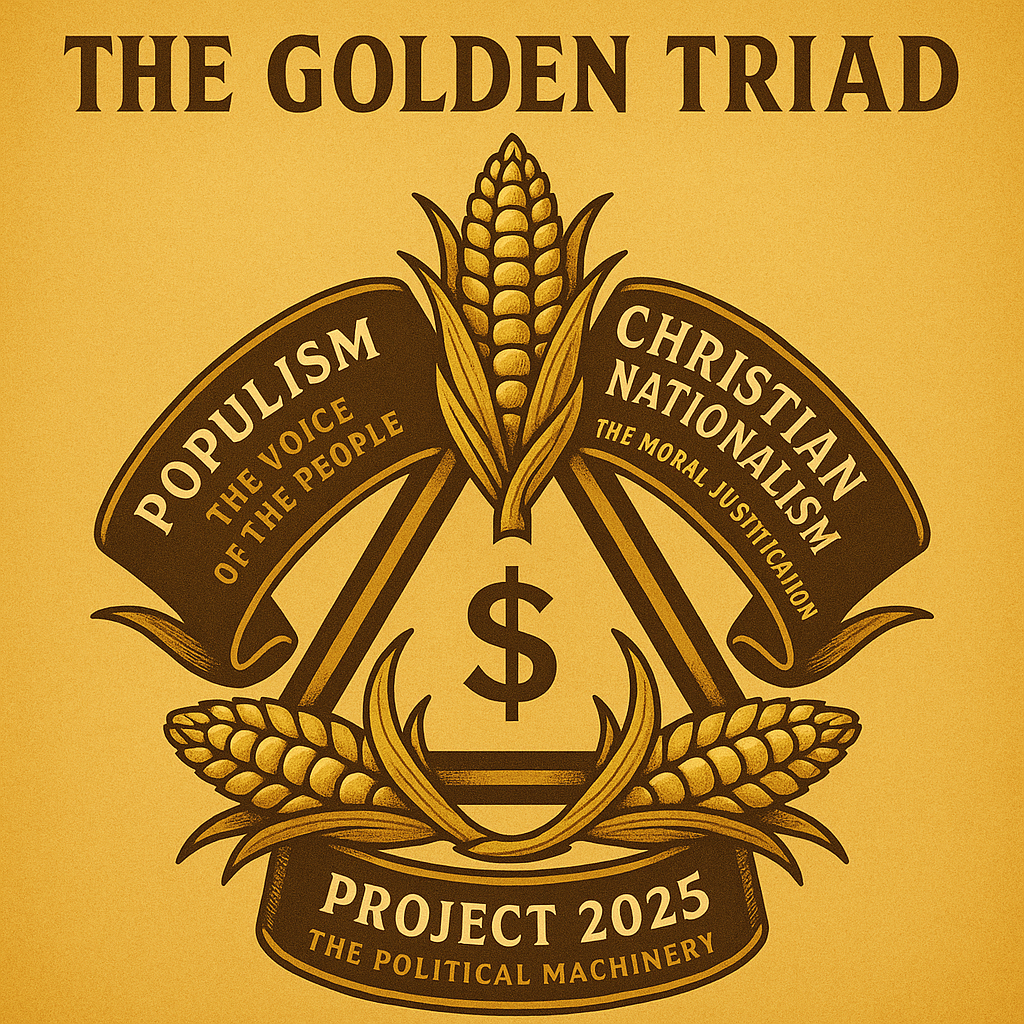
A glossy policy tome hovered in the air. “This was crucial,” he said. “Instead of arguing whether a faith should capture the state, package the capture as ‘restoring’ the nation to God. Forge a long to-do list – staffing, agencies, regulations, curricula – then brand it with piety. It’s not a power map; it’s a discipleship plan.” He chuckled. “Bureaucracy baptized.”
Phase Four: Media House of Mirrors
“I built an echo-stack: talk radio, streaming channels, newsletters, social content. The goal wasn’t persuasion; it was preemption. If your audience hears your version first every day, facts from the outside sound like persecution. Call journalists godless, academics degenerates, public schools satanic – simple, sticky labels. Once they believe truth is a team sport, the scoreboard is all that matters.”
“And the figure at the top?” I asked, careful not to say any name.
The Devil’s smile sharpened. “Ah. The chosen one. My proudest pivot.” He leaned forward. “I used to tempt kings with power; now I tempt congregations to crown one.” He traced a circle in the air. “If you anoint a man whose life mocks the Sermon on the Mount – but insist he’s anointed – then loyalty becomes a sacrament of denial. Every scandal becomes proof of persecution. Every lie becomes a loyalty oath.”
He looked almost tender. “Projection, my dear. Teach them to accuse others of the sins they cannot quit. Call mercy weakness. Call justice ‘woke.’ Call cruelty ‘courage.’ Call neighbors ‘enemies’ and enemies ‘neighbors in waiting.’ And when anyone objects, say they are the demons.”
“Isn’t that… obvious?” I asked.
He chuckled. “Most traps are. People don’t ignore the warning signs because they can’t see them. They ignore them because the signs would cost them something to obey.”
On the glass, the montage shifted again: crowds wrapped in flags, pastors laying hands on candidates, candidates promising to lay hands on agencies. Conference panels outlined a return to “ordered liberty,” the kind with fewer books and more punishments. School board agendas replaced reading lists with lists of forbidden words. Faith became synonymous with a nation under siege; patriotism became a ritual of suspicion.
“What about those who still preach humility, service, and the dignity of every person?” I asked.
“Oh, they’re the new radicals,” he said, amused. “They talk about refugees and prisons, about healthcare and hunger. How quaint.” He sighed. “I had to rebrand their work as heresy – call it socialism, secularism, globalism, anything but the words their Founder spoke. If they quote the red letters, say they’re cherry-picking. If they do the red letters, say they’re political.”
He paused. “And when they refuse to hate, accuse them of hating you.”
I stared at my notes. “You keep saying I did this,” I said. “But all I hear is… people choosing.”
He spread his hands. “Exactly. I don’t rig elections or ghostwrite sermons. I offer a bargain: trade the slow work of love for the quick thrill of domination. People sign. They always sign. It’s the signature that makes it binding.”
He walked to the glass. Now it showed a modest church basement: folding chairs, coffee in styrofoam, a circle of volunteers planning a food pantry. Then a civic hall with neighbors debating a zoning plan like grown-ups. A teacher reading a banned book after school to a handful of teenagers who listened like it mattered.
“You don’t seem worried about them,” I said.
He considered the scene like a vintner swirling something troublesome and pure. “They are slow, and I am fast. They build relationships, and I build brands. But I never leave them alone. I’m always there with the better-looking shortcut.”
He turned back to me. His eyes weren’t red or black; they were the forgiving brown of a warm auditorium just before a rally begins.
“Let’s return to the movement everyone’s talking about,” he said, businesslike again. “Call it Christian Nationalism, call it renewal, call it whatever polls best. Its genius is that it confuses identity with discipleship and country with kingdom. Once you fuse those, violence becomes sacramental, and policy becomes penance for other people.”
“You sound… almost reverent,” I said.
“I admire efficiency,” he shrugged. “Imagine: you can take a faith whose founder washed feet – and persuade millions that the holiest act is to plant a boot. You can take a creed whose first hymn was about emptying power – and sell it as a manual for seizing it. Honestly, I didn’t expect it to work this well.”
“And if they wake up?” I asked. “If people remember what their scriptures teach?”
He smiled – the kind of smile one saves for an opponent who still doesn’t see the trap door. “First, they’ll be called traitors. Then, demons. That’s how projection functions – it makes repentance look like betrayal.” He tapped the glass, and the headlines inverted themselves like a negative – “Traitors in the Pews,” “Devils in Disguise,” “War on the Faithful.” “Shaming is the gatekeeper of the machine.”
He sat again and folded his hands. “But if – if – they persist? If pastors preach the hard parts again? If congregants refuse to raise their children on fear? If local citizens run for office not to punish but to serve? If voters demand truth even when it embarrasses their team? Well.” He smoothed his tie. “Then my market share slips. Slowly at first, then faster. Love scales poorly in the spreadsheets, but it scales beautifully in the world.”
We were quiet. Somewhere above us, a choir rehearsed a reconciliation hymn in an empty sanctuary. It sounded fragile and stubborn and true.
“I have one last question,” I said. “What should people look for, practically, if they want to see your fingerprints?”
He nodded, pleased to be asked for advice. “Four tells,” he said, counting on his fingers.
“First: Speed over substance. If someone demands immediate obedience and calls deliberation disloyalty, they’re marketing me.”
“Second: Purity over people. If the plan saves the idea of the nation but sacrifices actual neighbors, I’m underwriting it.”
“Third: Power over principle. If a leader says the ends justify the means, write my name in the footnotes.”
“Fourth: Projection over confession. If critics are always demons and mistakes are never admitted, you’re hearing my favorite liturgy.”
He stood. The interview was over. The fern in the lobby bowed as if in a hot wind.
“Thank you for your time,” I said.
“Thank you for your platform,” he replied. “You know how this goes: the story will be called partisan by the partisans. Some will accuse you of slandering the faithful. That’s good. It proves my point. But if even a few readers recognize themselves in my boast and choose differently –” He shrugged, almost wistful. “Then I’ll have to work a little harder.”
The elevator doors closed. The headlines dimmed to coals. As I rose, the brass band struck up a new song I couldn’t place, something older than culture wars and bolder than cynicism. On the top floor, the air smelled like rain on old wood, and somebody was setting out chairs in a circle.
Outside, the night was ordinary. People argued and forgave on porches. A teacher graded papers. Somewhere a faith-leader drafted a sermon that would risk donors for the sake of truth. A school board agenda included both a budget and a book list. In a small office, a policy paper was being revised to protect the powerless rather than punish them.
The Devil’s playbook was clever. But a better story – slow, stubborn, and horizontal – was still being written, line by line, wherever neighbors refused to worship power and decided to love one another instead.
Read the other interview story here – more information about the details behind the strategy and how it has captured Iowans.