Forced Ideology Has No Place on Iowa Universities
On December 9, the ultra-conservative Manhattan Institute’s City Journal website published an essay by activist and commentator Christofer Rufo.
The post, “Conservatives in Iowa Will Finally Have a Voice on Campus,” celebrates the state-mandated creation of the University of Iowa’s Center for Intellectual Freedom, portraying it as a heroic stand against what Rufo insists is left-wing domination of the university.
Praise for Reynolds and activist regents
Rufo’s essay reads less like commentary and more like instructions for ideological takeover. His argument reduces higher education to a partisan battlefield where conservative ideas can only survive if politicians reshape the institution in their image.
He applauds Gov. Kim Reynolds and activist regents for “forcing” the university to comply – a revealing choice of words from someone claiming to champion open inquiry.
And by redefining DEI as “left-wing control,” he attempts to justify eliminating it; by depicting faculty as uniformly radical, he justifies overriding them; by invoking isolated anecdotes, he justifies sweeping state intervention.
Protect freedom by limiting it?
The through line is unmistakable: academic freedom, he argues, must be protected by limiting it.
Rufo is not simply offering an opinion – he is outlining a political strategy. His essay celebrating the launch of the University of Iowa’s Center for Intellectual Freedom is a case study in how cultural warriors justify reshaping public universities through state power while claiming to defend academic freedom.
At the heart of Rufo’s argument is a convenient fiction: that eliminating Diversity, Equity, and Inclusion (DEI) initiatives somehow eliminates “left-wing ideology” from campus.
DEI, of course, is not an ideology at all. It is an administrative framework covering everything from disability access to first-generation student support to compliance with federal civil-rights law.
But in Rufo’s telling, DEI becomes a proxy for all progressive thought. If DEI is dismantled, he implies, conservative ideas can finally “take root.” It’s a rhetorical shortcut – and a deeply misleading one.
Following a familiar pattern
The broader narrative follows a familiar pattern. First, assert that universities are dominated by the left. Second, offer no evidence. Third, claim that political intervention is necessary to “restore balance.”
This approach does not engage with how universities function – through faculty governance, peer review, research standards, and disciplinary expertise.
Instead, it reduces the entire academic enterprise to a partisan battlefield, where legislators and regents must “force compliance” to correct alleged ideological drift.
Rufo praises exactly this kind of top-down political pressure in Iowa, crediting the governor, legislature, and activist regents for compelling the university to create a conservative academic center.
The central contradiction of Rufo’s argument
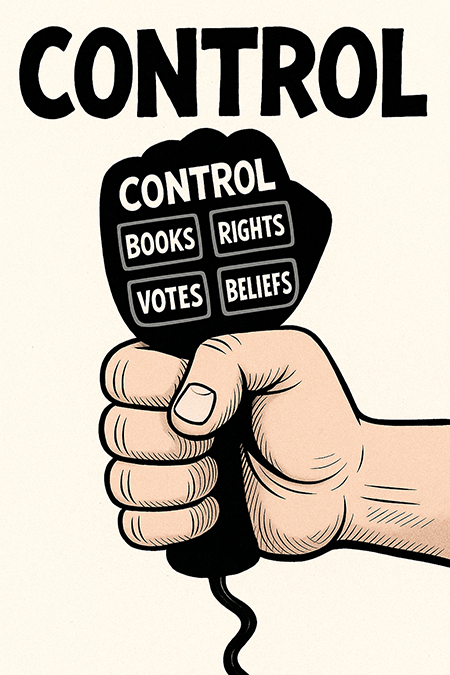
In the process, he inadvertently exposes the central contradiction of his argument: the Center for Intellectual Freedom is not the product of open inquiry, but of state-directed ideological control.
Academic units created through political fiat are not instruments of freedom; they are instruments of orthodoxy.
The anecdotes Rufo includes in his writing – the snowstorm, the Old Capitol staircase, the neon-haired graduate student allegedly endorsing book burning – serve as theatrical flourishes rather than evidence.
No substance to support his claims
They create a sense of cultural conflict without ever addressing the actual substance of academic life in Iowa.
He offers no data on faculty hiring. No analysis of curricula. No engagement with scholarly norms. Just a narrative designed to affirm the worldview of those already convinced.
The purpose of Rufo’s essay
But perhaps the most important thing to understand about Rufo’s playbook is its purpose. It is not written to persuade moderates or independent thinkers.
It is written to mobilize ideological allies – state legislators, regents, donors, and activists – who are already committed to reshaping higher education in their own mold.
It provides the vertically moral and strategic justification for policies that undermine academic autonomy under the banner of “freedom.”
Public universities serve all Iowans
Iowa’s public universities serve all Iowans: conservative, moderate, progressive, rural, urban, independent, and everything in between. Their role is not to mirror the politics of whoever holds office, but to preserve the conditions for inquiry, debate, and discovery.
When political actors seek to impose their preferred ideology on the academy, whether left or right, academic freedom is the casualty.
Understanding Rufo’s strategy makes the stakes clearer. This is not a debate about balance. It is a struggle over who controls knowledge – and whether higher education in Iowa remains a public good, not a partisan instrument.
Bottom Line
Rufo’s piece is not a call for intellectual freedom. It is a call for state-enforced ideological realignment.
It uses emotional framing, selective anecdotes, baseless claims, hero/villain dichotomies, and a narrative of conservative victimhood to build support for political control over higher education.
It is propaganda, not analysis.
And it absolutely does a disservice to education, scholarship, and students – the very people universities exist to serve.