
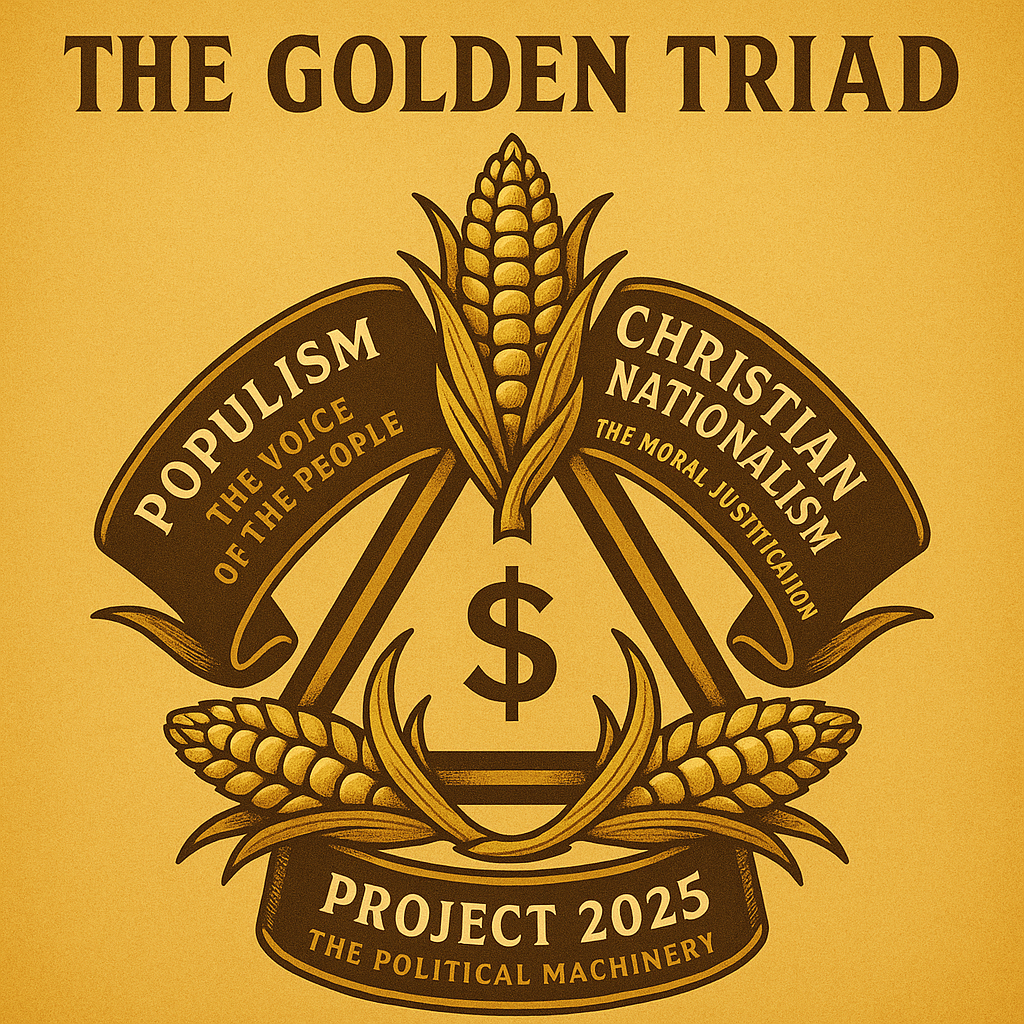
Project 2025 Finds Fertile Ground in Iowa’s Christian Nationalist Movement
In Iowa, where politics, prayer, and the plow have long shared the same soil, Project 2025 has found particularly fertile ground. Framed as a plan to “restore” traditional values and streamline federal power, the 900-page blueprint resonates with many of the same themes championed by Iowa’s conservative and Christian nationalist movements – from reshaping public education and reproductive policy to redefining the role of religion in government.
As local activists, pastors, and politicians echo its language, the project has become more than a Washington think-tank exercise; it’s a reflection of how deeply national culture-war agendas have taken root in the heartland. For Iowa, Project 2025 isn’t just a political vision – it’s a mirror held up to the state’s own evolving identity, faith, and future.
The influence of Project 2025’s ideology can be traced through Iowa’s political bloodstream. Organizations like The Family Leader, led by Bob Vander Plaats, have long championed a fusion of religion and governance that mirrors the project’s call for moral and administrative “restoration.”
State-level debates over book bans, school curriculum control, and reproductive rights echo the same priorities outlined in the Heritage Foundation’s playbook.
Meanwhile, several Iowa legislators have embraced rhetoric that frames policy through a biblical or “parental rights” lens — a direct reflection of the Christian nationalist framework embedded in Project 2025.
Together, these movements have made Iowa not just a testing ground for presidential hopefuls, but also a proving ground for a broader cultural realignment – one that seeks to redefine what it means to be both faithful and free in modern America.
Main Themes of Project 2025
Following are some of the main themes of Project 2025 (the Heritage Foundation–led conservative blueprint) with a short summary for each.
As always, there’s debate around how realistic or constitutional many of these proposals are — but this gives you a clear sense of what the document tries to push.
Centralizing Executive Power / Dismantling the Administrative State
Project 2025 aims to concentrate control over federal agencies and regulatory functions in the presidency, reducing agency independence and dismantling parts of the “deep state.” It proposes reclassifying civil service positions, replacing career staff with political appointees, and reducing or abolishing agencies seen as overreaching.
Ideological Purification & Social Policy Reversal
The plan pushes to undo many progressive or liberal policies around identity, gender, diversity, equity, and inclusion (DEI). It calls for removing protections based on sexual orientation or gender identity, restricting transgender policy, and rolling back federal diversity or equality initiatives.
Tightening Immigration, Border & National Sovereignty
A major focus is on immigration enforcement, border control, and limiting refugee / asylum pathways. The blueprint proposes mass deportations, reorganization or abolition of the Department of Homeland Security, and more aggressive internal enforcement.
Economic & Tax Overhaul
Project 2025 calls for major tax restructuring and deregulation, including simplified tax brackets (flat taxes or fewer brackets), lower corporate taxes, elimination of many deductions, and merging / eliminating government economic agencies. It also proposes to reduce the role and power of financial regulatory bodies.
Education, Culture, & Federal Role
The blueprint wants to dismantle or shrink the Department of Education, transfer education functions to states, promote school choice, and purge “woke” or progressive content from curricula. It also seeks to restrict research funding in fields deemed ideological (e.g. climate, gender studies) and reorient scientific policy to “serve national interest” under conservative frameworks.
Health, Reproductive Policy, & Public Health
Project 2025 calls for radical change in federal health policy: rolling back Medicaid and Medicare expansions, restricting abortion and contraceptive access, restructuring the NIH, and removing “ideological influence” from health agencies. It proposes renaming HHS as the “Department of Life” and aligning it with a pro-life agenda.
Environmental & Climate Deregulation
The plan calls for eliminating or rolling back environmental regulation, weakening or abolishing agencies like EPA and NOAA, and removing climate change from federal priority status. It opposes international climate commitments, power subsidies for renewables, and carbon regulation.
National Security & Surveillance
Project 2025 proposes expanding presidential control over security and intelligence, increasing surveillance powers, militarizing domestic enforcement in some contexts, and shifting priorities in foreign policy (especially toward China). It also calls for rethinking the U.S. nuclear posture and asserting more aggressive defense strategies.
Conclusion
At its core, Project 2025 is not merely a policy handbook — it is a manifesto for reshaping the machinery of American governance around a single moral and political worldview.
Its central themes – concentrated executive power, religiously informed policymaking, and the dismantling of regulatory safeguards – reflect an attempt to recast democracy itself through the lens of ideology rather than pluralism.
Supporters see it as a roadmap for restoring order and moral clarity; critics warn that it represents a blueprint for authoritarian control cloaked in faith and patriotism.
As Iowa goes, so often goes the nation. The debates unfolding in its churches, schools, and statehouse are not isolated skirmishes but early signals of a deeper ideological shift sweeping across America. Project 2025 crystallizes that shift – a vision in which faith and governance are intertwined, and the levers of power are retooled to serve a single moral narrative.
Whether seen as renewal or regression, its themes challenge the pluralistic foundation on which the country was built. For Iowans, the question is larger than politics: it is whether the values of open democracy and individual conscience can endure when belief becomes policy and dissent becomes disloyalty.
However one views it, Project 2025 demands serious attention, for it signals a pivotal struggle over what values will define the nation’s future – and whether the American experiment can survive when governance becomes a battleground for belief.

Iowa411 News Briefs for November 22, 2025
Summary Today’s Iowa411 briefs expose a widening crisis of accountability in education, healthcare, economics, and academia – where political power increasingly overrides transparency, truth, and the public good. From school districts to state politics, today’s...
Iowa411 News Briefs for November 17, 2025
Summary Today’s stories reveal an Iowa – and a nation – facing three interconnected battles. Citizens vs. State Neglect When government refuses to protect public health, citizens create their own solutions. Iowa’s water crisis is a direct result of political...
The UI “Center for Intellectual Freedom” Shows Its True Colors
True Colors Come Peeking Through By Iowa411 Editorial Board At first blush, the new Center for Intellectual Freedom at the University of Iowa sounded like something almost anyone could support: a place to champion free inquiry, robust debate, and the pursuit of truth...
Iowa411 News Briefs for November 15, 2025
Summary Across the state, Iowa institutions – universities, the National Guard, local government systems, and even voter rolls – are undergoing strategic, ideologically driven restructuring. The University of Iowa’s new “Center for Intellectual Freedom” is emerging as...
Iowa411 News Briefs for November 14, 2025
Summary Iowa’s institutions are under strain on multiple fronts: schools firing employees over political expression, a congressional race revealing deep fractures inside the Iowa GOP, a bipartisan revolt forcing transparency on the Epstein scandal, and a confirmed...