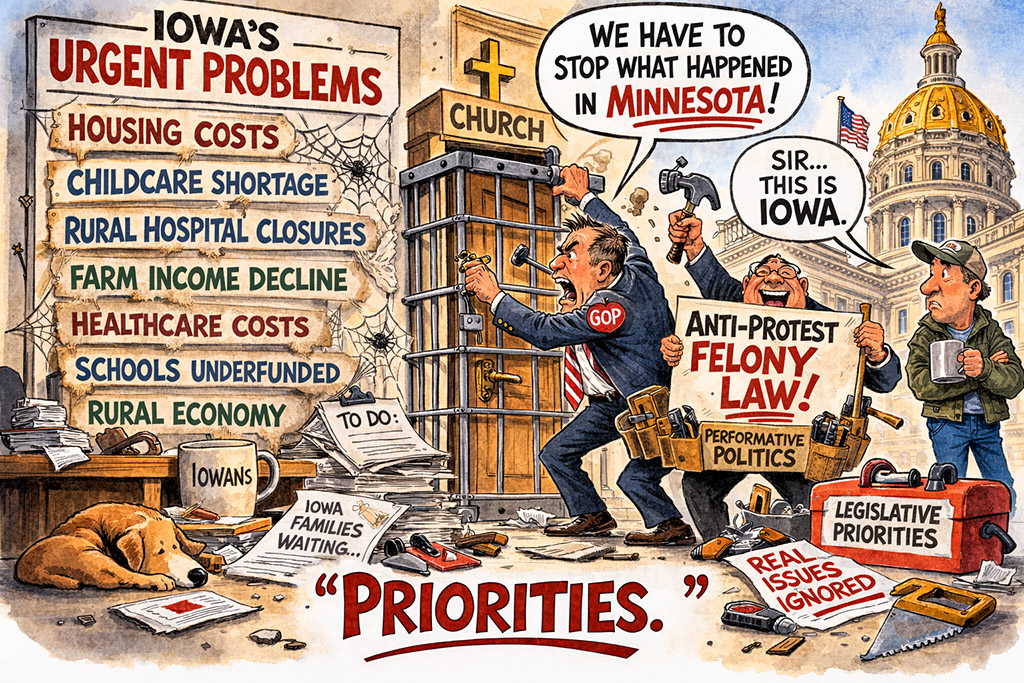
Iowa bill would make disrupting a church service a felony
An Iowa House bill would make disrupting or obstructing a religious service a felony, following a protest that interrupted a church service earlier this year in Minnesota.
House File 2579 would classify intentionally interfering with a religious gathering as a Class D felony, punishable by up to five years in prison under Iowa’s disorderly conduct law. The proposal would apply to conduct that “substantially obstructs, prevents, or interferes with the orderly conduct of a religious service or assembly,” including persistent noise, blocking entrances, or creating fear among congregants.
The legislation was introduced after a January 18 protest at Cities Church in St. Paul, Minnesota, where demonstrators entered the church during a service and chanted “ICE out,” accusing the pastor of serving as the acting director of Immigration and Customs Enforcement’s local field office. At least seven individuals have been charged in connection with the protest.
Rep. Carter Nordman (R–Dallas Center) said the Minnesota incident motivated the bill and described the protest as “disgusting behavior” intended to intimidate churchgoers. Although Nordman acknowledged he is not aware of similar incidents occurring in Iowa, he said the proposal is meant to send a clear message that religious services should not be disrupted.
A three-member Iowa House subcommittee voted 2–1 on March 11 to advance the bill to the House Ways and Means Committee. Rep. Monica Kurth (D–Davenport) opposed the proposal, arguing that existing laws already address disorderly conduct and allow judges to determine appropriate penalties. Rep. Steven Holt (R–Denison) joined Nordman in supporting the measure. Nordman said he plans to discuss the bill with the House Republican caucus to determine whether there is sufficient support to move it forward in the legislature.
Our Take
Respecting the right of people to worship peacefully is not controversial. But creating new felony laws in response to a single incident that did not occur in Iowa raises legitimate questions about legislative priorities.
Current Iowa law already allows authorities to address disruptive behavior, including disorderly conduct, trespassing, harassment, and other offenses. Critics argue that escalating such incidents to felony status carrying potential prison sentences risks turning what are typically handled as misdemeanor disturbances into serious criminal cases.
More broadly, proposals like this illustrate a recurring pattern at the Iowa Capitol: lawmakers reacting to national headlines or events in other states rather than addressing pressing issues affecting Iowans directly. While debates over hypothetical scenarios dominate legislative time, many residents continue to face more immediate concerns such as healthcare costs, childcare access, housing affordability, and rural economic stability.
Protecting religious freedom is important. But effective governance also requires distinguishing between real problems occurring in Iowa and symbolic legislation driven by political messaging. Iowans expect their elected officials to focus on issues that directly affect their communities—not to spend valuable legislative time solving problems that exist somewhere else.