
What Populism Is and Why It Matters
Populism is both a broad political idea and a specific rhetorical style, and it is having real resonance in Iowa today. It has become one of the most influential – and misunderstood – forces in American politics. Following is a detailed overview: what populism is, how it manifests, and how it currently affects politics, policy, and public life in Iowa.
Populism generally revolves around a few core propositions:
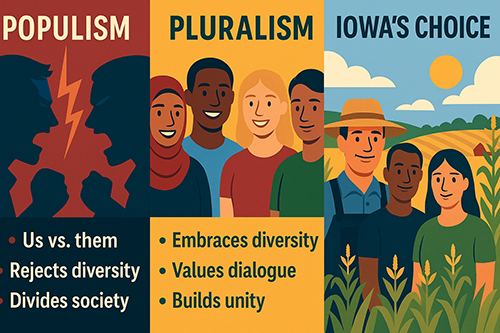
People vs. Elites. Populist rhetoric frames politics as a struggle between “the people” (often portrayed as honest, hardworking, common folk) and an elite or establishment that is seen as corrupt, self-serving, or disconnected.
Moral Certainty. Populist language often claims a kind of moral clarity: “we know who the real people are, who is the real danger, and we must reclaim power from corrupt elites.”
Crises and Threats. Populists emphasize crises – political, cultural, economic – to mobilize fear or urgency (e.g. “the system is rigged,” “they want to silence you,” “Christianity is under assault,” “we must take back control”).
Direct Representation. Populist leaders often portray themselves as direct voices of the people – bypassing intermediaries like media, bureaucracies, or conventional institutions.
Flexible Ideology. Populism is often more about style than fixed policy: it can exist on right-wing, left-wing, or centrist variants. The binding thread is typically the “anti-elite / anti-establishment” posture.
Why Populism Matters
Populism helps explain why many Iowans are frustrated with politics – feeling ignored by elites, suffering from rural decline, or seeing poor representation.
It shapes the political language you’ll hear around farm policy, carbon pipelines, regulation, energy, and property rights.
It offers both opportunities and dangers: candidates can channel legitimate dissent, but populism also risks being used to justify overreach, scapegoating, or erosion of institutions.
Historical Roots & Variants
In the US, a classic populist moment was the People’s Party (Populist Party) of the 1890s, rooted in agrarian discontent, railroad monopolies, and money-banking policies. Iowa played a role in that movement (James B. Weaver was an Iowa-based Populist candidate).
Later iterations include progressive-populism, economic populism, cultural populism, or nativist/populist nationalism – each with different policy emphases but similar styles of “us vs. them.”
Populism in Contemporary America
Populism has surged in Western democracies, often as a reaction to globalization, economic inequality, political disillusionment, and perceived institutional failure. Some features:
Anti-establishment messaging. Criticism of “Washington elites,” “corporate media,” or bureaucracies.
Identity & culture as flashpoints. Populists often tap into cultural anxieties (immigration, national identity, racial, or religious tensions).
Institutional conflict. Populist leaders may challenge norms, push for constitutional changes, or clash with judicial, media, or legislative institutions.
Simplification & emotional appeals. Rather than nuance, populist discourse often uses direct, emotional framing (“the people deserve more,” “they are silencing us,” etc.). Linguistic studies show populist speech tends to be more emotionally charged and direct.
Iowa’s Populist Legacy and Constraints
Historical Puzzles in Iowa
Scholars note that Iowa never fully embraced the 1890s Populist wave the way Kansas or Nebraska did. Some historians argue that Iowa’s party structures (Republican/Democrat realignments) and moderate political culture constrained radical populism.
But Iowa does have a tradition of agrarian activism, midwestern pragmatism, and “cornbelt populism” – a skepticism of distant elites, support for farmer cooperatives, fair markets, and anti-monopoly sentiment.
Modern Iowa Populism: Expression & Actors
Populist rhetoric currently in Iowa often merges rural economic concerns (commodity prices, trade, regulation) with distrust of elites – politicians, bureaucrats, big business.
For example, JD Scholten, Democratic challenger to Joni Ernst, describes himself as a “working-class proud Prairie populist” who rejects the status quo and frames politics as failing many Iowans.
On the Republican side, many candidates and officeholders adopt populist language – “drain the swamp,” “give power back to the people,” “establishment vs grassroots.”
How Populism Affects Iowa
Electoral & Political Impacts
Polarizing campaigns. Populist rhetoric often leads to more combative, binary elections, emphasizing identity, grievances, and outrage over policy detail.
Candidate emergence. Populist outsiders gain traction – lesser-known, anti-establishment figures can upset traditional nomination patterns.
Shifting coalitions. Populism encourages alliances among disaffected voters across class or party lines (e.g. rural conservatives, blue-collar discontents, libertarians).
Policy & Governance
Populist pressure on regulation. Calls to reduce regulatory oversight (energy, environment, banking) as harming “real Iowans.”
Skepticism of elites/institutions. State-level debates over university autonomy, regulatory agencies, environmental rules, or public health can be framed in populist terms.
Trade & tariffs. Farmers feeling squeezed see populist narratives around trade, globalization, and unfair trade deals as immediate concerns.
Infrastructure & rural investment demands. Populist rhetoric drives expectations that government should deliver tangible benefits to rural areas, not just symbolic gestures.
Risks & Weaknesses
- Oversimplification. Populist solutions often avoid tradeoffs and complexity – risk of unworkable promises.
- Institutional strain. Challenging norms or checks and balances can weaken governance stability.
- Populist backlash. As populist promises confront reality, disillusionment may rebound.
- Manipulation risk. Populism can be co-opted by power-seekers to erode democratic norms under the banner of “the people.”
A Toxic Mix
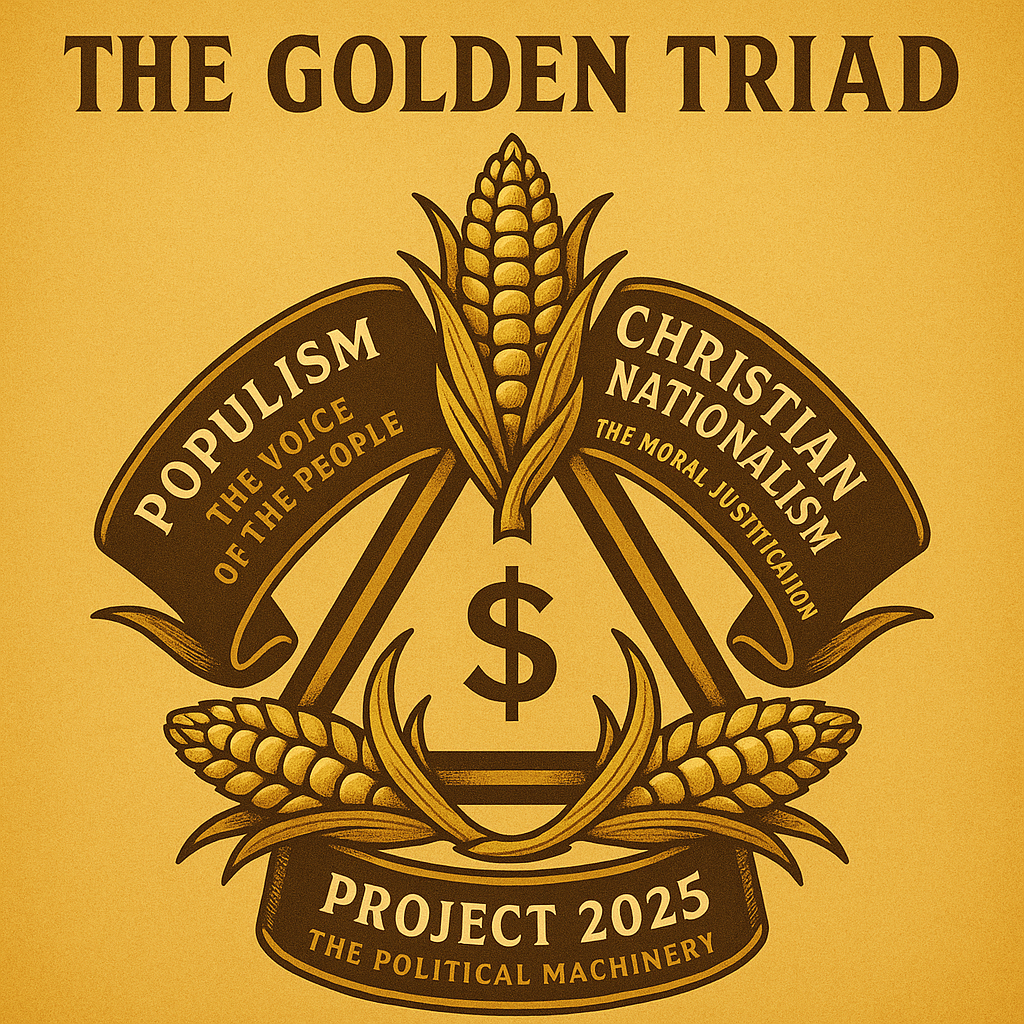
Populism’s dark side can be seen as it is one of three components of the insidious Golden Triad that consists of Project 2025, Christian Nationalism, and Populism. Read more about the Golden Triad.