Summary
Iowa411 News Briefs for December 15, 2025, cover the identification of Sgt. Nate Howard of the Iowa National Guard, killed in an ISIS-linked attack in Syria, and the broader impact on Iowa communities.
The briefs also examine controversy surrounding the University of Iowa’s new Center for Intellectual Freedom, including questions about political influence, academic autonomy, and the role of state power in higher education.
And they conclude with a summary of an Iowa411 editorial that warns against state-imposed ideology on public universities.
Meskwaki Police Chief Identifies Son as Iowa Guard Member Killed in Syria
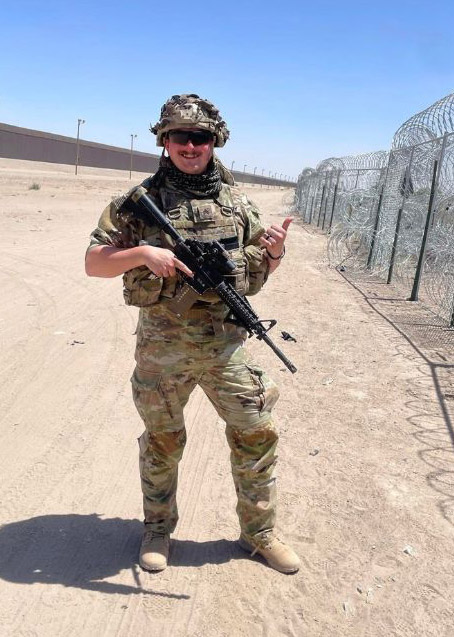
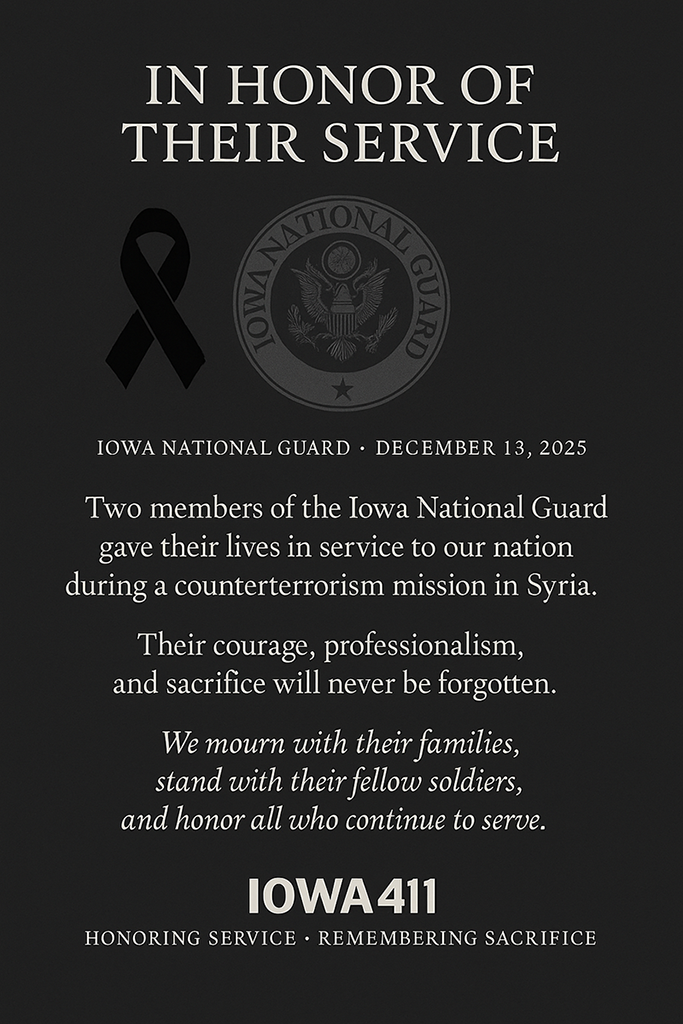
The Meskwaki Nation police chief has identified his son, Sgt. Nate Howard, as one of the two Iowa National Guard members killed Saturday in an ISIS-linked attack near Palmyra, Syria.
Chief Jeffrey Bunn shared the news in a social media post, describing his son as a dedicated soldier who “would be the first in and last out, no one left behind.”
The attack occurred during a key leader engagement as part of Operation Inherent Resolve, the U.S.-led coalition mission targeting ISIS. Three other Iowa Guard members were wounded – two critically but stable – and an American civilian interpreter was also killed. Approximately 1,800 Iowa Guard members are deployed to the Middle East, with 200–250 stationed in Syria.
State and federal officials, including Gov. Kim Reynolds, Sen. Joni Ernst, and Iowa Democratic Party Chair Rita Hart, offered condolences as the investigation continues. The second fallen soldier has not yet been publicly identified pending notification of next of kin.
Our Take
This tragedy cuts deeply – not only because Iowa lost two service members, but because it underscores the profoundly personal cost of distant, often-overlooked conflicts. Sgt. Howard was not an abstraction or a statistic; he was a son, a husband, a community member, and a leader who served with purpose.
As political leaders speak of retaliation and strategy, Iowans should remember that the burden of these missions is carried by families and communities who never sought the spotlight. Honoring that sacrifice requires more than rhetoric – it requires honesty about the risks borne by those asked to serve far from home.
UI Center for Intellectual Freedom Leaders Insist It Is “Not Political”
Leaders of the newly created Center for Intellectual Freedom at the University of Iowa say the center is not a political enterprise, despite polling showing strong student and faculty confidence in free expression on Iowa’s public university campuses.
Board of Regents member Christine Hensley and interim director Luciano de Castro defended the center’s mission during an appearance on Iowa Press, citing anecdotal concerns from parents, donors, and alumni about ideological imbalance in higher education.
However, a 2024 Regents survey found that 87% of students and 77% of employees felt comfortable expressing their views.
The center was created by legislative mandate and reports directly to the Board of Regents rather than university leadership.
Its 26-member advisory council is dominated by out-of-state faculty with conservative leanings, and its inaugural event featured Gov. Kim Reynolds and conservative activist Christopher Rufo as keynote speakers.
Our Take
When an academic center is created by political mandate, staffed largely by ideologically aligned outsiders, and launched with partisan culture-war figures, claims of neutrality strain credibility.
Repeating that the center is “not political” does not make it so – especially when its existence contradicts available data showing robust free expression on campus.
This effort appears less like an organic academic initiative and more like a state-directed intervention searching for a problem to justify itself. The mismatch between anecdote and evidence suggests diminishing political capital, not growing legitimacy. Iowa’s universities do not need ideological parachutes – they need trust in their existing academic institutions.
Iowa411 Editorial: Forced Ideology Has No Place on Iowa Universities
An Iowa411 editorial examines an essay by conservative activist Christopher Rufo celebrating the state-mandated creation of the University of Iowa’s Center for Intellectual Freedom.
The editorial argues that Rufo’s framing – casting higher education as a partisan battlefield – relies on anecdote, omission, and ideological narrative rather than evidence.
The piece critiques Rufo’s portrayal of DEI as a political ideology, his praise for “forcing” universities to comply with state directives, and his call for top-down intervention in academic life.
It warns that creating academic units through political fiat undermines, rather than protects, intellectual freedom.
Our Take
This is not a debate about balance or free speech. It is about control. When politicians and activists seek to reshape universities to reflect their own ideological preferences, academic freedom becomes collateral damage.
Public universities exist to serve all Iowans – not to act as instruments of whichever ideology holds temporary power. Intellectual freedom cannot be imposed from above. When it is, the result is not openness, but orthodoxy disguised as reform.