Summary
Today’s Iowa411 News Briefs cover the identification of two Iowa National Guard soldiers and a civilian interpreter killed in a Syria attack, prompting renewed questions about ongoing U.S. deployments.
The briefs examine Rep. Mariannette Miller-Meeks’ role as House Republicans push a health care overhaul while blocking a vote to extend ACA subsidies, leaving many Iowans facing steep premium increases in 2026.
Coverage also includes a split among Iowa Republicans on restoring federal workers’ collective bargaining rights and scrutiny of Attorney General Brenna Bird’s lawsuit against Roblox over child safety concerns.
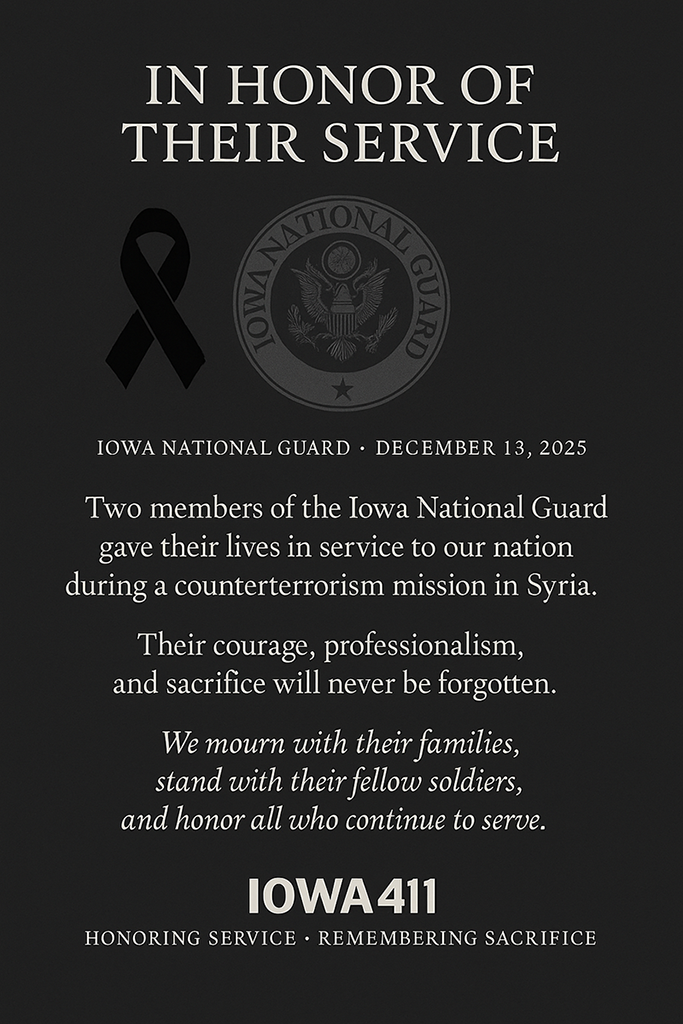
Fallen Iowa Guard Members and Interpreter Identified After Syria Attack
The Iowa National Guard has identified the two soldiers killed in a shooting attack in Palmyra, Syria, as Sgt. William Nathaniel Howard, 29, of Marshalltown, and Sgt. Edgar Brian Torres-Tovar, 25, of Des Moines.
An American civilian interpreter, Ayad Sakat, was also killed. Three additional Iowa Guard members were wounded, two seriously, and were evacuated for treatment.
All were assigned to the 113th Cavalry Regiment of the 34th Infantry Division, deployed as part of ongoing U.S. counterterrorism operations against ISIS. Approximately 1,800 Iowa troops have been deployed to the Middle East since May 2025, with roughly 250 stationed in Syria.
Gov. Kim Reynolds ordered flags lowered statewide in honor of the fallen. Sgt. Howard’s stepfather, Meskwaki Nation Police Chief Jeffrey Bunn, confirmed that Howard’s brother – also an Iowa Guard member deployed overseas – will escort him home.
Our Take
This tragedy is a stark reminder that even “low-visibility” military missions carry profound human costs. These were young Iowans with families, careers, and futures who died far from home in a conflict most Americans rarely think about.
As political leaders talk of retaliation and resolve, Iowans should not lose sight of the deeper question: what ongoing objectives justify continued exposure of Guard members – citizen-soldiers – to lethal risk in a conflict with no clear public endgame?
Honoring their sacrifice means more than ceremony; it requires accountability and clarity about why these deployments continue.
Miller-Meeks Leads GOP Health Care Push as ACA Subsidies Expire
U.S. Rep. Mariannette Miller-Meeks has become the public face of House Republicans’ latest health care proposal, the Lower Health Care Premiums for All Americans Act, which she says addresses the “root causes” of rising premiums while rejecting an extension of enhanced Affordable Care Act (ACA) tax credits set to expire at the end of 2025.
The bill emphasizes long-term structural changes, including expanded association health plans, looser rules on stop-loss insurance, and increased transparency requirements for pharmacy benefit managers (PBMs).
It does not prevent the immediate premium increases expected in 2026 for tens of thousands of Iowans who rely on ACA marketplace coverage.
House Speaker Mike Johnson has refused to allow a floor vote on extending ACA subsidies, even as a bipartisan group of House members has successfully advanced a discharge petition to force a vote on a three-year extension.
Our Take
This is less a neutral policy rollout than a calculated political assignment. By putting Miller-Meeks forward, House leadership gains a physician-lawyer spokesperson in a vulnerable swing district – while also positioning her as the face, and potentially the fall person, for a policy that does nothing to avert the 2026 affordability cliff.
The refusal to allow a floor vote on subsidy extension is revealing. If leadership believed the public was on their side, they would welcome a vote. Blocking it suggests the opposite.
Meanwhile, farmers, small business owners, and self-employed Iowans – many of whom gained coverage during the COVID-era expansion – are being told to absorb thousands of dollars in new costs while waiting for theoretical “root cause” reforms that may never materialize.
Iowa Republicans Split on Restoring Federal Workers’ Bargaining Rights
Iowa’s four Republican members of Congress split on a House vote to restore collective bargaining rights stripped from federal workers under a March executive order issued by President Trump.
Reps. Mariannette Miller-Meeks and Zach Nunn joined Democrats in voting for the Protect American Workers Act, while Reps. Ashley Hinson and Randy Feenstra voted against it. The bill passed the House but faces uncertain prospects in the Senate.
Hinson and Feenstra defended their votes by citing national security and taxpayer concerns, while Miller-Meeks and Nunn framed their support as standing with workers and public servants.
Our Take
There is, in fact, another way to read this vote: two members chose workers, two chose Trump.
Hinson and Feenstra’s position rests on an expansive definition of “national security” that sweeps in agencies ranging from agriculture to environmental protection.
That framing effectively treats collective bargaining itself as a threat – an argument long used to weaken labor rights.
Feenstra’s claim that Trump “always puts Iowa taxpayers first” is conspicuously unsupported by evidence. It functions as a loyalty statement, not a policy argument.
In contrast, Miller-Meeks and Nunn appear to have recognized that opposing basic workplace rights – especially for veterans, nurses, and federal firefighters – is politically and substantively untenable.
Iowa Attorney General Files Lawsuit Against Roblox Over Child Safety
Iowa Attorney General Brenna Bird has filed a lawsuit against Roblox, alleging the popular online gaming platform failed to protect Iowa children from sexual exploitation and misled parents about safety safeguards.
The suit seeks injunctive relief under the Iowa Consumer Fraud Act and could force Roblox to implement additional protections or cease operating in the state.
Roblox denies the allegations, arguing it has extensive safety systems and cooperates with law enforcement. The company notes that users cannot send images via chat and that new restrictions are being rolled out.
Our Take
Child safety online is a serious issue – but this lawsuit also reads like a headline-driven intervention. Roblox has been under national scrutiny for months, yet Iowa’s attorney general entered the legal fray only after the issue became highly visible.
Joining one of the existing multi-state actions would have reduced Iowa’s profile; filing a standalone suit ensures maximum attention.
That does not make the claims invalid – but it does raise a fair question: is this about systemic reform, or about political positioning?
True accountability will depend on whether this action produces measurable safety improvements rather than just press conferences.