Summary
Today’s Iowa411 News Briefs examine how national policy, corporate governance, and state politics intersect with everyday life in Iowa and the Midwest.
Tyson Foods faces shareholder pressure for transparency on immigration, environmental risks, and voting power, while Iowa reverses course and joins the federal Summer EBT program after years of political resistance.
A guest editorial warns of regulatory overreach in food labeling, reflecting broader tensions between agriculture and public‑health policy.
Meanwhile, letters to the editor reveal deep divisions over farming, democracy, water quality, college sports spending, and the direction of national politics.
Together, these stories highlight the complex forces shaping Iowa’s economic, political, and cultural landscape.
Tyson Board Rejects Shareholder Proposals on Immigration, Voting Power, and Waste Lagoons
Tyson Foods shareholders submitted three proposals ahead of the company’s February 2026 annual meeting, seeking greater transparency on immigration‑related labor risks, voting power disparities, and environmental impacts from waste lagoons.
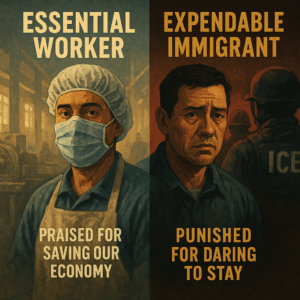
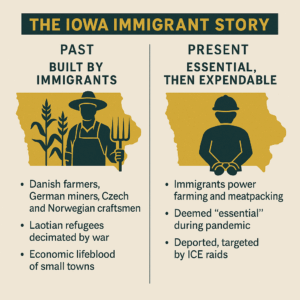
One proposal asked Tyson to assess how recent federal immigration policy changes could affect operations, noting that roughly one‑third of U.S. meatpacking workers are immigrants and that sudden changes in work authorization could disrupt production.
Tyson’s board urged shareholders to reject the proposal, insisting the company already complies with immigration laws and maintains “robust hiring practices.”
A second proposal sought clearer disclosure of voting results by separating Class A and Class B shares – a move aimed at highlighting the Tyson family’s 71.7% voting control. The board dismissed the idea as unnecessary.
A third proposal requested a report on environmental and health risks from waste lagoons in Tyson’s pork supply chain, citing past pollution incidents. Tyson argued its existing risk management systems are sufficient and called the proposal irrelevant.
Our Take
The board’s resistance to transparency, especially on immigration, is telling. Tyson’s workforce depends heavily on immigrant labor, and sudden federal policy shifts pose real operational risks. Acknowledging that reality shouldn’t be controversial.
Instead, the company appears determined to avoid public scrutiny, even as shareholders push for clarity. The dual‑class voting structure only reinforces how insulated leadership is from outside accountability.
Iowa Accepts Federal Summer EBT After Years of Resistance
A Des Moines Register editorial notes that after two years of rejecting federal Summer EBT funds, Iowa will join the program in 2026, providing $40 per month per eligible child to help families buy groceries during the summer months.
Previously, Gov. Kim Reynolds and state officials argued that federal benefits encouraged unhealthy purchases and that Iowa’s alternative program, Healthy Kids Iowa, better promoted nutrition.
Critics countered that the state’s program reached far fewer children and imposed logistical burdens on families.
The shift came after federal authorities allowed Iowa to impose restrictions on what Summer EBT cards can purchase, mirroring new SNAP limitations taking effect in January.
While the restrictions are confusing and paternalistic, the program will now reach nearly four times as many children as Iowa’s homegrown alternative and bring roughly $30 million in federal aid into the state.
Our Take
The editorial writer is right about one thing: this was never about nutrition. Iowa’s objections evaporated the moment the state was allowed to police what low‑income families buy.
The timing – coinciding with a friendlier federal administration – raises obvious questions about political motivations.
The good news is that more children will finally receive support. The bad news is that it took two wasted summers and a lot of ideological theater to get here.
Opinion: Anti‑Regulation Editorial Warns of “Overreach” in Food Labeling Laws
A Des Moines Register guest editorial by former Iowa legislator Tom Sand argues that new state‑level food‑additive labeling laws in Texas, Louisiana, and Wisconsin represent harmful regulatory overreach driven by federal officials, including Health Secretary Robert F. Kennedy Jr.
Sand claims these rules unfairly target corn‑derived ingredients, impose costly packaging changes, and ultimately raise grocery prices for rural families. He frames the issue as a betrayal of farmers who rely on corn and soybean markets.
He also criticizes what he calls “pseudo‑science” and foreign‑influenced labeling standards, arguing that regulators should trust American agriculture and avoid policies that increase costs or undermine farmer confidence.
In short, Sand’s message urges Washington to reduce regulations on corn‑ and soy‑based products and warns that rural communities may lose trust in federal leadership.
Our Take
This piece reflects a broader tension between food safety advocates and commodity‑crop interests.
The editorial frames all labeling requirements as anti‑farmer but avoids engaging with the underlying public‑health concerns that prompted these laws.
The issue is less about science and more about economics. And Sand clearly prioritizes protecting commodity markets over transparency for consumers.
The reference to RFK Jr. seems more rhetorical than substantive, but it signals how polarized food policy has become.
What Iowans Are Saying
Condensed summaries of Sunday’s Des Moines Register letters to the editor
Criticism of Iowa agriculture lacks solutions – M. Shaw
Shaw defends Iowa farmers and ISU President Wendy Wintersteen, arguing critics offer complaints without workable alternatives. He highlights decades of progress in efficiency and regenerative practices.
Trump’s policies are hurting farmers – J. Kopecky
Kopecky says tariffs and federal policies are damaging Iowa agriculture, forcing farmers to rely on bailouts while lobbyists profit. He calls for a farm bill that supports sustainability and clean water.
State meddling in county elections – B. Spence
Spence argues that Iowa lawmakers undermined local control by forcing redistricting in three counties, contradicting claims that Iowa’s system is the “best.”
U.S. showing signs of authoritarianism – T. Andersen
Drawing on experiences in 1960s Mozambique, Andersen warns that current U.S. political trends resemble early signs of dictatorship.
Tax all land equally – J. Johnson
Johnson proposes taxing every square foot of Iowa land at the same rate, including government and church property, to simplify and equalize the property‑tax system.
College sports spending is out of control – L. Erickson
Erickson criticizes the escalating financial arms race in college athletics and urges universities to redirect resources toward community needs.
Complaints about profanity are outdated – M. Mahoney
Mahoney dismisses outrage over a coach’s language, arguing that profanity is commonplace and not harmful to its intended audience.
Senators should oppose PERMIT Act – M. Ohloff
Ohloff warns that the PERMIT Act weakens Clean Water Act protections and would worsen Iowa’s already severe water pollution.
Democrats overspend on health care – D. Pine
Pine argues that Democrats rely too heavily on funding the ACA and calls for structural reforms instead of more spending.
Creston school board overreacted to online outrage – G. Ott
Ott says the board allowed anonymous social‑media backlash to drive decisions, undermining efforts to improve district culture.