Summary
Today’s headlines reflect a Midwest – and a nation – at a crossroads. From the upper plains to Capitol Hill, courts, Congress, regulators, and local innovators are all wrestling with competing visions of economic growth, private rights, public benefit, and long-term sustainability.
A North Dakota judge’s decision to strike down a forced carbon storage law highlights a growing backlash across rural America against corporate energy projects that rely on compulsory land access. Meanwhile, the U.S. Senate remains deadlocked on health care reform, leaving millions of Americans facing steep premium hikes just weeks before enrollment closes.
Here in Iowa, the tension between rapid technological expansion and public oversight comes into focus again as regulators approve a major high-voltage transmission line to support massive Google and QTS data centers – even as legal battles simmer over how such projects are awarded. In contrast, another infrastructure story shows government innovation at its best: Des Moines’ wastewater plant is preparing to turn sewage into sustainable fertilizer, offering an uncommon win-win for farmers, water quality, and taxpayers.
And finally, national manufacturing continues to slump under unpredictable tariff policies, a reminder that economic uncertainty remains a persistent undertow even as some sectors surge.
Together, these stories reveal the same underlying truth: the policy choices we make today – on land rights, health care, energy, environment, and trade – will determine who benefits, who pays, and how resilient our communities will be in the years ahead.
North Dakota Judge Overturns Carbon Storage Law in Win for Landowners
A North Dakota district court judge has ruled that the state’s carbon storage law – which allowed underground CO₂ sequestration projects to proceed with only 60% landowner consent – violates constitutional protections for private property.
Judge Anthony Swain Benson found the statute unlawful because it allowed the state to compel access to underground “pore space” without guaranteeing landowners the right to jury-determined just compensation.
The ruling directly affects Summit Carbon Solutions, whose multistate pipeline and storage network relied on the eased standard for obtaining storage rights. With 92% voluntary participation in its storage zone, Summit had hoped the law would allow it to proceed; now, that path is blocked pending appeals. Attorney General Drew Wrigley says the state is assessing its options.
Our Take
This is another clear signal that rural America is rejecting corporate models built on coerced access to land.
The court reaffirmed what landowners have been saying for years: “voluntary” must mean voluntary. Summit’s next move will reveal whether it can adjust its playbook – or whether it keeps trying to outmaneuver the communities standing in its path.
Senate Stalemate Leaves ACA Consumers Facing Soaring Premiums
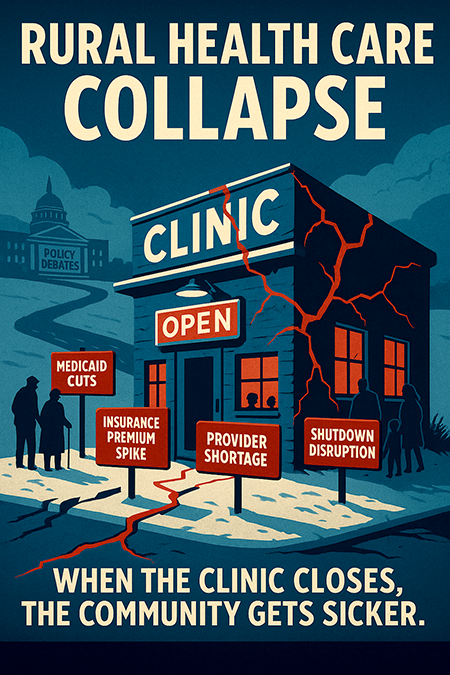
With just days left before open enrollment ends on December 15, U.S. senators admit they have no bipartisan path forward to address skyrocketing health insurance costs.
Democrats want to extend the enhanced ACA tax credits that helped stabilize premiums; Republicans are divided between restructuring subsidies, limiting eligibility, or shifting funds directly to consumers.
Without action, marketplace premiums are projected to rise an average of 26% next year – and more than double (114%) for many subsidized enrollees as the enhanced tax credits expire. Neither party expects the upcoming floor votes to pass, and both acknowledge that workable negotiations may not occur until after enrollment closes.
Our Take
Congress is about to leave millions of families with impossible choices – higher premiums, catastrophic-only plans, or no insurance at all.
Everyone agrees the system is broken, but no one is willing to risk political capital before an election year. The result is predictable: ordinary Americans pay the price for Washington’s paralysis.
Iowa Approves $221M Transmission Line to Power Massive Data Center Expansion
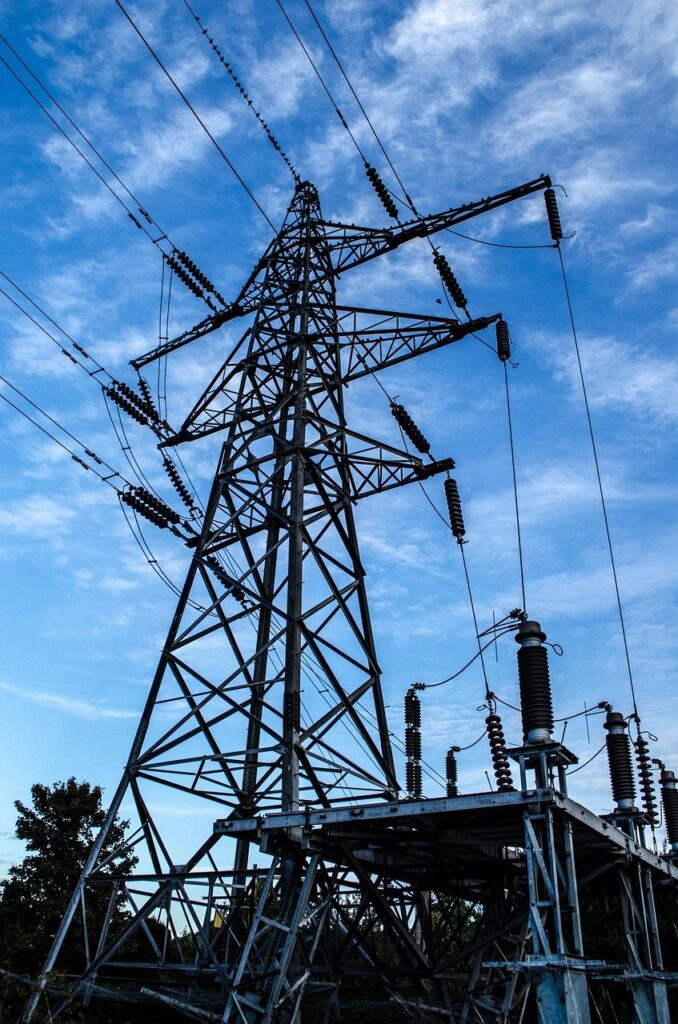
The Iowa Utilities Commission has approved ITC Midwest’s $221 million, 61-mile high-voltage transmission line between Marshalltown and Cedar Rapids, a project essential to powering Google’s and QTS’s multibillion-dollar data center developments.
Despite objections from LS Power and Southwest Transmission – who argued a court injunction prohibited further action – regulators sided with MISO’s reassessment, which reassigned the project to Iowa’s incumbent utilities to prevent delays that could jeopardize grid reliability.
ITC Midwest also received eminent domain authority for one unresolved parcel. The company now has two years to complete the project, which will support what may become Iowa’s single largest economic development investment.
Our Take
Data centers are reshaping Iowa’s energy landscape faster than the law can keep up. While these projects bring enormous economic potential, they also require transparency, strong oversight, and a recalibration of how eminent domain is used in the digital age. Iowa’s grid is entering a new era – the question is whether policy will evolve with it.
Des Moines Wastewater Plant Plans to Transform Sewage Into Sustainable Fertilizer
Turning Crap into Crops: A Fertilizer Revolution.
Des Moines’ Metropolitan Wastewater Reclamation Authority is moving forward with a $45 million plan to convert phosphorus-rich byproducts into struvite fertilizer pellets – a sustainable, slow-release fertilizer that delivering nutrients directly to crop roots, reduces runoff and boosts crop health.
The slow-dissolving struvite pellets also minimize loss to waterways. That makes the product valuable both economically and environmentally and aligns with Iowa’s Nutrient Reduction Strategy.
The project will save the plant nearly $1 million annually by preventing struvite buildup in pipes and reduce the need for expensive future nutrient-reduction upgrades. Construction may begin in 2026, with full operation expected two years later.
Our Take
This is a rare triple win: cleaner water, lower maintenance costs, and a valuable agricultural product created from a waste stream. It is local, sustainable, and smart – and it shows that good environmental policy doesn’t always require sacrifice. Sometimes innovation really does pay for itself.
U.S. Manufacturing Slumps Again as Tariffs and Uncertainty Weigh Heavily
Manufacturing activity contracted for the ninth consecutive month in November, according to the ISM index, as companies grappled with unpredictable tariffs, higher input costs, labor shortages, and supply chain confusion.
Some transportation equipment makers say they are now shifting production offshore, laying off workers, and revising long-term strategies in response to President Trump’s sweeping duties on vehicles and parts.
Even with some modest gains in AI-adjacent sectors, the broader picture is bleak. The ISM new Orders Index continues to shrink and manufacturers increasingly cite tariffs, inconsistent trade policy, and global uncertainty as barriers to recovery.
Our Take
The promise that tariffs would “bring manufacturing home” has not materialized. Instead, companies face uncertainty so severe that offshoring appears safer than staying put.
Manufacturing thrives on predictability – and right now, that’s the one thing the sector does not have.