Summary
Today’s Iowa411 News Briefs spotlight the growing divide between Iowa’s working class and its political leadership.
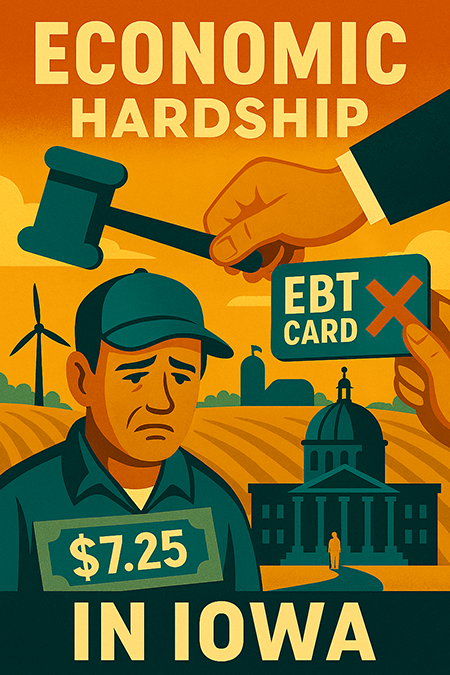
New SNAP restrictions and expanded work requirements threaten food security for thousands, while Iowa’s minimum wage remains frozen at $7.25 – one of the lowest in the nation.
As 88 jurisdictions raise wages in 2026, Iowa stands still. Meanwhile, a year-end special election could restore Republican supermajority control in the Iowa Senate, reshaping the state’s political landscape.
Together, these stories reveal how policy decisions – or the lack thereof – are deepening economic hardship and limiting democratic accountability in Iowa.
New SNAP Restrictions in Iowa Raise Alarm for Vulnerable Residents
Starting January 1, Iowa’s SNAP program will implement new restrictions that ban purchases of soda, candy, and many prepared foods – including some sandwiches and fruit cups – based on confusing criteria tied to state tax codes.
For Iowans who rely on convenience store meals, the changes are especially punishing. The rules are unclear and difficult to follow, and many fear that retailers may stop accepting SNAP altogether if enforcement becomes too burdensome.
The restrictions are part of a broader overhaul under President Trump’s “Big, Beautiful Bill,” which also expands work requirements to include older adults, parents, veterans, and young people aging out of foster care.
Critics say the changes will push thousands off the program, increase pressure on food banks, and disproportionately harm immigrants, who are now excluded from eligibility. Iowa will also have to shoulder a larger share of SNAP’s administrative costs, with penalties looming if its payment error rate rises.
Our Take
This is punishment by policy. The food restrictions are confusing, the work requirements are burdensome, and the exclusion of immigrants is cruel.
In today’s economic climate, these changes don’t promote health or employment – they push vulnerable Iowans deeper into crisis. The state’s refusal to raise the minimum wage only compounds the harm.
88 US Jurisdictions to Raise Minimum Wage in 2026 – Iowa Not Among Them
As affordability challenges mount nationwide, 88 cities, counties, and states will raise their minimum wage in 2026, with 79 jurisdictions reaching or exceeding $15/hour and 57 surpassing $17/hour.
These increases reflect inflation adjustments, phased step-ups, and voter-approved initiatives. Flagstaff, Arizona, will eliminate its subminimum tipped wage entirely, requiring employers to pay the full minimum wage regardless of tips.
Meanwhile, Iowa remains stagnant at $7.25/hour – the federal minimum – with no plans to raise the wage floor. The state hasn’t updated its rate since 2008, and in 2017, the Legislature repealed local minimum wage ordinances in five counties.
Advocacy groups say a $17/hour wage would benefit over 387,000 Iowa workers, especially women, parents, and people of color.
Our Take
Iowa’s refusal to act on wages is a policy choice that hurts working families. While other states respond to inflation and inequality, Iowa lawmakers sit idle. The state’s minimum wage is no longer a floor, it’s a trap. Raising it isn’t radical; it’s overdue.
Iowa’s Minimum Wage Still at $7.25 – One of the Nation’s Lowest
Iowa’s minimum wage remains frozen at $7.25/hour, matching the federal rate and placing the state among the lowest in the country.
Thirty states and dozens of localities have raised their wage floors above the federal level, but Iowa has not acted since 2008. Five neighboring states now exceed $10/hour, and Illinois will reach $15 in 2025.
Economic analysis shows that a $17/hour minimum wage would directly benefit 231,000 Iowa workers and indirectly raise wages for another 156,000. The average annual raise would be over $3,200. Affected workers are concentrated in retail, health care, restaurants, and manufacturing – sectors critical to Iowa’s economy.
Our Take
The numbers speak for themselves. Iowa’s wage floor is stuck in 2008 while costs have soared.
Raising the minimum wage would lift hundreds of thousands of workers and their families out of economic precarity. The only thing standing in the way is political will.
Republicans Aim to Reclaim Iowa Senate Supermajority in Year-End Special Election
A special election today will determine whether Republicans regain a supermajority in the Iowa Senate.
Democrat Renee Hardman faces Republican Lucas Loftin in a race to fill the seat left vacant by the death of Sen. Claire Celsi.
A Republican win would restore the party’s two-thirds control, allowing them to confirm Gov. Kim Reynolds’ appointments without Democratic support.
Hardman, a nonprofit CEO and West Des Moines City Council member, would be the first Black woman elected to the Iowa Senate.
Loftin, a former tree trimmer turned tech project manager, represents the GOP’s bid to flip the seat. Democrats hold a slight registration edge in the district, but holiday-week turnout could be volatile.
Our Take
This race isn’t just about one seat – it’s about power. A Republican supermajority would cement unilateral control over appointments and policy.
For Democrats, holding the line means preserving checks and balances. For voters, it is a chance to decide whether Iowa’s future will be shaped by consensus or consolidation.