Summary
Today’s news cycle captures a defining moment in Iowa’s political, environmental, and agricultural trajectory.
The Board of Regents shifts sharply toward Christian Nationalist-aligned leadership, raising fundamental questions about the ideological direction of Iowa’s public universities.
Meanwhile, Iowa’s water quality crisis deepens, with nitrate levels remaining dangerously high well into the fall – a warning signal that Iowa’s monitoring networks are too fragile, too underfunded, and too important to ignore.
The agriculture-related stories tighten this theme: another outbreak of avian influenza underscores systemic vulnerabilities in concentrated animal production, while our featured Iowa411 analysis explores a far more hopeful horizon – Iowa’s untapped potential to diversify its agriculture, restore its landscapes, and escape dependence on two crops.
Together, these stories paint a picture of a state at a crossroads – politically, environmentally, and economically – with decisions today shaping Iowa for decades to come.
Robert Cramer elected Iowa Board of Regents president
Regent Robert Cramer – construction executive, former Family Leader board member, and advisor to the youth program Starts Right Here – was elected president of the Iowa Board of Regents following Sherry Bates’ resignation.
Greta Rouse also stepped down as president pro tem, with Kurt Tjaden elected to the position. Cramer’s leadership term runs through April 2026; his board appointment continues until 2029.
Cramer emphasized affordability, academic excellence, and what he called “a fair and balanced place for vigorous debate,” adding that he seeks to “flip the narrative on higher education.”
Critics note his long-standing association with Christian Nationalist-aligned organizations and question how these ideological commitments may influence university governance.
Our Take
Cramer’s election signals a clear ideological shift – one aligned with Governor Reynolds’ broader push to frame higher education through the lens of conservative cultural priorities.
Iowa’s public universities should prepare for heightened cultural pressure campaigns framed as “balance” and “debate,” but rooted in an agenda to recast campus culture in more politically conservative terms.
Nitrate levels remain dangerously high across Iowa well into fall
The Iowa Capital Dispatch examines new data from Des Moines Water Works and the Iowa Water Quality Information System that show nitrate levels that remained unusually high from summer through late fall – a break from historical seasonal patterns.
Experts cite a wet 2025 following several drought years, heavy fertilizer use, manure application, and continuous tile drainage as key drivers.
Some rivers surpassed readings recorded during Iowa’s 2013 nitrate crisis. Although Des Moines Water Works hasn’t needed to restart its expensive nitrate-removal system since August, managers warn levels are still “higher than average.”
Many rivers across the state, including the Cedar and Iowa Rivers, show similar trends. Meanwhile, farm advocacy groups continue arguing water quality is improving – a claim contradicted by 75 years of hydrological data showing a steady climb in nitrate concentrations.
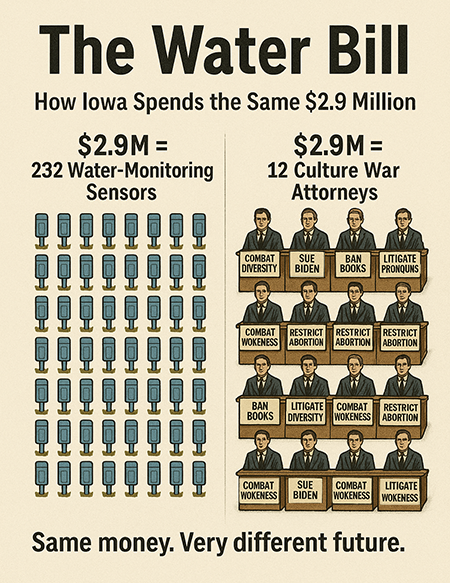
Funding for the statewide monitoring network expires in 2026, and experts warn Iowa is flying blind without robust, long-term data.
Our Take
This is not a weather story. It’s a policy story – and a long-brewing one.
Iowa’s nitrate problem is structural, stemming from industrial agriculture’s dependence on fertilizer-intensive corn production and unchecked manure runoff.
Until Iowa adopts enforceable nutrient standards and invests in monitoring systems instead of defunding them, the crisis will worsen.
And quite frankly, legislators who celebrate “progress” while drinking water utilities run emergency systems are not being honest with the public.
Bird flu detected in Hamilton County turkey flock
Highly pathogenic avian influenza (H5N1) has struck another commercial turkey flock, this one in Hamilton County, involving roughly 18,000 birds.
The outbreak renews concerns about biosecurity in Iowa’s poultry industry, coming just weeks after a similar case in Calhoun County.
Governor Reynolds issued a disaster proclamation to expedite response operations. The agriculture department reminds producers to watch for sudden deaths, lethargy, respiratory distress, and decreased egg production.
Our Take
Avian flu is becoming a predictable – and predictably expensive – consequence of concentrated livestock production.
While state leaders routinely praise “Iowa agriculture,” they rarely acknowledge that the same industrial model increases both ecological and disease vulnerability.
The cycle of outbreaks, mass culling, and emergency declarations is now part of Iowa’s agricultural calendar, and without structural reforms, it will continue.
Iowa’s Untapped Agricultural Future
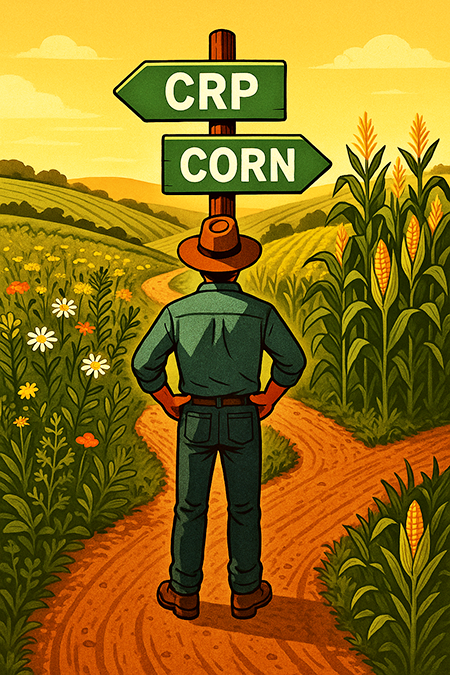
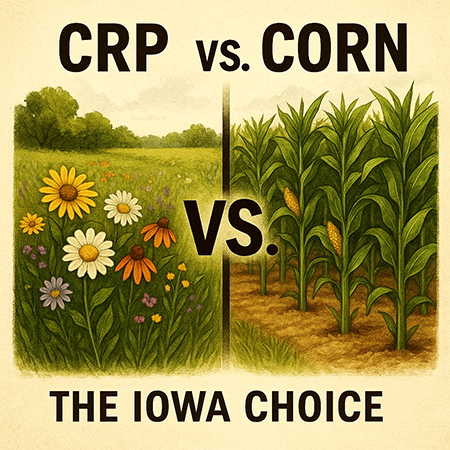
For decades, Iowa has functioned as a two-crop economy – corn and soybeans – with all the environmental, economic, and political fragility that monoculture creates. Despite having some of the most fertile soils on Earth, Iowa has not pursued the crop diversity seen across much of the Midwest.
Our story argues that Iowa could become a national leader in regenerative and diversified agriculture, including small grains, legumes, fruits, oilseed crops, perennial grains like Kernza, industrial hemp, and climate-forward biomass crops.
The barriers are not agronomic – they are political and infrastructural. Commodity systems, subsidies, crop insurance, and Big Ag lobbying have locked farmers into a narrow and increasingly risky model.
Our Take
This is the agricultural story Iowa needs but rarely hears. The state’s future doesn’t lie in doubling down on monoculture or carbon pipelines, but in diversified farming, new markets, soil regeneration, and farmer-led innovation.
Iowa could lead the nation – but only if policymakers loosen the grip of industrial agriculture and allow creativity, not conformity, to guide the land.