
Summary
Today’s briefs trace a common thread through Iowa and beyond: who gets to control information, institutions, and public narratives — and under what pretense.
In Des Moines, the Iowa Supreme Court quietly pushed back against that control, ruling that Auditor Rob Sand can represent his office independently when he believes public funds and transparency are at stake, even when the attorney general would prefer to narrow his powers.
In Iowa’s civic and media spheres, voices like Art Cullen and strong local reporters are fighting a different battle: one to keep real-world problems (toxic water, cancer, hollowed-out rural towns) on the agenda while political elites distract voters with culture wars and curated “freedom” centers.
In Alabama and at the University of Iowa, we see how “anti-discrimination” and “intellectual freedom” are being weaponized to silence or marginalize certain kinds of speech – especially those centered on women, Black students, and critical perspectives on power. Student magazines get shuttered in the name of civil-rights compliance; a “Center for Intellectual Freedom” is built with ideological filters and donor oversight while insisting it’s “not about politics.”
The common denominator: control over who gets to speak credibly, who watches the watchers, and which problems count as “real.” Sand’s victory is a rare institutional win for independent oversight; Cullen’s docuseries is a grassroots attempt to recenter facts and lived experience; the Alabama and UI stories show a growing effort to build structurally protected, top-down ideological projects while shrinking or intimidating bottom-up, pluralistic voices.
For Iowa411 readers, these aren’t separate threads; they’re pieces of the same tapestry: whether Iowa’s future is shaped from the courthouse and newsroom outward, or from the donor suite and partisan boardroom downward.
Iowa Supreme Court backs Auditor Rob Sand over AG Bird
The Iowa Supreme Court ruled 6–0 that State Auditor Rob Sand may represent his own office in the Davenport settlement case, rather than being forced to use Attorney General Brenna Bird’s office as counsel.
The dispute stems from Sand’s investigation into whether the Davenport City Council violated open meetings laws when it approved $1.8 million in harassment-related settlements for three city officials. Sand subpoenaed closed-session records; Davenport sued to block access, arguing attorney–client privilege and attorney work-product protections.
A district court judge had ruled that Sand’s office could access attorney–client communications (but not attorney work product) and ordered an in-camera review of the records. Davenport appealed.
Initially, Bird’s office supported Sand’s legal position that the auditor is entitled to attorney–client communications, but Bird later stripped that argument from her brief and refused to argue it, saying the position was unlikely to prevail and could affect other agencies. Sand then filed his own brief through his office’s general counsel and asked the Court to disregard Bird’s filing.
The Supreme Court held that Bird’s office has a conflict of interest because it does not want to argue for the full scope of the auditor’s subpoena power, while Sand does.
The Court also held that Sand did not need Executive Council approval to use in-house counsel, since he wasn’t hiring outside paid lawyers. Justice Mansfield’s opinion noted that the auditor had represented himself before the Court in 2021 as well.
Justice Waterman recused. Sand, now a candidate for governor, said the ruling affirms transparency and prevents the attorney general from “unilaterally silencing” other statewide elected officials; Bird’s office responded that it remains concerned about protecting attorney–client privilege for agencies and officials.
Our Take
This is a quiet but major check on the Golden Triad-style power grab we have been tracking:
Bird tried to define everyone’s “official” legal position – not just on this case, but on how far the auditor can go in uncovering waste, fraud, and abuse. The Court essentially said: you don’t get to sandbag another constitutional officer’s authority because you fear the precedent.
The conflict is not just about “strategy”; it’s about who gets to decide whether watchdogs may see sensitive information. Bird signaled she wants auditors’ access limited for all agencies, not just Davenport. The Court called that a conflict and cut her off at the knees.
This also undercuts the broader pattern we see with the UI “Intellectual Freedom” Center, the anti-DEI regime, and the 2023 law limiting the auditor’s power: centralize control, neutralize independent oversight, and call it “checks and balances.” Here, actual checks and balances worked the other way – against overreach by the AG.
Practically, this ruling doesn’t decide whether Sand ultimately gets all the Davenport records, but it preserves his ability to fully argue for robust audit authority. That matters for every future case where public money, secrecy, and potential misconduct intersect.





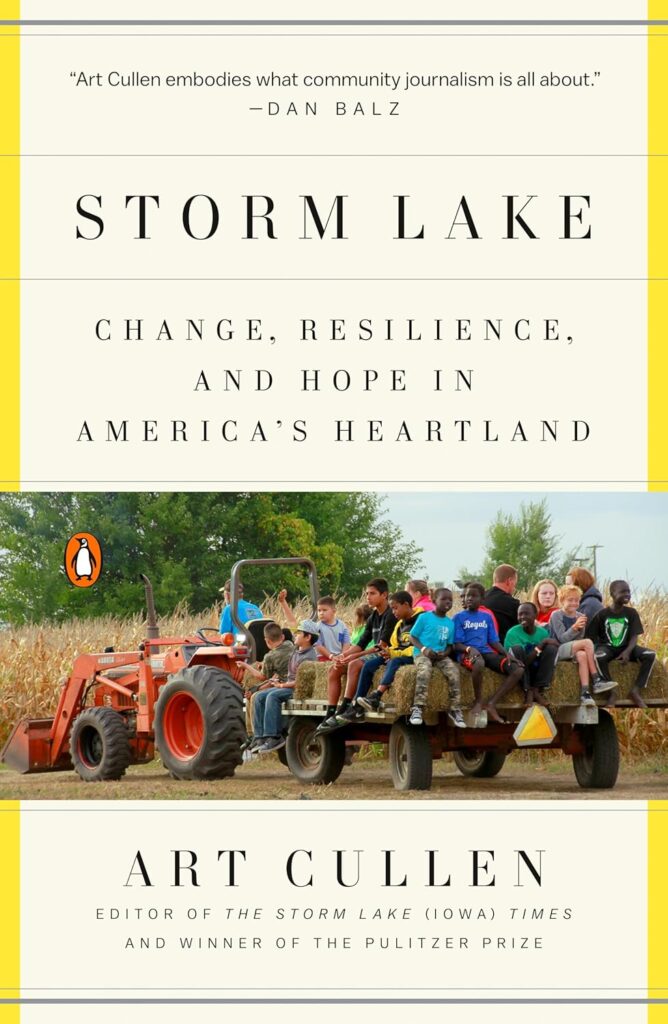

Art Cullen’s What’s Eating Iowa docuseries
Pulitzer Prize–winning editor Art Cullen of the Storm Lake Times Pilot has launched a multi-part documentary series, What’s Eating Iowa, produced by award-winning cinematographer Jerry Risius. The series examines the realities facing Iowa’s working families, from toxic water to high cancer rates and rural decline.
Cullen travels across the state, interviewing experts and everyday Iowans. The first four episodes focus on:
- Nutrient pollution from fertilizer and manure and its impact on Iowa’s already degraded water.
- Iowa’s second-highest and fastest-rising cancer rates, including Cullen’s own prostate cancer and his conversations with others fighting cancer.
- How to build a more sustainable and prosperous agricultural economy.
- Rural consolidation, including population loss in Keokuk and the town’s efforts to revive its main street.
Each episode costs around $20,000 to produce; Cullen is raising funds through the Western Iowa Journalism Foundation to continue the series. The show is available via Iowans for Stronger Communities, YouTube, and partner newspapers such as the Storm Lake Times Pilot and the Cherokee Chronicle Times.
Our Take
Cullen is doing, in documentary form, what robust local journalism is supposed to do but often can’t afford to anymore.
He connects environment, health, and economic policy instead of treating them as siloed topics. Toxic water, cancer, CAFO/chemical agriculture, and hollowed-out rural towns are one story about an economic model that treats rural Iowa as expendable.
Cullen’s tone – “these are facts” – matters. In a landscape flooded with culture-war noise, he’s insisting on empirical reality: worst-in-the-nation water quality, high cancer rates, and political leaders who mostly look the other way.
There’s a sharp contrast to the UI “Intellectual Freedom” Center universe: Cullen is practicing bottom-up public-interest journalism, whereas the Center is a top-down, donor-driven “reform” project that spends most of its time attacking other people’s ideas instead of scrutinizing power.
Iowa411 featuring Cullen’s work is part of the same counter–Golden Triad ecosystem: local, factual, and focused on the daily lives of Iowans, not abstract grievance theater.
Alabama shuts down student magazines over DEI memo
The University of Alabama has suspended all activities at two student-led magazines – Alice Magazine (focusing on women’s health, wellness, fashion, and issues) and Nineteen Fifty-Six (focused on Black culture and campus life) – citing the need to “comply with our legal obligations.”
The move is in response to U.S. Attorney General Pam Bondi’s July memo, which claims that diversity, equity, and inclusion (DEI) initiatives can amount to illegal discrimination and warns against “unlawful proxies” for race or sex in federally funded entities.
Editors say the magazines did not exclude anyone based on identity; they merely centered on particular communities while welcoming contributors of all backgrounds. Alice editor-in-chief Gabrielle Gunter thought the problem was having a “specific target audience.” She was surprised the university didn’t view the publications as protected by First Amendment press freedoms.
The Student Press Law Center (SPLC) strongly disputed the university’s stance, arguing that the First Amendment does protect student media, and that the magazines “amplify the voices of communities that have historically been marginalized,” which is protected expression, not discrimination.
SPLC also suggested Alabama’s move may be illegal viewpoint discrimination, since only magazines primarily serving women and Black students were suspended.
The crackdown comes amid broader attacks on student media, including Indiana University’s firing of its student newspaper adviser and ending print publication, and the University of Central Oklahoma’s decision to end print publication of its student paper.
Our Take
This is a preview of what could happen under Iowa’s anti-DEI and “freedom center” regime. Targeting identity-focused student publications is a direct way to chill speech from marginalized communities while pretending to be “neutral.” Alabama is saying: you can talk about women and Black life only if you don’t foreground them as a community.
The Bondi memo’s logic (“unlawful proxies” for race/sex) becomes a Swiss Army knife for suppressing any organized space where marginalized people talk to and for each other — cultural centers, student groups, specialized media.
Apply that logic to Iowa, with DEI programs dismantled and the UI Center for “Intellectual Freedom” explicitly framed as a corrective to “radical” ideas, student papers and magazines that challenge the new orthodoxy could face similar pressure, especially if they are labeled “DEI” by opponents.
The SPLC’s point is crucial: this looks a lot like viewpoint discrimination, not neutral civil-rights enforcement. Only the women’s and Black-focused mags were shut down; other publications continued. That pattern mirrors the selective outrage about “indoctrination” in Iowa – DEI is demonized, but hand-picked ideological “centers” are celebrated and lavishly protected.
For Iowa students, this is a warning: press freedom is becoming the next frontline in the anti-DEI crusade.
UI Center for Intellectual Freedom plots its future (and control)
At the second day of its inaugural event, the University of Iowa’s Center for Intellectual Freedom – created by state law and governed by the Iowa Board of Regents rather than the university – convened academics, regents, lawmakers, and allies to discuss how to build and protect ideologically conservative “intellectual freedom” centers.
Speakers praised the Center’s structure as being on campus but outside UI administration, describing that as a shield against hostile faculty and administrators.
University of Texas professor Daniel Bonevac said programs located “inside” universities are eventually “taken over” by forces hostile to their original mission; he urged tight control over hiring, admissions, and leadership succession to prevent such “capture.” He described categories of “sheep,” “fellow travelers,” and “radicals,” arguing that radicals target individuals and that sheep and fellow travelers ultimately facilitate purges of dissenters.
Former UNC–Chapel Hill provost Chris Clemens urged the Center to create visible hiring rubrics, plan for inevitable controversies, and define a coherent philosophical vision from the outset. He warned that a “center for intellectual freedom that has hiring preference and ideological filters is not a center for intellectual freedom,” saying such a contradiction could “kill it” if not resolved.
Regent Christine Hensley and former regent/current Trump Assistant Secretary for Postsecondary Education David Barker recounted how the Center arose from dissatisfaction with DEI and the perceived political imbalance at UI, driven by legislation that directed regents to dismantle DEI and create alternative centers.
Hensley noted “seven-figure donors” unhappy with UI’s direction, complained of “challenges” working with university leadership, and confirmed there were no UI administrators present at the event. Next steps include a national search for a permanent director, marketing studies, and programming expansion.
Graduate student and union organizer Clara Reynen questioned how the Center can decry ideological “cloning” by liberal faculty while its own advisory committee is appointed by Gov. Reynolds, de Castro, and the regents rather than chosen through an open process.
Interim director Luciano de Castro insisted the Center is “not about politics, it’s about truth” and academic excellence. A sidebar revealed a planned panelist dropped out due to fear of “retribution” from his university, according to de Castro; he framed it as evidence of the climate the Center seeks to counter.
Our Take
This piece makes the control strategy almost painfully explicit. The Center’s boosters openly celebrate that it is physically on campus but institutionally outside UI’s control, answerable instead to a regents board that has already purged DEI and is responsive to wealthy donors. That’s the design, not a side effect.
Bonevac’s playbook – control admissions, hire only those “on board with the mission,” build leadership succession in advance, and be willing to stand up to “radicals” – is a manual for building an ideological enclave, not a pluralistic center. It’s the mirror image of what they accuse DEI of being.
Clemens’ warning is telling: if a “center for intellectual freedom” uses ideological filters, it has a “contradiction in its soul.” Yet the entire project is premised on creating exactly that – a cordoned-off structure where only one version of “truth” is institutionally protected.
Hensley’s remarks about “seven-figure donors” and “past leadership” that wouldn’t “deal with these issues” reveals the power structure: big-money donors + partisan regents + hand-picked advisory boards, all aligned to discipline a university that is seen as ideologically noncompliant.
The sidebar claim about a panelist fearing retribution is convenient and vague – no name, no institution, no specifics. It fits a narrative of conservative martyrdom while ignoring the very real retribution we see against student journalists, DEI staff, and dissenting faculty elsewhere.
Taken together with the Alabama student-media crackdown and the Iowa DEI eliminations, this looks less like a campaign for “intellectual freedom” and more like building a parallel, protected ideological infrastructure on campus – one that can shape policy, hiring, and public narratives while calling everyone else “radical” or “crazies.”