Summary
This week’s Iowa stories form a clear pattern: Iowa is fighting a war over information. Who controls it, who can access it, and who benefits when the public can’t see clearly.
The DNR’s new report showing 723 “impaired” waters is the kind of statewide fact that should drive policy urgency. Yet Iowa politics too often treats water quality as background noise, a problem acknowledged in theory but avoided in practice. House Democrats’ “Healthy Water Act” highlights what has been missing: a unified, measurable, public strategy with clear incentives and monitoring. The difference is not capability. It is political will.
At the same time, the University of Iowa’s new cancer mapping tool represents a major step toward transparency. It replaces vague county averages with ZIP-code-level modeling that can reveal localized cancer patterns without exposing private health data. This is the kind of tool that forces Iowa to confront uncomfortable possibilities: environmental exposure, uneven public health protection, and whether policy choices are contributing to preventable harm.
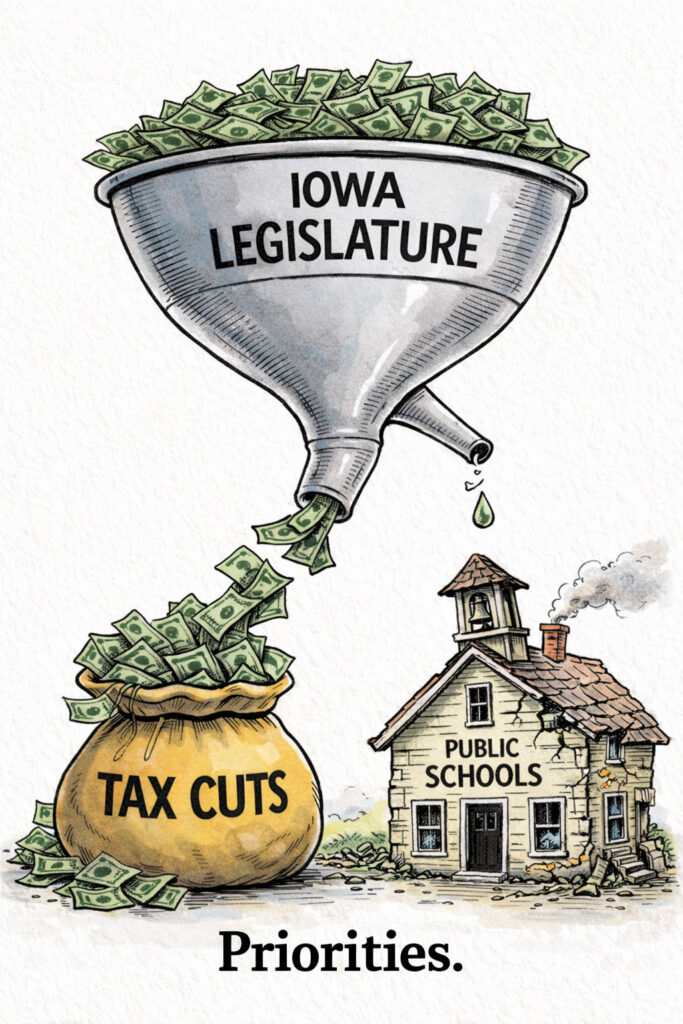
Against that backdrop, the legislature’s push to expand MEGA incentives for an NFL stadium is not just a goofy distraction it is a metaphor. Iowa has real problems that require sustained attention, data-driven governance, and serious investment. Instead, lawmakers spend time on performative bills that generate headlines but don’t improve daily life.
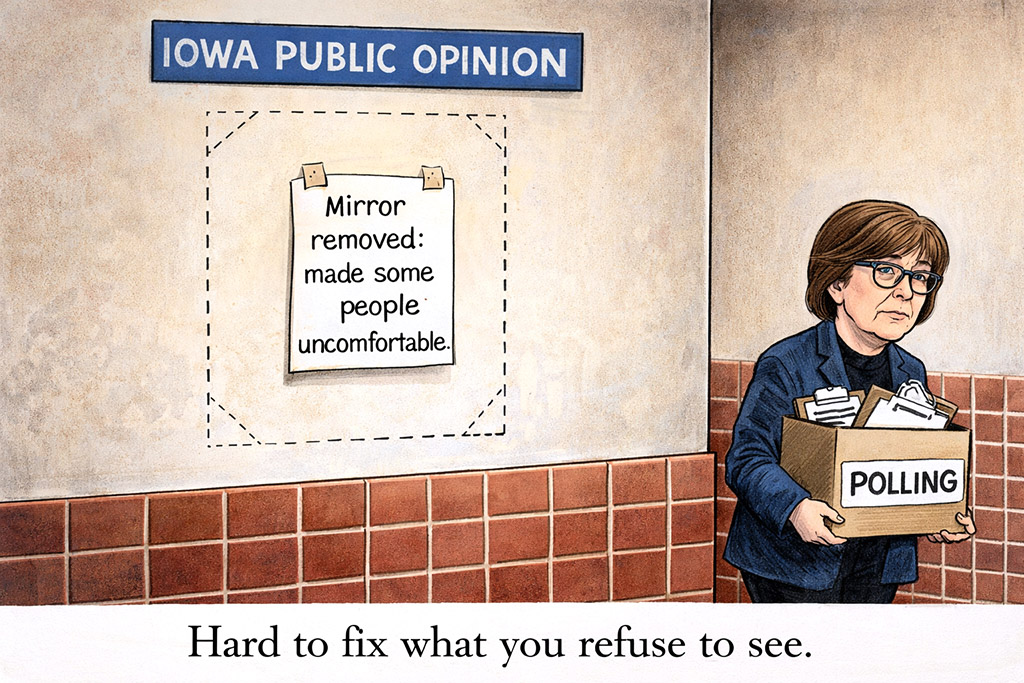
Finally, the continuing legal fight over Trump’s lawsuit against Ann Selzer and the Iowa Poll ties the entire package together. It is a dispute over whether public information like polling, data, and civic measurement is protected or punished. Iowa’s recent trends suggest an emerging political strategy: weaken transparency, undermine watchdogs, and reduce accountability mechanisms so power can operate with fewer constraints.
New state report lists more than 700 impaired waters in Iowa
Iowa DNR released a draft of its 2026 biennial “integrated report,” listing 723 impaired water segments statewide, including rivers, lakes, and wetlands. The report draws from extensive monitoring data (2022–2024 for rivers/streams; 2020–2024 for lakes) and determines whether segments meet criteria for designated uses such as fishing, recreation, aquatic life, and drinking water.
The report shows Iowa’s impaired waters count has remained relatively stable for a decade, and the 2026 list includes only three fewer impaired segments than the 2024 report. About 51% of assessed river segments were designated impaired, with the largest drivers being indicator bacteria and biological impairment (where aquatic life populations are lower than expected).
The report also includes nitrate impairments, including a Category 5 impairment segment on the Iowa River north of Iowa City and a Category 4 impairment segment of the Raccoon River through West Des Moines into the Des Moines River. DNR officials emphasized that “impaired” does not necessarily mean unsafe for all uses, but rather that one or more parameters fail standards.
Our Take
This is one of the most sobering numbers in Iowa public life: 723 impaired waters is not a “technical report.” It is a statewide health, economy, and quality-of-life report card.
And the most alarming part is not that Iowa has impaired waters. It is that the problem has been described as “stable” for a decade. Stability is not progress. It is normalization.
Iowa House Democrats release water quality package (“Iowa Healthy Water Act”)
Iowa House Democrats announced a multi-part water quality proposal aimed at improving monitoring, transparency, and incentives for nutrient reduction practices. The package includes funding for a statewide water monitoring program and dashboard, expanded support for Iowa’s Nutrient Reduction Strategy, tax credits for farmers implementing best practices, a clean water certification program tied to property tax credits, and a zero-interest loan program for equipment linked to water quality improvements.
A key element is $600,000 to establish a statewide monitoring system led by Regents institutions (including the Iowa Flood Center). Democrats argued that Iowa’s current approach is fragmented, and that the state cannot manage water quality without consistent measurement.
Republican leaders acknowledged water quality as an issue but argued Iowa is already investing heavily and that Iowa drinking water is approved by EPA. Democrats countered that the scale of Iowa’s pollution problem demands larger, more systematic action.
Our Take
Democrats are doing something Iowa desperately needs: treating water quality as infrastructure rather than a public-relations nuisance.
This package is also politically revealing. If the majority party wanted to pass meaningful water legislation, they could. If they don’t, the state will keep drifting toward a future where clean water is treated as a luxury, not a baseline expectation.
Cancer maps drill down to risk details by ZIP code (UI CAMSA tool)
University of Iowa researchers released a new mapping tool, Cancer Analytics & Maps for Small Areas (CAMSA), which estimates cancer incidence at the ZIP code level using statistical modeling. The tool was created to overcome the limits of county-level reporting, which can hide meaningful variation — especially in rural communities where confidentiality rules often suppress data.
The tool reveals striking differences. For example, one Urbandale ZIP code (50323) shows breast cancer risk roughly 100 times higher than a Fort Dodge ZIP code (50501). For colorectal cancer, a Sioux City ZIP code (51106) shows modeled risk nearly 97 times higher than Iowa City’s 52245. Researchers emphasized that the map identifies patterns, not causes, but can guide where to focus research and public health interventions.
The tool also reinforces that Iowa’s cancer burden is not evenly distributed, and that some high-incidence regions cannot be fully explained by lifestyle or demographics alone — suggesting environmental and other local drivers may be involved.
Our Take
This is what public health transparency looks like: granular information without violating privacy.
Iowa’s cancer crisis has been treated for too long as a statewide statistic, which is politically convenient because statewide averages don’t point fingers.
ZIP-code-level data changes that. It forces Iowa to ask harder questions about local exposure, environmental risk, and whether public policy has been protecting people or protecting industries.
Chicago Bears hunt continues at Capitol (MEGA incentives expansion)
Iowa Senate Republicans advanced a bill expanding the state’s MEGA incentives program to include NFL stadium projects, effectively allowing tax incentives for a professional football franchise to build in Iowa. Supporters framed the bill as strategic positioning if the Chicago Bears leave Illinois. Sen. Scott Webster promoted Bettendorf as a possible landing spot.
Currently, MEGA incentives are designed for companies investing at least $1 billion in Iowa and operating primarily in advanced manufacturing, biosciences, or R&D. The bill would broaden eligibility to include businesses and affiliates building an NFL stadium.
Democrats criticized the effort as unserious and distracting, especially given Iowa’s ongoing needs and a projected budget deficit.
Our Take
This is not serious governance.
Even if it is pitched as “just being ready,” it still represents something deeper: a legislature that has time for spectacle and fantasy while Iowa’s water, public health, and workforce realities remain unresolved.
When lawmakers spend time on bills that have virtually no chance of materializing, it isn’t harmless. It is a signal of misplaced priorities.
Judge to hear dismissal plea in Trump’s Iowa Poll lawsuit
An Iowa District Court judge will hold a hearing on whether Donald Trump’s lawsuit against Ann Selzer and the Des Moines Register should be dismissed. The judge also ruled that discovery will be paused until after that hearing, preventing Trump’s legal team from demanding documents or testimony at this stage.
Trump’s lawsuit argues that the Iowa Poll violated consumer fraud law because it showed Kamala Harris ahead by 3 points shortly before the 2024 election while Trump ultimately won Iowa by 13 points. Selzer and the Register argue the lawsuit is frivolous, lacks legal merit, and represents an attack on First Amendment protections.
The procedural history is complex, including earlier filings in federal court, refiling in state court, and timing tied to a new Iowa law allowing expedited dismissal of lawsuits seen as intended to suppress free speech.
Our Take
The most important outcome so far is not legal. It is cultural.
If pollsters and journalists are punished for publishing inconvenient snapshots of public opinion, the effect is predictable: fewer snapshots, less transparency, and more political mythology.
And in Iowa, the stakes are higher because Selzer wasn’t just “a pollster.” She was a civic institution. Read more about this in our Iowa411 editorial on the topic.