Summary
Today’s stories reveal a recurring theme of fragmentation of governance. Food safety deregulation, homeschool tax credits, tuition increases, and precious metals legislation. Each addresses a narrow policy lane while broader systemic pressures remain unresolved.
In education, tuition hikes coexist with expanded tax credits and ESAs, yet there is no unified framework assessing total public education spending or long-term fiscal sustainability. In public health, raw milk deregulation advances despite CDC warnings. In economic policy, symbolic currency measures move alongside legitimate energy reforms.
Meanwhile, everyday Iowans are quietly adjusting to rising tuition bills or $5 cups of coffee.
The common thread is structural tension between ideology and systems. The question is not whether change is occurring. It is whether that change is coordinated, evidence-based, and sustainable.
Iowa Bill Would Expand Raw Milk, Cottage Foods, and Farm-to-Table Events
A House subcommittee advanced House File 2444, which would create a $100 annual permit allowing farms to host unlimited farm-to-table meals, expand the sale of raw milk and raw milk products at farm-based stores, and allow cottage foods to be sold in grocery stores.
Supporters framed the bill as a pro-agritourism, pro-small farmer measure that increases access and opens local markets. Opponents, including the Iowa Environmental Health Association and state regulatory officials, warned that the bill creates regulatory workarounds, lacks clarity on meat processing and sanitation oversight, and could introduce food safety risks. CDC continues to warn of serious health risks associated with raw milk consumption, including salmonella, E. coli, listeria, brucella, and potential H5N1 exposure.
An amendment is expected before floor debate.
Our Take
This is not simply an agritourism bill, it is a deregulatory bill. When public health inspectors warn that inspection capacity, slaughter standards, and sanitation rules are unclear, that deserves more than ideological enthusiasm.
Iowa can support local agriculture without weakening public health guardrails. Food safety laws exist because history has shown what happens when they don’t.
Board of Regents to Consider 3% Tuition Increases
The Iowa Board of Regents will consider 3% tuition increases for resident undergraduates at the University of Iowa, Iowa State University, and the University of Northern Iowa. Differential increases are proposed for certain programs, including a 4% increase for ISU’s veterinary medicine program.
The increases are described as necessary to offset inflation, deferred maintenance, health care costs, collective bargaining obligations, and student aid support. The proposed hikes would generate an estimated $38 million in additional tuition revenue, roughly 2.1% of the general education fund operating budget.
The timing follows new legislation requiring tuition decisions to be finalized by April 30.
Our Take
Recent political rhetoric about capping tuition now collides with institutional fiscal reality. Either earlier proposals were politically aspirational, or legislative control is reasserting itself over universities in subtler ways.
Rising costs reflect structural funding pressures, not administrative excess alone. If lawmakers want lower tuition, they must confront the state funding side of the equation, not merely the sticker price.
$4,000 Tax Credit Proposed for Homeschool Families
House File 2078 would provide a refundable $4,000 tax credit per homeschooled child, regardless of income. Families could receive the credit in advance, and the program would be funded through a newly created “Opportunity Fund.”
Supporters argue homeschool families save the state money by not using public schools. Critics warn the bill lacks guardrails, income limits, or spending accountability. Notably, some homeschool parents testified against the measure, arguing that accepting public funds could invite regulation and compromise autonomy.
An amendment is expected to narrow eligibility to “competent private instruction” families subject to reporting requirements.
Our Take
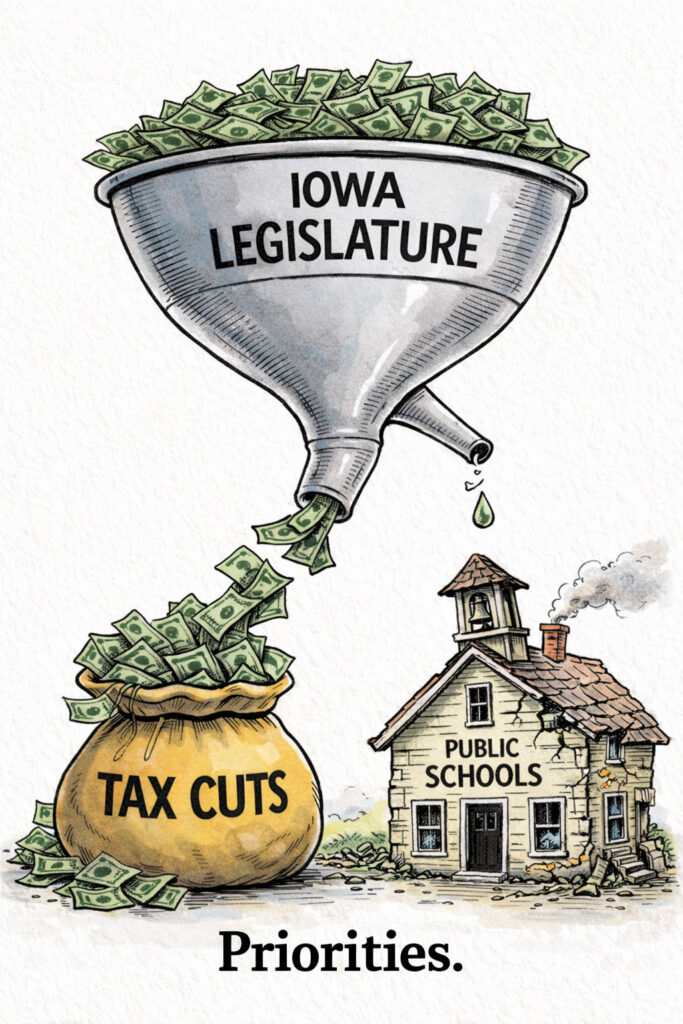
This proposal continues Iowa’s shift from funding public systems to funding individual educational choices. Whether one supports school choice or not, education policy is increasingly fragmented with ESAs, tax credits, tuition policy, public funding each debated in isolation. The absence of a comprehensive, system-wide fiscal review risks long-term instability in public education financing.
House Panel Advances Gold and Silver Legal Tender Bill; Utility Reforms
The House Commerce Committee advanced several bills for community solar expansion, ratepayer transparency in utility planning, data center reporting requirements, grid-enhancing technology studies, making gold and silver legal, tax-free tender in Iowa, and pipeline land restoration protections.
The gold and silver bill would require the state treasurer to establish a bullion depository and electronic payment systems using precious metals.
Our Take
Some utility reforms appear pragmatic and bipartisan, particularly regarding data center energy costs and ratepayer transparency.
However, the gold-and-silver legal tender proposal risks appearing symbolic rather than economically substantive. Iowans facing affordability pressures may question whether alternative currency systems address the core issue of rising costs.
Coffee Prices Up 18% Year Over Year
Driven largely by tariffs on Brazil and other coffee-producing nations, U.S. coffee prices rose 18.3% in January compared to last year. Climate disruptions in major coffee producers of Vietnam, Indonesia, and Brazil are also driving global price pressures to a lesser extent.
Many consumers are cutting back on café purchases or switching to cheaper at-home brewing. Surveys suggest overall consumption remains steady despite rising prices.
Our Take
Coffee inflation is a microcosm of tariff harms and global supply chain vulnerability. Climate volatility in one part of the world quickly affects daily routines in Iowa. Inflation is not abstract. It shows up in habits, trade-offs, and small sacrifices.