
Or is it.
Summary
Today’s three stories share a throughline: who gets funded, who gets protected, and who is expected to absorb the consequences.
In K-12 education, lawmakers approved a 2% SSA increase and touted record spending, but critics argue adequacy, not raw totals, is the honest measure, especially as costs rise faster than state aid and ESA expenditures scale upward.
In federal policy, the missed E15 deadline underscores a recurring Iowa frustration: broad support at home, delay in Washington, and the persistent gravitational pull of refinery interests that can reshape outcomes behind closed doors.
Finally, at the Statehouse, the ethics committee’s dismissal of a complaint involving trooper-legislators signals a permissive conflict-of-interest posture, one that relies on “profession” logic and slippery-slope defenses rather than bright-line safeguards.
Together, these stories point to a governance pattern: strong messaging, contested priorities, and accountability standards that often depend on who holds power and which interests are at stake.
Iowa lawmakers pass 2% K-12 school funding increase
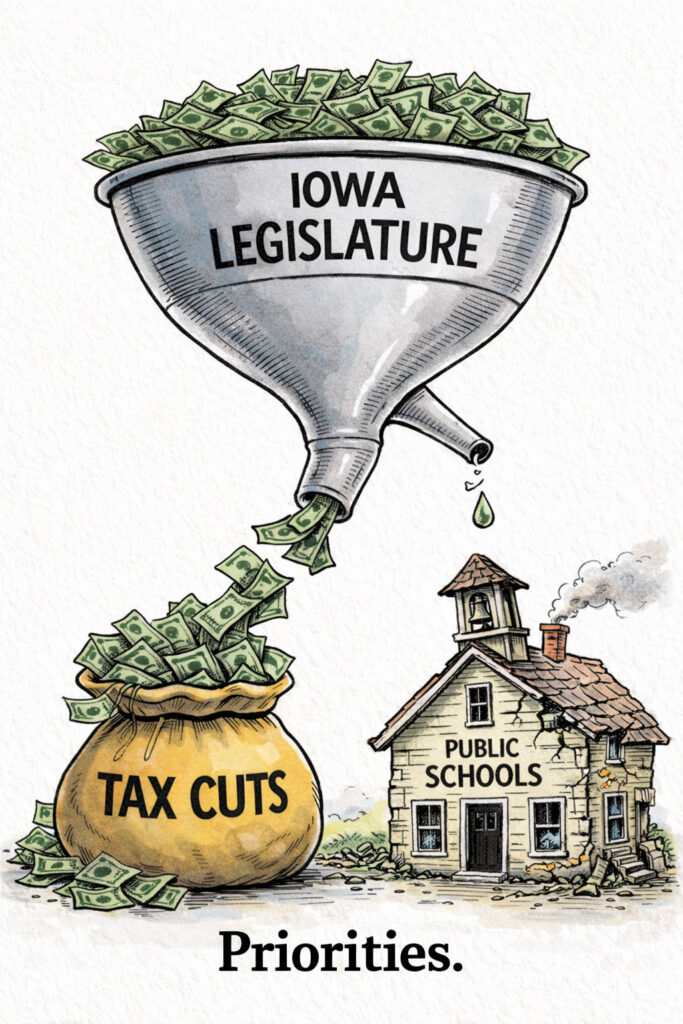
Iowa lawmakers approved a 2% increase in State Supplemental Aid (SSA) for K-12 schools for the 2026–27 year, which equals about $160 more per student, raising the per-pupil amount from $7,988 to $8,148. Total general-fund K-12 spending would rise to $3.98 billion, an increase of $98.9 million.
The legislation leaves 199 districts on the “budget guarantee,” which ensures a 1% funding increase even when enrollment declines. This year, the bill shifts the guarantee’s cost to the state ($42.2 million) rather than local property taxpayers. The bill also includes $7 million for paraeducator and support staff pay (with House GOP leaders indicating they may seek additional pay funding elsewhere).
Debate centered on adequacy: Democrats and education advocates argue 2% does not keep pace with school cost growth (insurance, supplies, staffing), while Republicans emphasize “record spending” totals and the broader funding picture (local, federal) and defend school choice policy, including Education Savings Accounts (ESAs). Under the bill, ESA amounts also rise to $8,148 per student; the governor’s office estimates ESA spending could reach $349.6 million.
Our Take
“Most we’ve ever spent” is not a meaningful adequacy metric. Any increase, even $1, can be framed that way. The real question is whether state aid keeps pace with actual cost growth and whether districts can maintain programs without cutting staff, moving to four-day weeks, or shrinking electives.
This bill contains two realities at once: it adds money, and it likely leaves many districts still structurally squeezed, especially if expenses rise faster than 2%. The most important policy signal is the combined direction of moderate SSA growth alongside rapidly growing ESA obligations.
That isn’t neutral budgeting; it reflects priorities. If Iowa’s education strategy increasingly funds “choice” expansion while public districts are told to “stretch and smile,” the measurable outcomes (programs, class sizes, staffing stability) will tell the truth over time.
Congress misses deadline for year-round E15
Iowa biofuels advocates escalated public pressure after the U.S. House missed a Feb. 25 target to vote on legislation allowing year-round sale of E15 (15% ethanol gasoline). The year-round E15 provision was stripped from a federal budget bill last month. House Republicans then tapped Rep. Randy Feenstra to co-lead a Rural Domestic Energy Council and bring a biofuels bill to the floor by Feb. 25, but the deadline passed without a vote or breakthrough.
Feenstra told the press negotiations were slowed by a Washington snowstorm and emphasized meetings with oil refiners, some seeking blending exemptions. Sen. Chuck Grassley said he is hearing frustration from constituents and criticized certain refinery voices entering the debate now. Rep. Zach Nunn issued a statement supporting E15 and promising to keep pressing for certainty. Iowa Democrats seized on the delay as proof the Iowa GOP delegation is failing to deliver.
Our Take
This is a familiar Washington script: a hard deadline becomes a soft deadline; “next week” becomes “soon”; and a policy with broad Iowa support gets trapped between agricultural interests and refinery leverage.
Oil refiners are a powerful constituency, and exemptions are often the quiet mechanism by which “support for ethanol” turns into a diluted outcome. The key accountability test isn’t optimism or press quotes, it’s transparency: What is the hold-up, who is demanding what, and what concessions are being negotiated? If the final deal includes carve-outs that undercut demand, Iowa farmers will feel the difference even if the talking points claim victory.
For Iowa’s federal delegation, this is a clean litmus test: E15 is either treated as a priority deliverable for Iowa, or it remains a recurring campaign promise that slips when refinery politics tighten the vise.
Iowa House ethics committee dismisses complaints against 2 lawmakers
A House ethics committee voted unanimously to dismiss an ethics complaint against Reps. Josh Meggers and Zach Dieken, both Iowa State Patrol troopers, who voted in committee for a bill (HSB 551) that would raise pay for state troopers. The complainant argued they should have recused themselves due to a direct personal financial interest. The lawmakers responded that they voted in the “interest of a profession,” not a specific personal interest. Meggers also alleged the complaint stemmed from a past traffic ticket dispute.
The committee’s chair framed the complaint as resembling a personal vendetta. The top House Democrat on the committee agreed there was no violation. The relevant House rule recognizes that members may vote on bills affecting broad classes but says members should avoid action that furthers their “specific employment” or “specific interest” as distinct from the interests of a profession or class.
Our Take
There are two separate issues here: the complainant’s motive and the underlying conflict standard. Even if a complaint is filed by someone with questionable motives, the ethical question still deserves clean analysis: does voting on your own compensation create a direct conflict?
The committee leaned heavily on the House rule’s “profession/class” language and the slippery-slope argument (“then teachers couldn’t vote on education bills”). But those are not identical scenarios. A teacher voting on general school funding is not necessarily voting on a bill that directly sets the teacher’s own pay classification. The closer analog would be legislators voting on a bill that directly raises their own pay, something lawmakers conspicuously treat as ethically sensitive, even when legal.
A more credible standard is simple: if legislation directly affects your personal compensation, the cleanest governance practice is disclosure and, depending on chamber norms, recusal. Iowa’s House rules appear to allow broader discretion, and the committee chose that permissive interpretation. The public will decide whether that interpretation builds trust or erodes it.