
Free Speech, Rewritten by Power
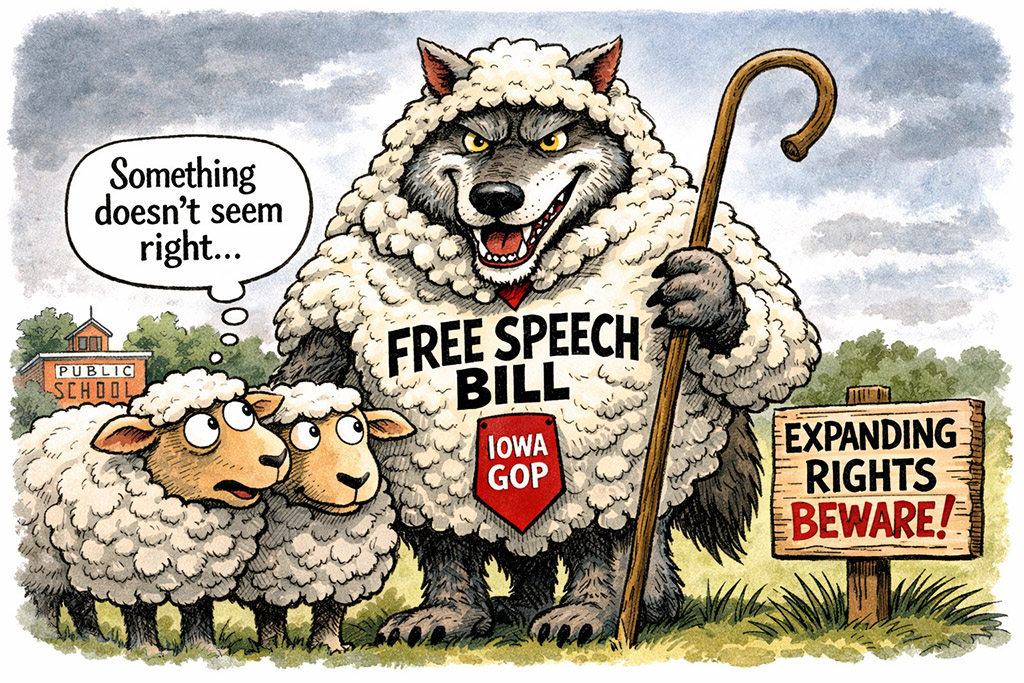
Across Iowa’s Capitol and campuses, Republicans are advancing a coordinated redefinition of “free speech” that expands state power while narrowing genuine freedom. Bills that claim to protect expression instead introduce litigation mandates, curriculum control, and vague standards that invite ideological enforcement.
At the same time, real-world cases involving public employees disciplined for controversial speech reveal how quickly free speech protections evaporate under political pressure.
Taken together, these efforts reflect a broader strategy of weaponizing the language of constitutional rights to justify greater control over schools, universities, and public employees. The danger is not abstract.
When lawmakers decide which speech needs “protection” and which speech needs punishment, free expression stops being a right and becomes a permission that is granted selectively, revoked conveniently, and enforced politically.
Iowa GOP advances bill claiming to “expand” student free speech rights
Republican lawmakers in Iowa have advanced legislation they describe as expanding student religious, political, and ideological speech rights in public K-12 schools. The bills, Senate File 2062 and House File 2106, branded by supporters as the “SPEAKS Act,” would codify student speech protections and allow students to sue school districts that violate them, with mandatory civil penalties starting at $5,000.
Supporters argue the legislation is needed to prevent viewpoint discrimination and ensure uniform application of First Amendment protections. They cite past litigation involving student religious organizations at Iowa’s public universities as evidence that clearer state law could reduce costly lawsuits and provide guidance to school districts.
Opponents counter that the bill largely restates existing constitutional protections already guaranteed under the First Amendment and the federal Equal Access Act, while introducing new risks. Critics warn the bill’s vague language could create loopholes for extremist or exclusionary student groups, interfere with schools’ ability to maintain safe learning environments, and invite litigation driven more by financial incentives than genuine rights violations.
Several education and civil rights groups also raised concerns about the bill’s reach into classroom instruction, an area where courts have historically granted educators discretion.
Our Take
This bill does not expand free speech rights. Those rights already exist. What it would expand is state intrusion, litigation risk, and ideological leverage over public schools.
By reframing settled constitutional law as a “gap” needing legislative correction, lawmakers are manufacturing a problem to justify new enforcement mechanisms that chill school governance. Calling this “constitutional clarity” is misleading at best. And dangerous at worst.


Legislature advances mandate requiring ideologically driven civics courses at state universities
A separate Republican-backed proposal, Senate File 2033, would require all Iowa public university students to complete mandatory general education courses in American history and government as a condition of graduation. The bill also mandates that newly created university “civics centers” design the courses, run lecture and debate series, and submit annual reports to lawmakers and the governor.
While supporters frame the bill as strengthening civic literacy, university officials and lawmakers raised significant concerns about cost, staffing, transfer credit compatibility, and legislative overreach. Estimates suggest implementation could cost more than $6.6 million statewide and require dozens of new faculty hires. But no funding mechanism is included in the bill.
The legislation also includes language restricting courses that focus on “subgroups of Americans,” a term left undefined by the bill’s sponsor when questioned. Critics argue this ambiguity could effectively prohibit legitimate academic inquiry into race, gender, labor, immigration, or other core topics in American history.
Our Take
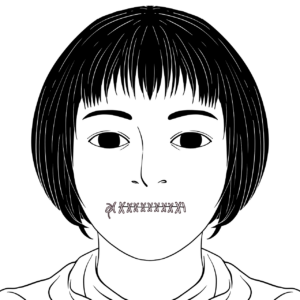
This is not about free inquiry. It is about compelled ideology. Forcing students to take state-designed courses, taught through legislatively favored centers, while restricting how history can be framed is the opposite of intellectual freedom. This is curriculum control dressed up as civic education, imposed without funding, definitions, or respect for academic independence.
Charlie Kirk-related lawsuits expose contradictions in GOP “free speech” claims
In the wake of the 2025 killing of conservative activist Charlie Kirk, Iowa became a focal point in a national debate over public employee speech. At least 10 Iowa public employees, mostly teachers and university staff, were investigated or disciplined over social media posts reacting to Kirk’s death, with several filing lawsuits alleging First Amendment violations.
As courts review these cases, judges are applying long-established Supreme Court precedents governing public employee speech, including Garcetti v. Ceballos, Connick v. Myers, and Pickering v. Board of Education. Central to the analysis is whether employees spoke as private citizens on matters of public concern, and whether their speech caused actual, demonstrable workplace disruption.
Legal experts warn that disciplining employees in response to political backlash risks creating a “heckler’s veto,” where speech is punished not for operational harm but because it angers powerful figures or online mobs.
Several cases remain unresolved, and outcomes have varied depending on how courts interpret disruption and job-relatedness.
Our Take
Here’s the contradiction: the same political actors claiming to “expand” speech rights in schools are pressuring public employers to punish speech they dislike.
When free speech protects conservative viewpoints, it’s sacred. When it protects critics, it’s suddenly “disruptive.” That selective application is precisely what the First Amendment was designed to prevent.