Summary
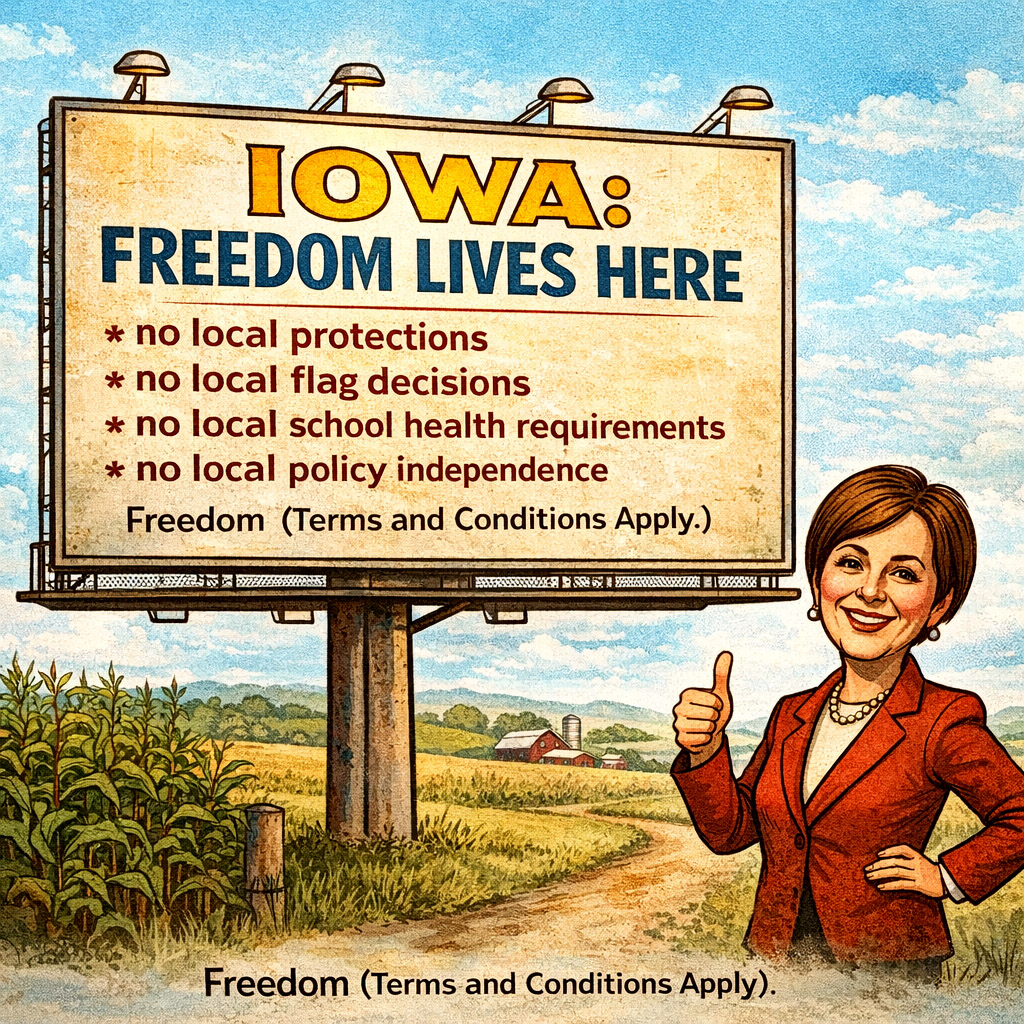
Iowa’s latest legislative agenda shows a tightening pattern: centralizing control, weakening public institutions, and restricting local or institutional autonomy while framing these moves as “parental rights,” “merit,” or “common sense.”
A bill restricting school-library partnerships is being advanced as a safeguard against inappropriate content, but opponents argue it would disproportionately harm underfunded schools and reduce student access to reading materials even when parents can already opt out.
At the university level, lawmakers are pushing for mandated American history and civics courses while simultaneously pursuing tuition freeze policies that could constrain institutional budgets and increase pressure on public higher education systems.
Meanwhile, Gov. Kim Reynolds is promoting tobacco tax increases as part of Iowa’s cancer-prevention strategy, an approach that targets behavioral risk factors but may sidestep deeper environmental questions that many Iowans believe contribute to the state’s unusually high cancer rates.
Finally, a sweeping bill removing affirmative action and equal opportunity requirements signals a major shift in Iowa’s civil rights landscape, drawing public protest and raising concerns about workforce impacts, discrimination safeguards, and Iowa’s ability to retain young residents and attract diverse talent.
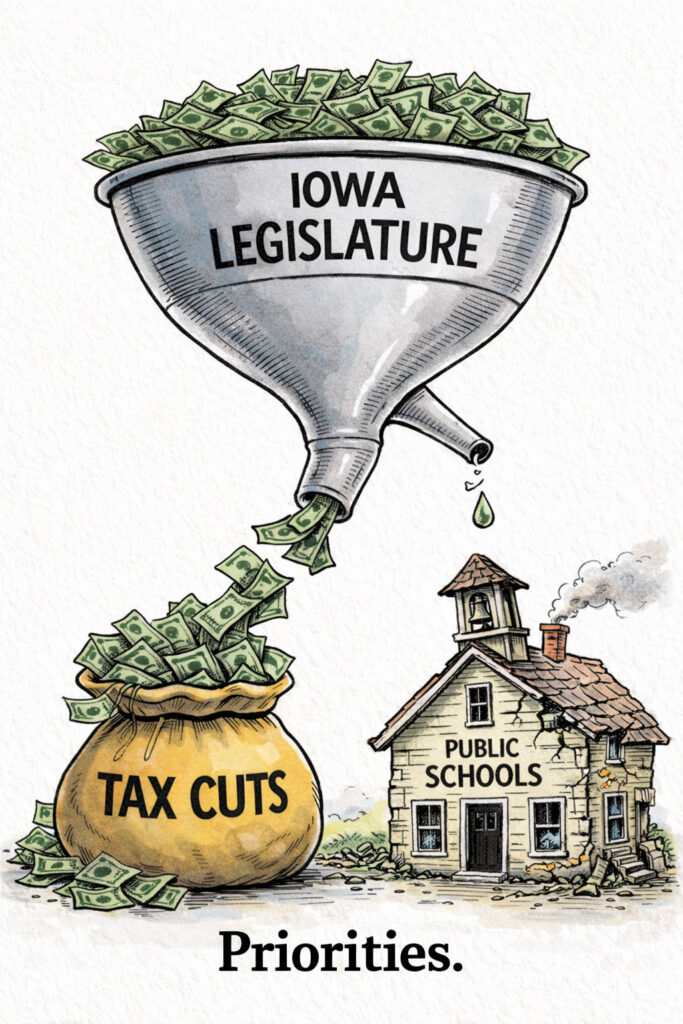
Taken together, these proposals reflect a consistent political strategy: reduce pluralism, limit institutional independence, and reframe government authority as the tool for enforcing a narrow ideological vision, even as Iowa faces urgent challenges in education funding, health outcomes, and workforce stability.
Iowa bill advances to ban school-library partnerships over book fears
A bill moving through the Iowa Legislature would restrict schools from partnering with public libraries or bookmobiles in ways that allow students to check out materials using school-issued IDs. House Study Bill 636 is framed by supporters as a “loophole closer,” meant to prevent schools from allegedly bypassing Iowa’s 2023 restrictions on school materials that depict sex acts or are deemed not to be age-appropriate.
Opponents argued the bill is both impractical and harmful, especially for schools that do not have physical space for a library or rely on local public libraries for student access. Des Moines Public Schools, for example, noted that several buildings do not have libraries, and partnerships exist precisely because districts are under-resourced. The bill advanced out of committee and is eligible for House floor debate.
Our Take
This is not about “protecting children.” It is about controlling information. And it is structured in a way that makes that control harder to challenge.
The current system already allows parents to opt out. The bill targets institutional access, not parental rights. That matters. It’s the difference between parents’ right to choose what their child reads and the state preventing access to literature because some parents disapprove.
And yes, the pattern aligns with national culture-war architecture. Whether or not Iowa legislators cite Project 2025 explicitly, the functional goal is identical. Shrink the public sphere, break civic institutions (schools, libraries), and replace pluralism with ideological gatekeeping.
The sneaky part is the mechanism. They aren’t banning books directly, they are banning the pathways by which books reach kids in underfunded schools.
Iowa lawmakers advance bills to freeze tuition, mandate American history at universities
Iowa lawmakers advanced a bill requiring all undergraduates at Iowa’s public universities to take survey courses in American history and American government. Supporters say the bill strengthens civic education and reforms “embarrassing” general education offerings. Rep. Taylor Collins criticized certain university classes, arguing they reflect misplaced priorities.
Democratic lawmakers raised concerns about feasibility: staffing, cost, student schedules, and whether students could still graduate in four years without increasing course loads. The bill also directs the Board of Regents to review and overhaul general education requirements.
The same committee also advanced a tuition-freeze proposal that would lock resident students into their freshman-year tuition rate for four years, with amendments allowing tuition adjustments for students who transfer between public universities.
Our Take
The American history requirement is a political project, not an educational one.
Civics is important; but this isn’t civics reform. It is a power move aimed at disciplining universities and delegitimizing entire academic domains. When lawmakers mock courses like “The Economics of Discrimination,” they are not defending rigor. They’re signaling which topics they consider unacceptable for public institutions.
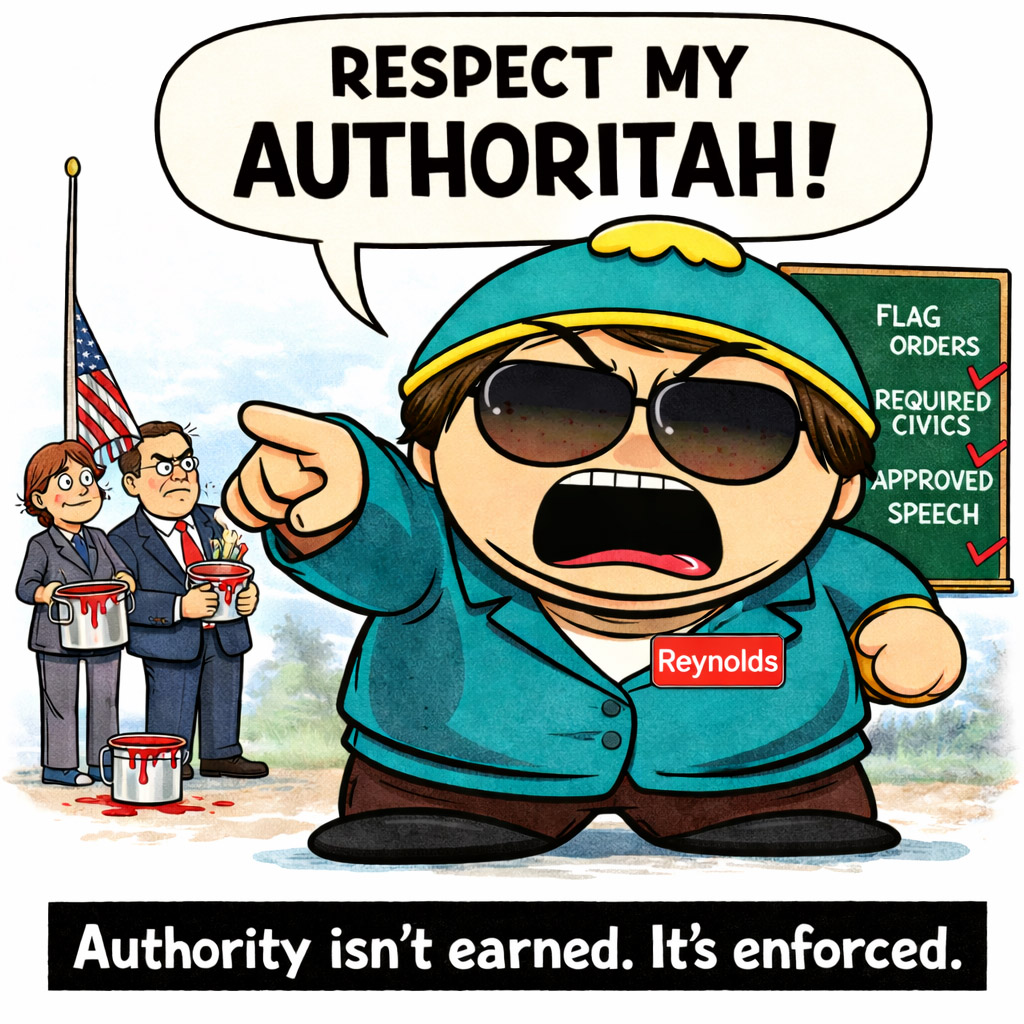
The deeper pattern is consistent: the legislature is using financial leverage and mandates to force universities to cut “undesirable” programs and expand “approved” content. That is ideological governance, not policy.
The tuition-freeze bill also looks like consumer protection on the surface, but it’s politically convenient in another way: it can be used to justify future cuts in state funding while universities absorb the long-term financial impact. In other words, the legislature can claim they are helping families while also tightening the noose around public higher education.
Kim Reynolds calls for hiking tobacco tax as Iowa studies cancer rates
Gov. Kim Reynolds is proposing an increase in Iowa’s cigarette and tobacco taxes and new taxes on vaping and consumable hemp products. The proposal comes as Iowa public health officials release preliminary findings from a major statewide study examining why Iowa has one of the highest cancer incidence rates in the U.S.
Early findings highlight behavioral risk factors such as smoking, obesity, binge drinking, and low vegetable consumption. Researchers emphasized cancer’s complexity and noted that future phases of the study will examine environmental and genetic factors, as well as screening patterns. Reynolds said research will continue and that the state should act on prevention.
Our Take
Raising tobacco taxes is not inherently wrong. Smoking is a major cancer risk factor and tobacco taxation is a well-established public health tool.
But Reynolds’ framing is politically useful in a way that should make Iowans cautious. It emphasizes “personal responsibility” while Iowa’s biggest cancer questions remain unresolved, especially the environmental and agricultural exposures that many Iowans suspect are part of the story.
This is the classic “safe target” approach. Tobacco is politically easy to attack because the industry is already widely disliked. But the more controversial question is whether Iowa’s high cancer rates are tied to agricultural chemicals, nitrate contamination, rural water quality, industrial exposures, and weak environmental enforcement.
Those issues require confrontation with powerful industries and donors. Tobacco does not.
So yes, this could become a diversion if the state stops at cigarettes while refusing to seriously investigate the other likely drivers.
Bill removing state affirmative action measures approved by Iowa House panel
A House subcommittee advanced House Study Bill 668, which would remove a wide range of affirmative action and equal opportunity requirements from Iowa law. The bill would eliminate reporting and planning requirements across multiple state agencies and education systems, including school districts, community colleges, and the Board of Regents.
The proposal drew strong public opposition and visible protest, including boos and chants of “shame.” Critics argued the bill would legalize discrimination, dismantle civil rights protections, and worsen Iowa’s struggles to retain young people and attract workers. Provisions also include removing requirements for racial and cultural awareness training and bias prevention in law enforcement training.
Supporters argued the bill aligns Iowa law with a “merit-based system,” and that it updates code after Iowa’s earlier restrictions on DEI.
Our Take
This is the most consequential bill in today’s set, because it isn’t about symbolism. It is about removing institutional safeguards for human rights.
The phrase “merit-based” is doing a lot of work here. Merit is not a policy; it’s a slogan. The real policy question is to ask, “What mechanisms remain to detect discrimination and unequal access?”
This bill removes those mechanisms.
And the bill isn’t limited to higher education. It reaches into public systems where workforce shortages already exist, especially health care. Removing language that protects licensing access for non-citizens is not “neutral.” It’s a targeted narrowing of who gets to participate in Iowa’s workforce.
This is a national trend, and yes, it aligns with Project 2025-style governance: dismantle civil rights enforcement, restrict public institutions, and redefine equality as the absence of any structural accountability.
Iowa’s lawmakers are not simply “ending DEI.” They are ending the tools used to measure whether discrimination is occurring.