
Summary
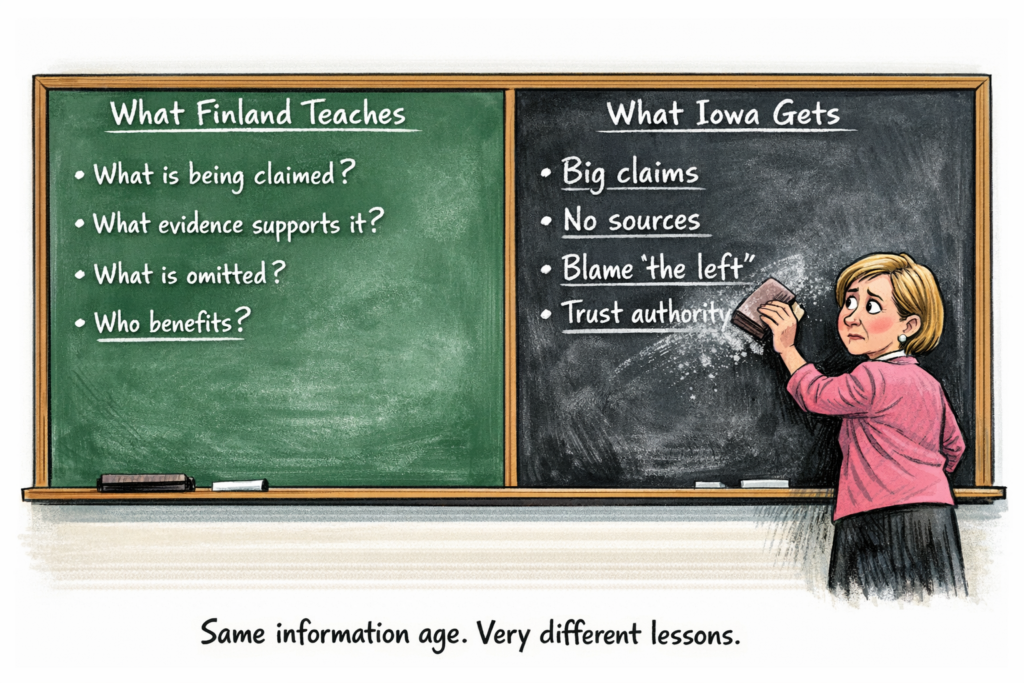
Taken together, these four stories reveal a profound contrast in how democratic societies approach information and power. Finland treats media literacy as a foundational civic skill, explicitly teaching citizens, starting at age three, to question claims, examine evidence, identify omissions, and recognize whose interests are served by belief. Critical reasoning is not an afterthought; it is infrastructure.
In Iowa, that infrastructure is uneven. The Des Moines Register’s editorial demonstrates how disciplined analysis can puncture exaggerated rhetoric without resorting to partisanship. By contrast, the guest editorials from Reps. Hinson and Feenstra rely on omission, repetition, and unsourced assertions; communication strategies that work best when audiences are not trained to interrogate them.
The difference is not merely stylistic; it is democratic. Finland assumes citizens must be equipped to challenge power. Much of Iowa’s political media ecosystem assumes power’s claims will be accepted, repeated, or defended without rigorous scrutiny.
As AI-generated content accelerates and political rhetoric grows more detached from verifiable outcomes, the Finnish question set becomes increasingly urgent for Iowa readers as well: What is being claimed? What evidence supports it? What is omitted? And who benefits if I believe this?
Fighting Fake News Through Education in Finland
Finland has spent decades embedding media literacy into its national education system, beginning as early as preschool. Children are taught to evaluate headlines, assess sources, identify omissions, and question who benefits from a claim. This effort intensified in recent years as Finland faced sustained disinformation campaigns linked to Russia, particularly following Russia’s invasion of Ukraine and Finland’s accession to NATO in 2023.
Today, Finnish schools are expanding this framework to include artificial intelligence literacy, teaching students how to recognize AI-generated images, videos, and manipulated content. Media organizations reinforce this work through national initiatives like “Newspaper Week” and the distribution of verified media literacy materials to teenagers. As a result, Finland consistently ranks at the top of European media literacy indexes and treats critical thinking as a core civic and national security skill.
Our Take
Finland assumes democracy requires trained skepticism. Rather than trusting citizens to “just know” what’s true, the country invests early and continuously in teaching people how to interrogate information.
The emphasis is not ideological conformity, but disciplined questioning. What is being claimed? What is missing? Who benefits? In an era of AI-generated content and political manipulation, Finland’s approach offers a striking model of democratic self-defense.
Trump Delivers Strong Economic Message for Some Other State | Des Moines Register Editorial
The Des Moines Register Editorial Board offers a measured critique of President Trump’s January 27 visit to Iowa, noting the disconnect between his economic claims and the realities facing many Iowans. While national economic indicators such as GDP growth remain strong, Iowa continues to lag in key rankings, and many of Trump’s rally talking points had little relevance to the state.
The editorial highlights exaggerations and contradictions in Trump’s remarks, including claims about gas prices, housing affordability, and agricultural support. It notes that Trump’s trade policies contributed to farm bailouts, that promised achievements like year-round E15 remain unrealized, and that job losses in Iowa contrast sharply with manufacturing gains touted elsewhere. The piece concludes that while some economic metrics are positive, Trump’s rhetoric often substitutes vague assurances for tangible results.
Our Take
This editorial is a model of something increasingly rare in Iowa’s media environment, evidence-based skepticism applied even-handedly. Rather than reflexive opposition or partisan cheerleading, it evaluates claims against data and context. In doing so, it echoes the same analytical habits Finland deliberately teaches its children; demonstrating that critical reasoning is not anti-political, but pro-democratic.
Iowans Are Earning More, Paying Less After Trump’s Return | Guest Editorial by Rep. Ashley Hinson
Rep. Ashley Hinson’s Des Moines Register guest editorial presents an unqualifiedly positive assessment of President Trump’s return to office, citing tax cuts, wage growth, lower inflation, reduced energy costs, and economic relief for working families. The column asserts that Trump delivered the largest middle-class tax cuts in history, eliminated taxes on tips, overtime, and Social Security, and restored economic opportunity for Iowans.
The piece largely omits discussion of trade-offs, costs, or countervailing evidence. Tariffs are framed as beneficial without acknowledging their direct cost to consumers and farmers. Inflation trends are attributed exclusively to prior administrations without global context. Claims of wage growth and affordability are presented without sourcing or acknowledgment of uneven impacts across income groups or regions.
Our Take
This editorial exemplifies a form of political communication that assumes credulity rather than scrutiny. Assertions are broad, sources are absent, and inconvenient facts like tariff costs borne by Americans, farm sector distress, or uneven economic recovery are excluded.
When readers are not encouraged to ask what’s missing, persuasion replaces explanation. This stands in stark contrast to the Finnish model, where omissions are treated as warning signs, not rhetorical conveniences.
Trump Delivered for Iowans, Over and Over, in His First Year | Guest Editorial by Rep. Randy Feenstra
Rep. Randy Feenstra’s Des Moines Register guest editorial praises President Trump’s first year in office as a series of decisive victories, citing border enforcement statistics, drug seizures, tax cuts, and agricultural support. The column describes Trump’s election as a “decisive” mandate and credits his administration with securing the border, boosting wages, cutting taxes, and opening export markets for Iowa agriculture.
Like Hinson’s piece, the editorial relies heavily on selective statistics presented without context or comparison. Claims about drug seizures, border security, tax refunds, and wage gains are not accompanied by baseline data, long-term outcomes, or acknowledgment of costs. Significant omissions include the economic burden of tariffs on U.S. consumers, farm losses during trade disputes, and the narrow margins of Trump’s 2024 electoral victory.
Our Take
Feenstra’s column offers a textbook example of cherry-picked evidence paired with absolute conclusions. Numbers are presented as self-explanatory, even when stripped of context that might alter their meaning.
This style of argument does not invite readers to reason; it asks them to accept. In environments where such claims go unchallenged, misinformation thrives not because people are uninformed, but because they are not encouraged to question.