Summary
Today’s Iowa411 News Briefs highlight three interconnected realities shaping life in Iowa: experimentation at the margins of industrial agriculture, the politicization of science and regulation in abortion policy, and the mounting mental health toll on farmers.
From Kernza’s promise to reduce nitrate pollution and diversify crop systems, to coordinated efforts to misuse environmental law to restrict abortion access, to urgent calls for farmer mental health support, each story reveals how policy choices and distortions directly affect public well-being.
Together, they underscore a central theme: evidence-based solutions exist, but ideological and economic structures often stand in the way.
An Iowa Farmer Experiments with Kernza
In a field north of Des Moines, farmer Lee Tesdell is growing Kernza, a perennial grain developed by The Land Institute as an experiment in both agronomy and environmental stewardship.
Tesdell is one of only two farmers in Iowa cultivating Kernza, which is derived from intermediate wheatgrass and known for its deep roots, low input requirements, and exceptional ability to absorb nitrate before it reaches waterways.
Early research from Minnesota suggests Kernza can capture up to 96% more nitrate than corn or soybeans, a notable benefit in a state long plagued by nitrate contamination in drinking water.
Kernza’s appeal lies not only in environmental performance but in system efficiency. As a perennial crop, it does not require annual tillage or replanting, reducing fuel use, labor, and soil disturbance.
Tesdell uses the crop in three ways: harvesting grain for food and brewing, baling the residue as hay, and grazing sheep on the fields after harvest.
Still, Kernza remains economically marginal. Yields are low, processing infrastructure is distant, and markets are limited, requiring Tesdell to ship grain to Nebraska for milling.
One emerging market is craft beer. At Brightside Aleworks in Altoona, Kernza is featured in a hazy IPA called Farm Hand. Brewer Andrew Frana says the grain performs similarly to rye or wheat, adding body and flavor while aligning with regenerative agriculture values. While Kernza is currently more expensive than conventional grains, Frana sees value in helping introduce consumers to the crop through a social and narrative-driven product like beer.
Our Take
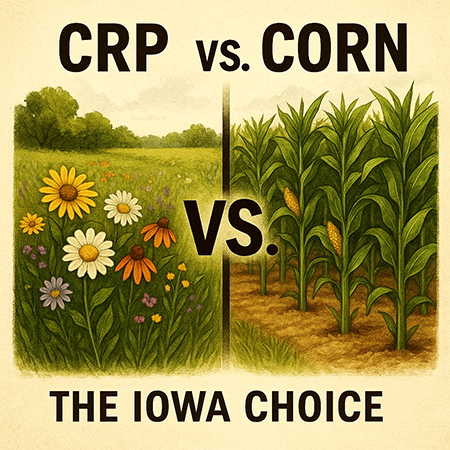
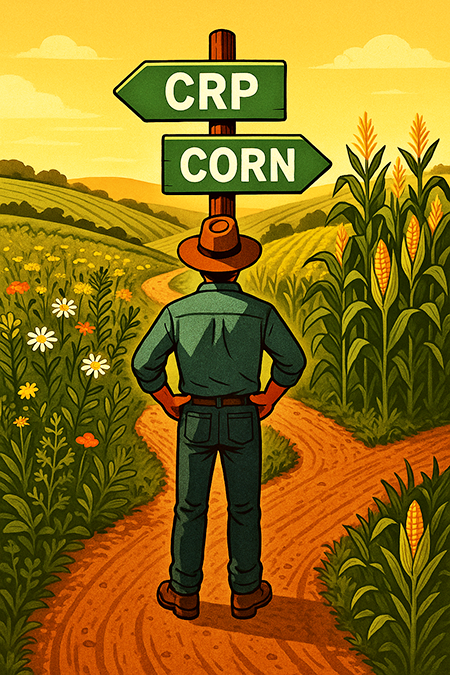
Kernza illustrates what diversification could look like in Iowa. And, why monoculture remains dominant. The agronomic and environmental benefits are real, particularly for nitrate reduction and soil retention, yet the economic ecosystem is not built to support alternatives.
Processing, distribution, and price signals all favor corn and soybeans, reinforcing corporate control over planting decisions.
Kernza’s future will depend less on farmer curiosity and more on whether public policy, water-quality incentives, and regional markets are aligned to reward positive outcomes, including cleaner water, healthier soils, and reduced risk.
Regulating Abortion Pills as “Pollutants”: A New Front in Anti-Abortion Policy
As abortion opponents continue to pursue restrictions following the overturning of Roe v. Wade, new efforts are emerging to further regulate medication abortion, specifically mifepristone, under environmental law. Groups such as Students for Life of America have promoted the unfounded claim that abortion pills contaminate drinking water, lobbying lawmakers and the Environmental Protection Agency to study or regulate the drug as a pollutant.
In 2025 alone, lawmakers in at least seven states introduced bills requiring water testing, mandating medical waste kits for patients, or banning telehealth abortion under the guise of environmental protection. None of these measures passed, but proponents are expected to reintroduce them in 2026.
Parallel legislative efforts include fetal wrongful death lawsuits, attempts to override voter-approved abortion rights amendments, expanded civil liability for providers and helpers, and challenges to abortion privacy protections.
At the federal level, Republicans have pressed for renewed restrictions on Planned Parenthood funding and intensified scrutiny of FDA leadership overseeing mifepristone’s safety review.
Meanwhile, states that protect abortion access are focusing on shielding medical data and limiting surveillance tools used to track patients across state lines. A small number of lawmakers have also introduced deliberately provocative bills, such as mandatory vasectomies for convicted rapists, to highlight the imbalance in bodily autonomy laws.
Our Take
The “environmental pollutant” argument is not science-driven policy; it is ideological repackaging. There is no credible evidence that mifepristone poses a risk to drinking water, and these proposals selectively ignore the far larger pharmaceutical and agricultural contaminants already documented in U.S. waterways.
The strategy is clear. Weaponize environmental regulation to accomplish what voters and courts have resisted, restricting abortion access indirectly. This approach risks corrupting environmental law itself, undermining public trust in regulatory agencies by using them as tools of cultural enforcement rather than evidence-based governance.
“Ask for Help”: Mental Health Resources for Iowa Farmers
Farmers face some of the highest suicide rates of any profession, with rural suicide rates significantly exceeding those in urban areas. According to the National Rural Health Association, farmers die by suicide at more than three times the national average, a trend worsened by volatile markets, trade instability, high input costs, and prolonged stress.
Mental health hotlines serving agricultural communities have seen increased call volumes in 2025. Therapists working with rural populations emphasize early warning signs such as irritability, sleep disruption, increased substance use, and withdrawal. Farmers’ self-reliant culture often delays seeking help, even as isolation and long work hours compound stress.
https://iowacapitaldispatch.com/2026/01/03/ask-for-help-mental-health-resources-and-stress-management-tips-for-farmers/
And access remains a challenge, with many rural regions functioning as mental health care deserts. Several organizations are working to close that gap. Iowa State University operates the Iowa Concern hotline, offering confidential counseling, financial planning assistance, and legal referrals. FarmAid provides crisis support, while groups like Farm Rescue offer direct operational help to families in distress. Telehealth services are increasingly positioned as a practical option for rural households.
Our Take
This is not a personal failure problem; it is a systemic problem. Farmers are operating under intense economic pressure while being asked to absorb market shocks, climate risk, and policy uncertainty largely alone.
Mental health resources are essential, but they are downstream responses. Long-term relief requires addressing the structural drivers of stress: debt, consolidation, volatile trade policy, and the erosion of community-based support systems. Still, making help visible and stigma-free saves lives, and that work cannot wait for broader reform.