Summary
Iowa’s agricultural future remains uncertain as China delays promised soybean purchases and Congress extends the Farm Bill for a third time.
While the extension preserves key programs like conservation and rural development, it highlights a fractured policy system, rising costs for farmers, and increasing instability.
From trade reliance on China to piecemeal federal solutions, Iowa producers face growing risk – and an urgent need for long-term vision, diversification, and real reform.
Iowa Ag Secretary: China’s Soybean Promises – “Trust but Verify”
The Lee-Gazette Des Moines Bureau reports that Iowa Agriculture Secretary Mike Naig says the U.S. must “trust but verify” China’s promise to purchase large volumes of U.S. soybeans.
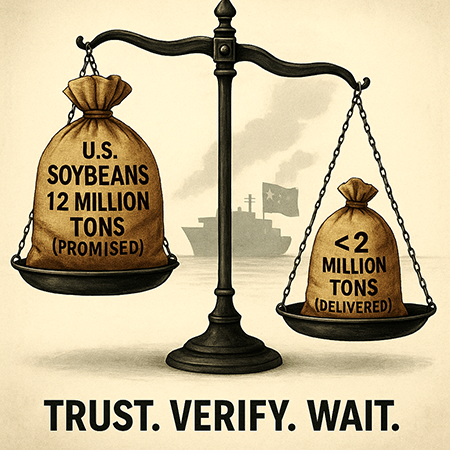
While the White House announced that China agreed to buy 12 million metric tons in the final two months of the year, plus 25 million tons annually for the next three years, actual purchases so far total less than 2 million tons since the agreement was announced.
Naig made his comments while speaking to the Westside Conservative Club and later in interviews. He expressed cautious optimism but emphasized that China historically “pushes the envelope” and that enforcement will be critical if the agreement is to hold.
This matters deeply to Iowa because China was, until recently, Iowa’s top soybean export market, and the state remains the second-largest exporter of soybeans nationally.
Naig also touched on high production costs and low commodity prices, promoted his department’s “Choose Iowa” program, and referenced recent trade missions to Southeast Asia as part of a strategy to diversify export markets.
Our Take – Cautious Optimism, Political Framing, and Real Risk for Farmers
“Trust but verify” may sound prudent, but for Iowa farmers, this is not an academic exercise – it’s their livelihood.
The reality is that China has a long track record of using agricultural purchases as leverage; less than 2 million of the promised 12 million tons have been purchased, and Iowa farmers are being asked to plan their 2026 planting decisions amid uncertainty.
Naig’s comments reflect real concern, but they are wrapped in political messaging designed to highlight loyalty to the Trump administration’s trade strategy. This is where policy and politics become blurred for producers.
Meanwhile, farmers are still dealing with depressed crop prices, elevated fertilizer and fuel costs, climate volatility, equipment debt, and market instability caused by tariffs and retaliation.
Put simply: Iowa farmers do not need slogans. They need stable markets, verified contracts, and transparent enforcement of trade agreements.
And once again, Iowa’s heavy reliance on a single dominant export market exposes a critical weakness in its agricultural system – the very vulnerability that diversification efforts are meant to solve.
What to Know About the Latest Farm Bill Extension
Congress has extended portions of the 2018 Farm Bill for a third time, keeping essential agricultural, conservation, rural development, and nutrition programs alive for one more year as part of a federal government funding package.
Iowa Public Radio reports that key programs affected include:
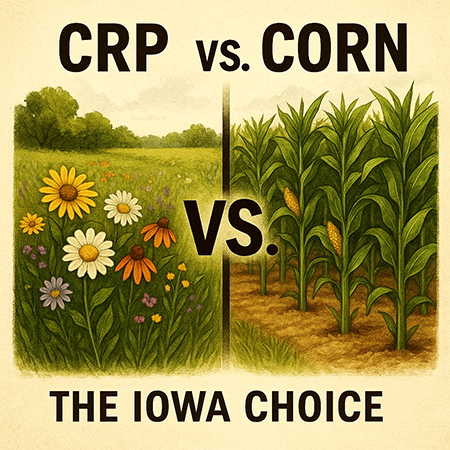
- The Conservation Reserve Program (CRP) – nearly 26 million acres enrolled
- Rural microenterprise funding – small business loans in rural areas
- Farm Service Agency (FSA) and NRCS operations – now reopened after shutdown
- SNAP (food assistance) – funded at $107.5 billion
- WIC – funded at $8.2 billion
CRP is considered the “backbone” of conservation policy, providing farmers stable income for retiring vulnerable lands and protecting water and soil. Without renewal, new acres could not be added and expiring contracts would have disappeared.
However, this extension comes after the One Big Beautiful Bill Act (approved by every member of Iowa’s Congressional Delegation), which increased commodity safety nets but also:
- Slashed $186 billion from food assistance programs
- Reworked conservation funding through 2031, and
- Fractured the traditional rural-urban coalition that historically supported the Farm Bill.
Some experts now believe the five-year omnibus Farm Bill may be effectively over, replaced by a fragmented, piecemeal approach going forward.
Our Take – A Temporary Lifeline vs. A Broken System
Yes, the extension is a relief. But make no mistake: this is a Band-Aid on a broken system.
Farmers needed stability, predictability, and a long-term policy framework.
Instead, they received another short-term extension, more political uncertainty, and weakened conservation and nutrition coalitions.
What’s especially alarming is the potential unraveling of programs like the Conservation Reserve Program, which has quietly done more to protect Iowa’s soil and water than most politicians will ever acknowledge.
At the same time, nutrition programs were severely damaged, USDA services were temporarily shut down, and farmers were left “flying blind” during budget chaos.
That wasn’t leadership – it was legislative improvisation.
Iowa doesn’t just need a farm bill extension. It needs a vision for the future of agriculture that balances production, conservation, food security, rural vitality, and climate resilience.
Right now, Washington is offering short-term relief in exchange for long-term risk.