SNAP Ruling: Hope on Paper, Hunger in the Checkout Line
Two federal judges ordered the Trump administration to tap contingency funds to keep SNAP afloat during the shutdown, but Iowa anti-hunger advocates warn the relief will come too late for families expecting benefits on Nov. 1.
“It’s a good sign,” said Luke Elzinga of the Iowa Hunger Coalition, “but it does not mean that suddenly a valve is turned on for tomorrow.”
Iowa distributes $45 million a month in food aid to 131,000 households. Reloading EBT cards takes a week or more, so food banks are already seeing record lines.
Gov. Kim Reynolds announced a $1 million state match for food-bank donations and mobilized the Iowa National Guard to move supplies, but advocates note $2 million ≠ $45 million in lost benefits.
Republicans are blaming Senate Democrats for the shutdown; Democrats are urging Reynolds to use $107 million in federal-recovery-fund interest to keep Iowans fed. Until Washington acts, pantries will “fill the gap.”
Farm Labor Crunch: Deportations Meet a Government Shutdown
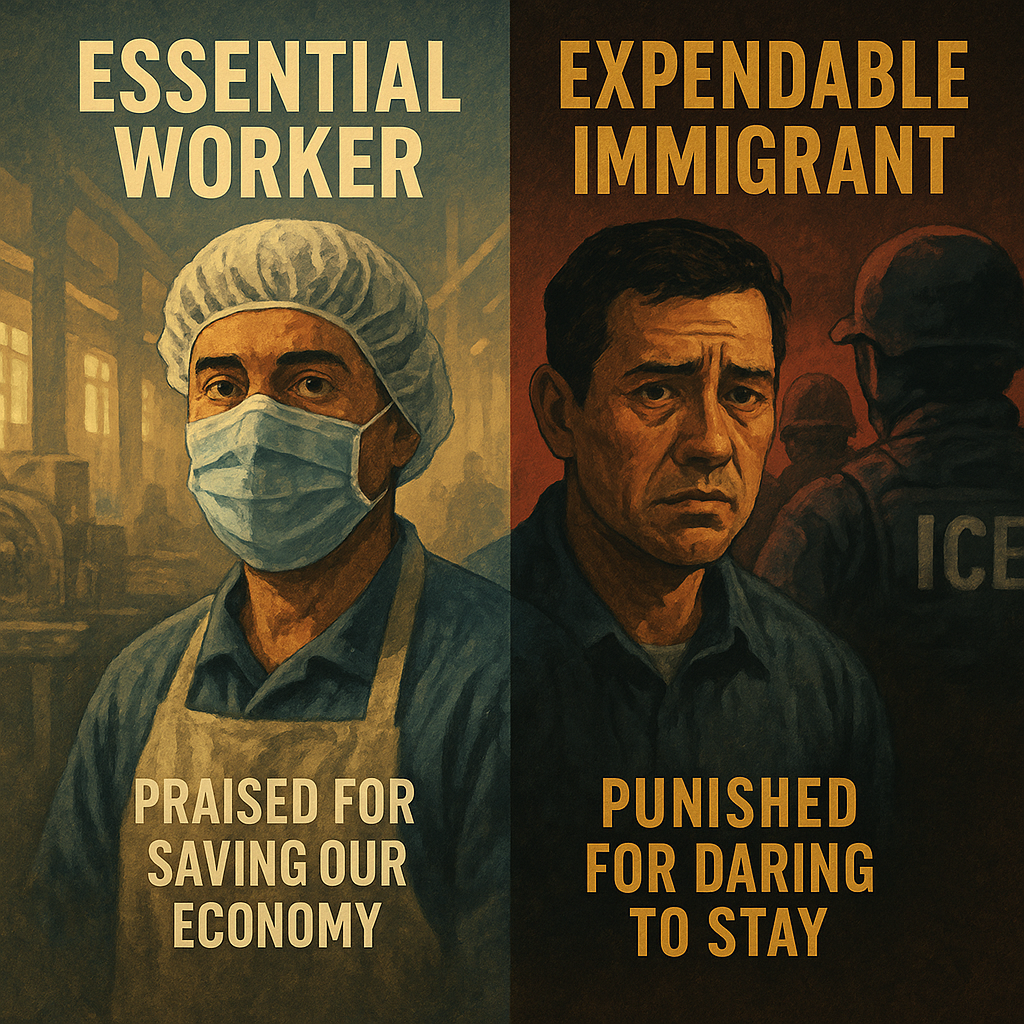
Trump’s deportation of more than half a million people, combined with a shutdown-related suspension of the H-2A farm-worker visa program, is crippling agriculture.
Out of roughly 2 million farmworkers, about 44 percent are undocumented. Raids, visa cancellations, and processing delays have left fields unharvested and dairies short-staffed.
Even as Trump officials claim U.S.-born workers will fill the gap, the Department of Labor quietly admitted its own crackdown risks “supply-shock-induced food shortages.”
“Basically, they’re saying, we want workers, but we don’t want people,” said Daniel Costa of the Economic Policy Institute. The likely outcome: consolidation into large industrial farms that can afford visa labor or automation – and another blow to small Iowa producers.
Book Bans in Iowa: Laws Weaponized, Challenges Mostly Denied
A Des Moines Register survey found 24 challenges statewide since lawmakers passed Senate File 496 (sex-act restrictions) and House File 802 (“divisive-concepts” law). Challenged titles spanned from 1984 and The Bluest Eye to American Born Chinese and Heartstopper.
Most challenges were denied, but the process itself is reshaping curricula through intimidation and self-censorship. “When even 1984 is challenged for being un-American, you know we’ve crossed into satire,” an Iowa teacher told the Register.
Inside Iowa’s Book Battles
Topics Targeted:
Race | LGBTQ+ identity | Poverty | Policing | U.S. history
Outcome Snapshot:
• 24 total challenges
• 3 removals (Till, Shout, Monster from curriculum)
• 21 retained or restricted (1984 kept in high-school library)
Key Irony:
1984 – a book about state censorship – was itself restricted under a state law aimed at controlling what students read.
Community Lenders Defunded: CDFIs on the Chopping Block
The Trump administration has frozen $324 million Congress set aside for Community Development Financial Institutions, mission-based lenders that fund small businesses in rural and minority communities.
Sen. Thom Tillis (R-N.C.) called the move “amateurish,” noting CDFIs are vital in red states and rural America.
Some CDFIs are closing by year’s end; others are merging or rewriting their websites to remove DEI language to avoid being targeted. Without these lenders, many Iowa entrepreneurs will turn to credit cards or payday loans – or give up altogether.
Regents Rankings: ISU Leads, Diversity Scores Plunge
In the Wall Street Journal’s 2026 rankings, Iowa State University again tops state universities, ranking at 141, ahead of the University of Iowa (No. 207) and UNI (No. 289).
And all three saw sharp drops in diversity scores after the 2024 law that defunded DEI offices. On a scale of 1 to 100:
- ISU fell from 41 to 18
- UI from 42 to 9
- UNI received a 4
In the Wall Street Journal’s 2026 college rankings, Iowa State University once again edges out the University of Iowa and the University of Northern Iowa – but all three public universities dropped overall, and their diversity scores cratered.
The WSJ focuses on “value” and outcomes – salary impact, graduation rates, learning environment, and diversity. Iowa’s regent universities slashed more than $2 million in DEI roles and offices in 2024 after a new state law, and the free-fall in diversity scores suggests real, measurable consequences for how inclusive and competitive these campuses now appear to prospective students.
You’ve basically got a state policy that attacks DEI, followed by a national ranking that says, “Yep, we can see that.”
The rankings confirm what students already feel – Iowa’s campuses are less diverse and less welcoming, even as they tout “career readiness” and “value.”
Rural Press Fadeout: Local Voices Go Silent
Axios Des Moines reports that the Medill School of Journalism at Northwestern University has published a report that shows rural Iowa’s independent papers are closing faster than chain-owned outlets.
Since mid-2024, three weeklies in northwest Iowa have folded: the Lyon County News, Schaller Herald, and The Aurelia Star.
“When you lose a news source in a small town, no one else is coming in to cover that town,” said Becky Vonnahme of the Western Iowa Journalism Foundation.
The Axios story mentions that innovation still exists: the Daily Iowan has purchased community papers, the Western Iowa Journalism Foundation funds digital transitions, and local journalists are re-launching independent outlets. Each represents a fight to keep local democracy alive as Iowa’s news map shrinks.