
Summary
Medicare premiums will rise again this year in the second-largest increase in the program’s history.
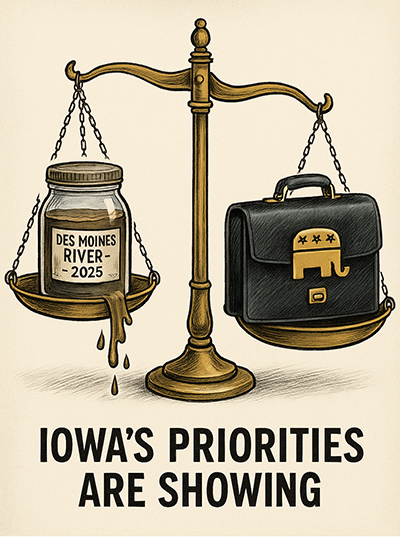
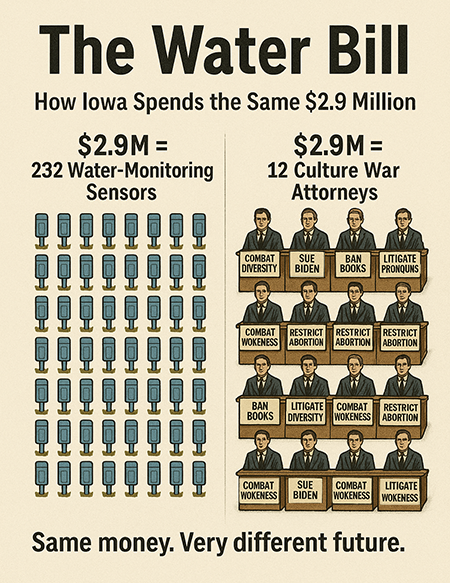
A Des Moines staff editorial questions whether Iowa’s state government will vote to fund needed programs to monitor the state’s substandard water quality or choose instead to fund 12 new partisan attorneys to help AG Brenna Bird’s ambition to accelerate the flames of culture wars.
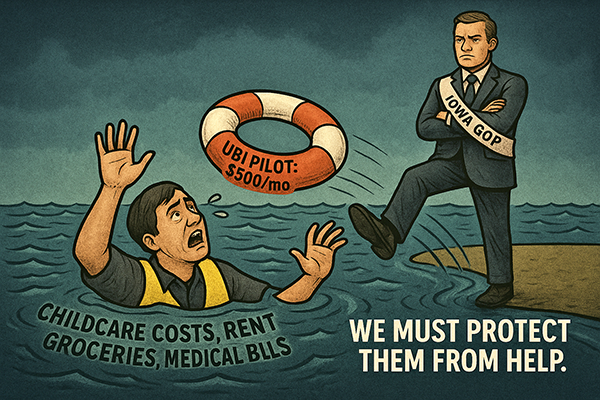
And although Universal Basic Income (UBI) programs are gaining popularity across the country, there will be none here. That’s because Iowa lawmakers and the governor got together last year to draft and enact a law that bans local guaranteed basic income programs. Nice.
Medicare Premiums Jump Again and Seniors Lose Ground
Medicare Part B premiums will rise to $202.90 in 2026, a $17.90 (9.7%) increase – the second-largest increase ever.
The boost far exceeds next year’s 2.8% Social Security COLA, meaning seniors’ already strained budgets will shrink again. Average Social Security checks will rise about $56, but the Medicare hike wipes out nearly one-third of that.
The hold-harmless provision will shield some low-income seniors (benefits ≤ $640/month) from having their entire COLA eaten by the Part B increase, but most beneficiaries will bear the full cost. Meanwhile, many Part D drug plans will jump as much as $50/month, and deductibles for Part B will rise to $283.
CMS noted the increase could have been even worse without changes in billing rules for expensive skin substitutes.
Our Take
Iowa’s fixed-income seniors – already the only age group whose poverty rate increased last year – are getting squeezed between rising premiums, shrinking benefits, and a state government ideologically opposed to even discussing structural solutions like UBI. The Legislature’s pre-emptive ban on UBI pilots looks especially cruel now, as other states test real solutions while Iowa’s older adults fall deeper into precarity.
Universal Basic Income Gains Momentum Nationwide
Dozens of cities – red, blue, and purple – are running UBI/guaranteed income pilots, driven by high living costs and the growing threat of AI-driven job loss.
Research from Stockton, California’s program shows significant benefits: reduced financial stress, better physical and mental health, fewer income shocks, improved employment outcomes, and stronger family stability.
Historical data also supports early-life guaranteed income. The Cherokee Nation casino revenue distributions have dramatically improved educational and social outcomes for Native youth.
Advocates argue that stimulus checks during COVID proved the concept at scale, while skeptics continue to demand “instant transformations,” ignoring decades of evidence that escaping poverty requires long-term stability.
Our Take
If any state needs UBI pilots, it’s Iowa – where stagnant wages, rural decline, and punishing health-care costs leave families one emergency away from disaster.
But last year the Legislature banned participation in any pilot program before one was even proposed. Once again, ideology blocks innovation while other states gather evidence. Iowans deserve better than preemptive sabotage.


2024 Iowa Ban on Guaranteed Basic Income Programs
Last year, the Iowa Legislature passed House File 2319, a bill prohibiting cities and counties from creating or participating in guaranteed basic income (GBI) programs – even when no state dollars are involved. And Iowa Governor Kim Reynolds happily signed it into law.
The main program targeted was UpLift, a privately and publicly funded research pilot that provided $500 per month to 110 low-income parents in Polk, Dallas, and Warren counties to study the effects on health, stress, and financial stability.
Key facts:
- UpLift is funded by private foundations, plus local governments (Des Moines, Urbandale, Windsor Heights, Polk County).
- No state money is used.
- 68% of UpLift participants work.
- One in seven Iowa working families struggles to meet basic needs.
- The program was scheduled to run through April 2025, but the law shut it down last year.
- The law empowers the Iowa Attorney General to issue cease-and-desist orders and sue local jurisdictions for non-compliance.
Proponents of the law argued that GBI discourages work, that earnings should only be the product of labor, and the state must protect its “work ethic” by banning all GBI programs.
Rep. Steven Holt, R-Denison, said allowing GBI is akin to “allowing cities and counties to have differing laws on murder,” accusing the programs of “murdering our work ethic.”
Consider the differences between the arguments. Opponents of the legislation cited facts and data from real-world studies. And Steven Holt spouts an opinion and comparison that are so patently inane that they open the Iowa representative to well-deserved ridicule.
Opponents to the legislation countered that the bill is a massive overreach of state power into local government.
If private donors want to fund an anti-poverty experiment, they should be allowed to. And the blanket ban on these programs undermines Iowa’s ability to study solutions to generational poverty.
Our Take
Christian Nationalists Strike Again – This Time Against Poor Working Families
This bill is not about preserving “work ethic.” It is about punishing the poor, blocking research that might embarrass the legislature’s anti-welfare ideology, and stripping cities of their ability to govern themselves.
There are three hard truths.
This was state overreach – plain and simple
UpLift would have used no state funds. It is a research project in which local governments chose to participate. And the state intervened solely to stop cities from trying something that might work.
This is textbook authoritarian centralization, not conservative governance.
The state’s arguments against GBI are ideological, not factual
Decades of research – from Alaska to the Cherokee Nation to Stockton – show that workers participating in UBI programs do not quit jobs en masse, families experience less stress, children do better in school, local economies benefit, and personal emergency expenses do not become life-ruining crises.
UBI is not “government dependence.” It’s economic stability.
The Iowa bill and law banning UBI programs were driven by the same Christian Nationalist agenda that has captured Iowa politics.
Control, punishment, moralizing, and the obsession with regulating personal lives – all while ignoring real crises like rural hospitals closing, dirty water, failing schools, and child poverty.
And yes, when the state forbids local governments from helping their own residents, that is indeed how authoritarian systems function. It may not be full-blown fascism, but it is on the spectrum of anti-democratic governance.
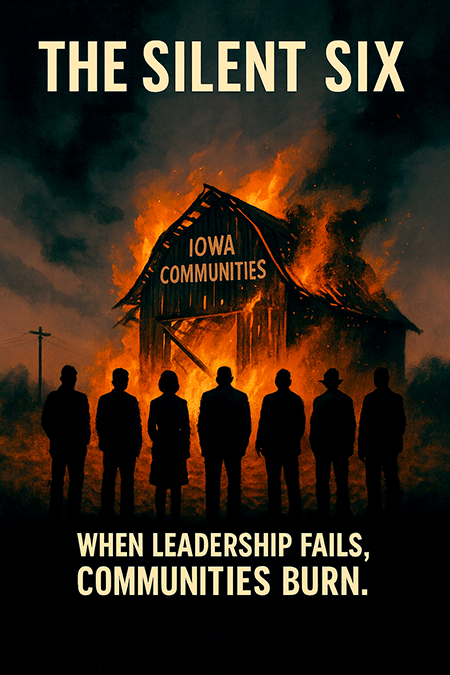
And while the Silent Six – Iowa’s Congressional delegation – are not directly involved here, the pattern is identical to their strategies and inaction.
Concentrate power. Crush local autonomy. Use government to enforce ideology, not improve people’s lives. Call compassion “dangerous.” And call poverty relief “murder.”
Iowans deserve better than this cruelty masquerading as principle.
Register Editorial: Will Iowa Fund Clean Water – or More Lawyers?
The Des Moines Register editorial board warns today that Iowa lawmakers will soon reveal their true priorities by making a choice: protecting clean water or expanding political and culture-war litigation.
Iowa’s water remains among the dirtiest in the country due to agricultural pollution, failed voluntary strategies, and weak enforcement.
Meanwhile, Attorney General Brenna Bird wants $2.9 million more to hire 12 additional attorneys. State funding for the Iowa Water Quality Information Service was zeroed out in 2023 and now survives only through county-level rescue efforts.
And for years, the Legislature has ignored affordable, evidence-based solutions recommended by scientists.
The editorial argues that Iowa’s years-long hands-off approach to farm pollution has failed completely and that clean water is worth the investment.
Our Take
This is the clearest encapsulation of Iowa governance today: starving essential environmental monitoring while expanding political legal warfare.
With 700+ impaired waterways and nitrate spikes threatening public health in our state, refusing to take meaningful action is not just irresponsible – it’s dangerous.
What Iowans Are Saying
Letters to the Editor: Climate, Hunger, Regulation, and Community
Summary of themes from today’s Des Moines Register’s letters to the editor.
Climate Accountability
Writers argue the U.S. bears responsibility for global climate damage and note the Trump administration’s refusal to engage at COP30. They describe climate denial as a moral and generational failure.
Starving Children and U.S. Aid Cuts
A seminary graduate recounts Kenyan experiences, linking Trump-era cuts to USAID programs to child malnutrition and preventable deaths – calling the decision “evil” and demanding restoration of aid.
Regulation Hypocrisy
One letter highlights Gov. Kim Reynolds’ insistence that “regulation is hardly ever the answer” for agriculture – while aggressively regulating higher education and curriculum.
Weak Enforcement, Dirty Water
A writer criticizes the EPA’s minuscule fine for a feedlot that discharged manure for three straight days, arguing weak enforcement encourages chronic pollution.
Inspiration from Local Food Systems
Another letter praises Dogpatch Urban Gardens’ sale to Lutheran Social Services, calling it a rare bright spot in a time of political bitterness – and an example of community-first business.
Des Moines’ Future
And one writer urges Des Moines to embrace a diversified, sustainable growth strategy that blends affordability, livability, and innovation.
Our Take
These letters share a quiet but powerful theme: the systems meant to protect people – water, climate, children, truth, food – are repeatedly undermined by political choices. The public sees it clearly. The question is whether policymakers will finally listen.