Iowans Respond With Context and Information Reynolds Conveniently Left Out
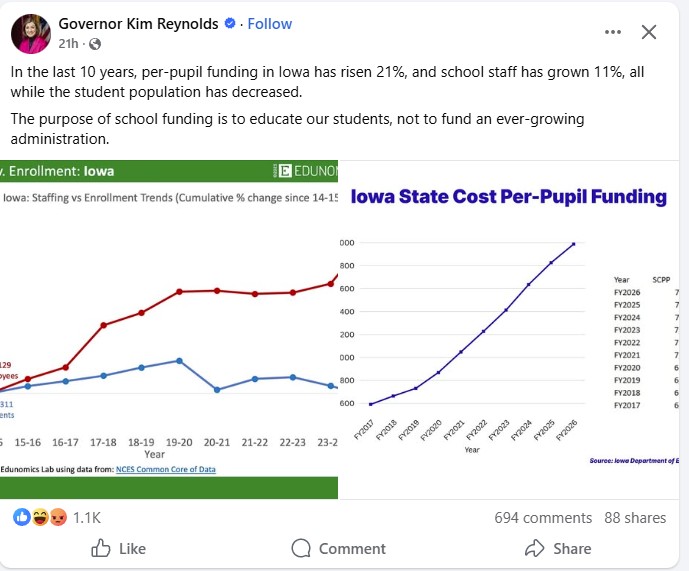
Gov. Kim Reynolds posted a claim on Facebook that per-pupil funding in Iowa has risen 21% over 10 years while school staff grew 11% and student enrollment declined. She concluded that schools are funding “ever-growing administration” instead of students.
Iowans responded with a blunt counterpoint: those numbers are meaningless without context, and the “administration bloat” conclusion does not follow from the data she presented.
What Iowans Actually Said (and Why It Matters)
Across hundreds of replies, several themes dominated. And they were notably specific, data-aware, and hard to dismiss.
Adjust for inflation.
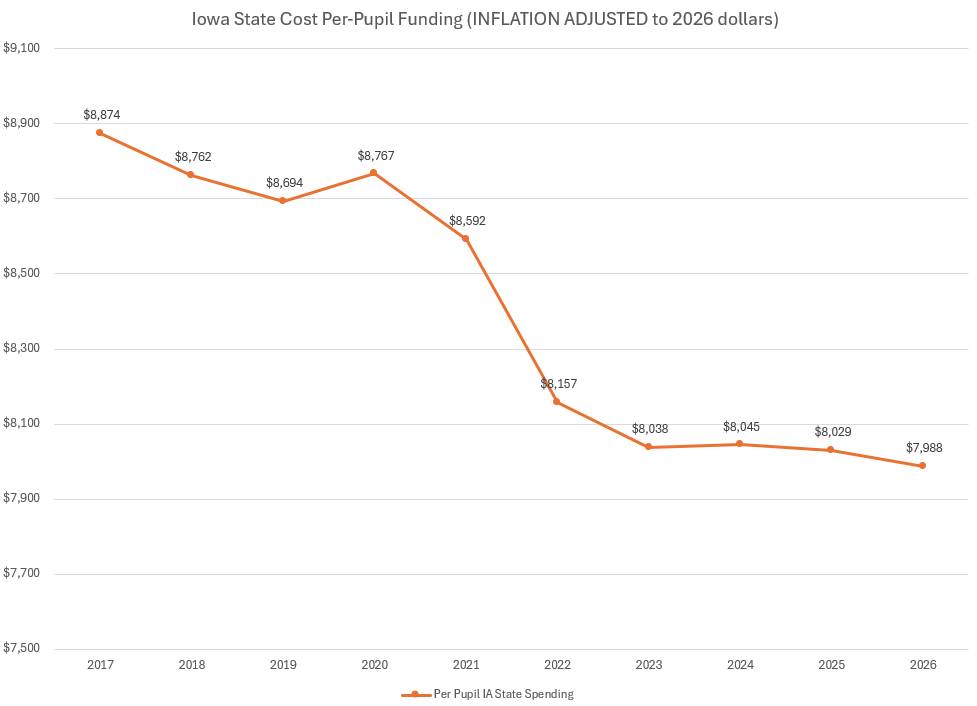
The most common rebuttal was straightforward: commenters cited cumulative inflation over the decade (many referenced ~35%, give or take depending on the exact start/end years). Their point: a 21% nominal increase can still be a real-dollar cut in purchasing power. In plain language: schools can be “getting more” on paper while being able to buy less in reality.
You can’t claim ‘admin bloat’ from ‘staff’ growth.
A recurring critique was that Reynolds’ post jumps from “staff increased” to “administration is growing” without showing an administrator breakdown. Many commenters argued staffing growth is often paras, special education supports, behavior intervention staff, mental health supports, nurses, and other student-facing roles, especially as IEP/504 needs, classroom behavior challenges, and mandated services increase.
State policy creates costs and then blames schools for having costs.
Multiple replies pointed out that Iowa lawmakers regularly impose new requirements: documentation rules, curriculum mandates, reporting, compliance tasks, and program changes. Commenters argued those mandates aren’t “free,” especially for small rural districts where fixed costs (building operations, transportation, minimum staffing) don’t decline proportionally with enrollment.
Rural decline and suburban growth are opposite problems and statewide averages hide both.
Many Iowans emphasized that the “statewide average” masks a two-track reality: Rural districts lose students but can’t instantly eliminate fixed costs without consolidations that bring their own burdens (longer bus routes, fewer offerings, community loss). And fast-growing suburban districts must hire quickly just to keep class sizes legal and services functional. High-level averages don’t explain either situation well.
What about vouchers?
A significant portion of commenters asked whether the per-pupil funding and staffing figures include private-school ESA/voucher impacts, and how public-school budgets are affected when enrollment shifts but fixed costs remain. Even among people who support “choice,” many asked for transparent accounting: how much is going where, and with what oversight?
Outcomes and rankings matter.
Another theme: if the state is going to make a “waste” argument, show results. Commenters demanded a discussion of teacher pay, retention, class sizes, student achievement, reading/math proficiency, graduation readiness, and the real-world condition of classrooms. Several noted Iowa’s slide in national standing as evidence that “starve and blame” is not working.
Show the receipts.
A noticeable share of responses challenged the governor to post source data, methodology, and breakdowns, not slogans. The underlying message was consistent: if this is a serious governance claim, treat Iowans like adults and provide transparent numbers.
The Real Story
Reynolds’ post isn’t just “incomplete.” It’s rhetorically engineered: it presents select inputs (nominal funding, staffing, enrollment) and smuggles in a predetermined conclusion (“admin bloat”) without showing the actual admin share, inflation effects, fixed-cost realities, or policy-driven cost increases.
That’s why the public reaction was so sharp. People didn’t just disagree; they recognized the deception.
Kudos to the Post Respondents
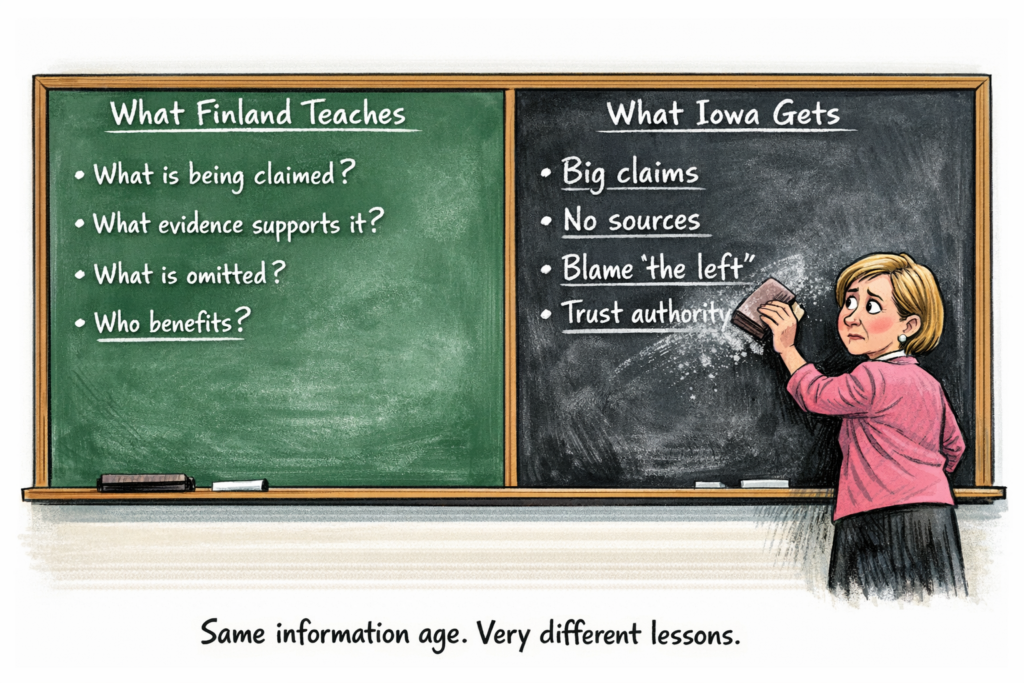
If you want a living demonstration of why critical thinking matters, this is it.
The governor posted a simplified set of statistics and used them to imply misuse of funds without providing the key context that determines whether the numbers mean anything at all: inflation, staffing categories, mandates, district-by-district realities, and where voucher dollars fit.
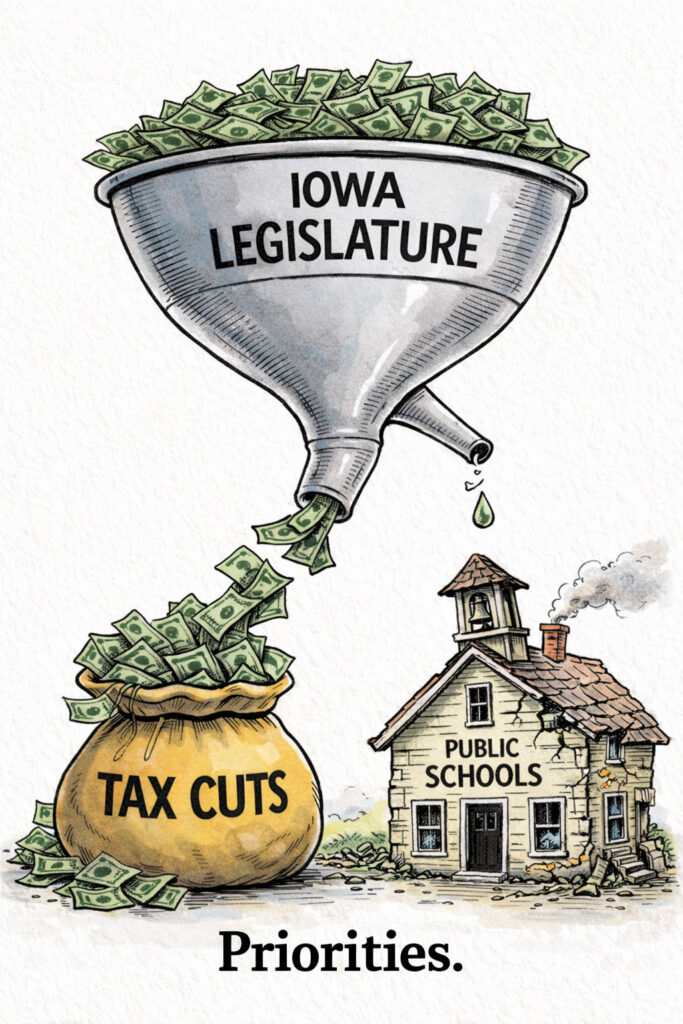
Reynolds demonstrated how political propaganda works in 2026: it isn’t always an outright lie. It is a misleading frame, designed to steer anger toward public schools rather than toward the policy choices that shape school budgets.
Iowans’ responses were the antidote: define terms, demand context, separate staff from “administration,” adjust for inflation, and ask the simplest accountability question of all: show the breakdown.