Society
From beginnings to todayThe Living Fabric of a State
Every society has a soul. Iowa’s has long been woven from humility, hard work, and faith in one another – a quiet conviction that what we build together will outlast what divides us.
But today, that fabric is fraying. The Iowa that once united around fairness and fellowship has split into parallel worlds: rural and urban, populist and pluralist, faith-based and fact-based. The great challenge before us is not to choose between them – but to remember that both are part of who we are.
From Frontier to Framework
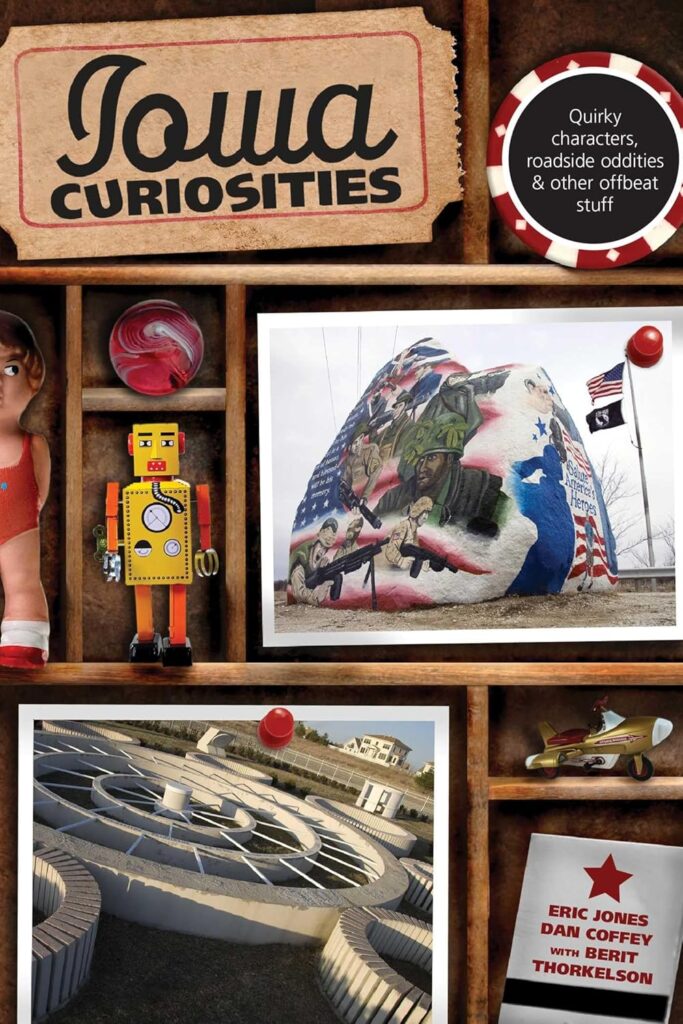
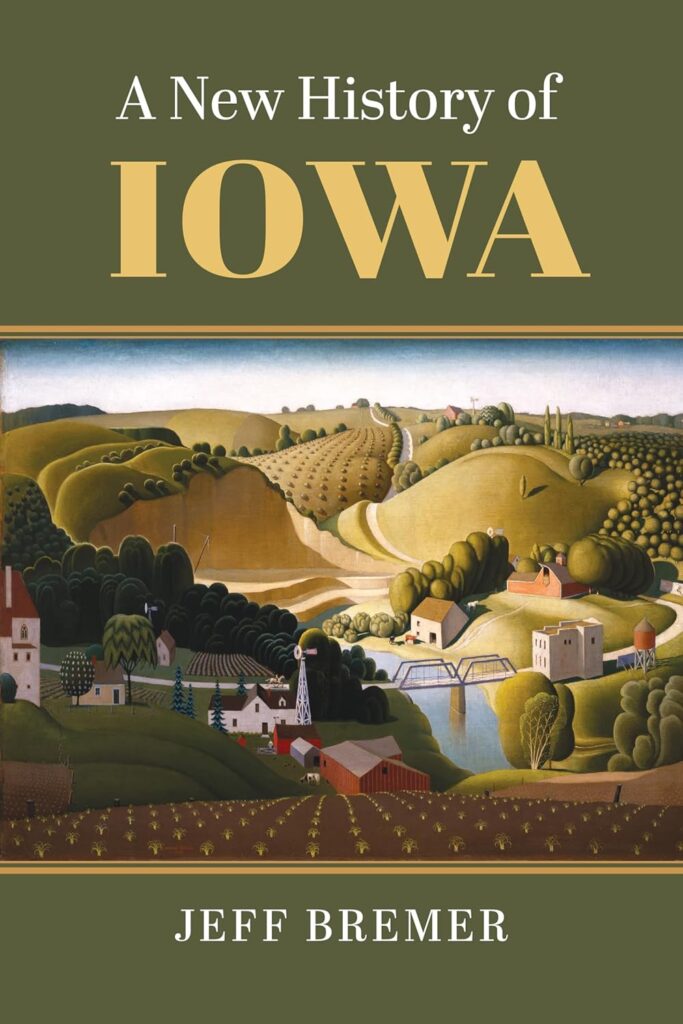
Iowa was born of cooperation. The first settlers erected barns by hand, one community raising another’s before tending to their own. That sense of shared effort grew into cooperatives, credit unions, and a state where education and hard work were twin pillars of progress.
As towns grew into cities, Iowa developed a dual identity:
- The Rural Heart: grounded in family, faith, and land.
- The Urban Mind: rooted in education, innovation, and reform.
Both identities were strong – and when they worked together, Iowa thrived. But after the farm crisis of the 1980s and the industrial hollowing-out of small towns, rural Iowa lost not just jobs, but purpose. Urban centers prospered through universities, hospitals, and new industries. The divide widened – and along the way, opportunists planted seeds of fear.
The Best of Iowa Society
Despite all, the good remains.
In rural Iowa, there’s loyalty that runs deeper than the rivers. Neighbors plow each other’s driveways before their own. Faith communities sustain people through droughts and disasters. There is dignity in simplicity and a moral sense that “your word still matters.”
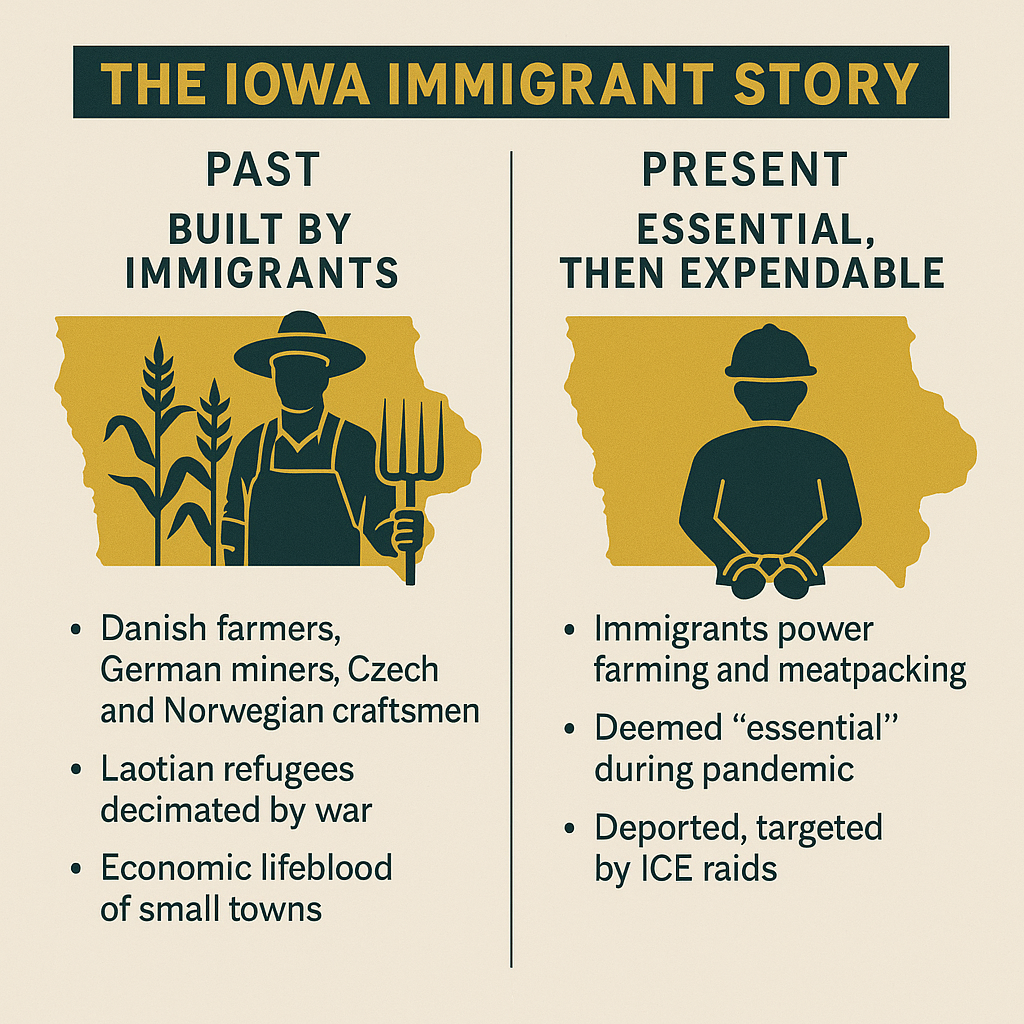
In urban Iowa, diversity is growing – and with it new voices, new art, and new hope. Universities light the path for scientific and social progress. Students, immigrants, and families build a mosaic of belonging.
When these two worlds meet – at county fairs, in classrooms, in small-town coffee shops and city markets – we glimpse the Iowa that could be: practical, principled, and plural.
The Shadows We Inherited
Yet, where light shines, so does shadow.
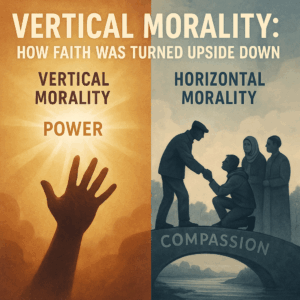
Rural Iowa’s deep roots in faith and tradition have been exploited by movements that weaponize religion into power. Urban Iowa’s pride in progress has too often curdled into condescension.
In small towns, information deserts left space for disinformation to bloom – and a sense of betrayal to take hold. In cities, the failure to listen bred its own arrogance. Together, these dynamics gave rise to a politics of grievance, where fear travels faster than facts.
“Iowa Nice,” once a virtue of civility, has become a shield for silence. When fairness yields to comfort, and morality to obedience, even good people can be led astray.
The Quiet Capture
Behind the cultural divide lies a deeper story – of influence and ideology.
Christian nationalism and Project 2025 have taken root in Iowa’s halls of power, sold to many as a defense of faith and freedom. But their true purpose is control: of thought, education, and democracy itself.
Rural congregations and local media have been targeted with a message that cloaks power in piety. Urban institutions – universities, agencies, even the press – have been cowed into silence. Iowa didn’t surrender because it lacked courage; it surrendered because the attacks came cloaked in moral certainty.
The Crossroads: Fear or Fellowship
And yet, every generation gets its turning point.
Ours begins here – in the space between town and field.
Pluralism – the idea that no one group owns the truth – was Iowa’s original promise. It was written in our Constitution, spoken in our classrooms, and lived in our town halls. Pluralism doesn’t mean surrendering conviction; it means respecting others enough to live beside them in peace.
We cannot rebuild Iowa by shouting across the fence. But we can start by crossing it.
Renewal: From Silos to Circles
The farm silo is both a symbol and a warning. It keeps grain safe but keeps people apart.
To move forward, Iowa must turn its silos into circles. Circles of dialogue, of shared learning, of economic cooperation. Circles where rural pastors meet university professors, where farmers and immigrants share meals, where journalists and citizens rebuild the trust between truth and neighbor.
The path is not through anger – it is through understanding.
It’s not about “winning back” Iowa – it’s about becoming whole again.
Closing Reflection: The Field Between Us
“The fence line between field and city was never meant to divide us.
It was meant to remind us that every good harvest – of crops, of ideas, of justice – depends on both hands working the same soil.”
The question for Iowa now is not whether we can heal.
It’s whether we choose to.