
Austin Harris, A First-Term Lawmaker Building a Culture-War Portfolio
Legislative Profile
Iowa Rep. Austin Harris is a first-year legislator who has quickly emerged as one of the Iowa House’s most active sponsors of legislation tied to the national Republican culture-war agenda. Though he is new to elected office, Harris has already taken a central role in shaping bills that target public education, public assistance programs, and political speech, often using the language of “integrity,” “accountability,” and “public safety” to justify proposals that critics say expand government control over everyday life.
Harris’s background reflects a path that has become increasingly common in Iowa politics: a young political operative moving into office through party networks rather than through long public-service experience in fields like education, healthcare, agriculture, or local government.
His prior work for U.S. Rep. Mariannette Miller-Meeks helped place him inside the Republican political ecosystem, and his legislative output suggests he is not attempting to be a quiet freshman. He is positioning himself as an aggressive enforcer of a political worldview that prioritizes ideological conformity, punishment-based governance, and culture-war messaging over practical problem-solving.
A legislative pattern: “Government is the problem,” except when it’s enforcing ideology
Harris’s bill sponsorship shows a clear theme. He frequently frames government programs as vulnerable to “waste, fraud, and abuse,” while simultaneously supporting expanded state authority in schools, social policy, and public behavior. This contradiction, hostility to government spending paired with enthusiasm for government enforcement, is not unique to Harris, but he appears to be making it a signature.
This pattern is especially visible in proposals affecting public assistance and education. Harris has supported “program integrity” measures that sound responsible in the abstract, but in practice often function as barriers that disproportionately affect low-income families, immigrants, and people in crisis. The WIC proposal debated in February is a prime example: a program designed to prevent malnutrition among pregnant women, infants, and small children was pulled into an ideological immigration fight, with the predictable result that the most vulnerable people would bear the consequences.
Education bills: more oversight, more punishment, more politics
Many of Harris’s bills align with the Iowa GOP’s multi-year campaign to weaken public schools while elevating alternatives such as private schools, charter schools, and Education Savings Accounts. His proposals include measures that increase reporting requirements, impose new restrictions on instruction, and add civil penalties.
These bills are frequently marketed as “transparency” or “parental rights,” but they also create new enforcement mechanisms that can intimidate teachers and administrators as they increase bureaucracy in a system already strained by staffing shortages and funding disputes.
Harris has also signed onto legislation that places political litmus tests into higher education policy, including bills targeting student organizations accused of supporting terrorism and restricting access to financial aid based on political speech or association. Whether one agrees or disagrees with the politics of those organizations, the trend is clear: the state is being invited into the role of deciding which viewpoints are acceptable, and which are punishable.
Law-and-order branding and symbolic politics
Harris’s legislative record also includes bills centered on law enforcement benefits, bail restrictions, and criminal penalties. These are consistent with a broader Republican identity-politics approach of emphasizing “public safety” as a cultural brand while often ignoring the deeper drivers of safety, like mental health, housing instability, poverty, addiction, and lack of access to healthcare.
In short, Harris’s legislative profile is not built around pragmatic governance. It is built around ideological signaling and enforcement. His bills rarely focus on Iowa’s most urgent challenges: rural hospital stability, OB/GYN shortages, childcare affordability, workforce retention, water quality, housing supply, or property tax fairness for working families.
Instead, his most visible work centers on policing behavior, restricting eligibility, and regulating speech, particularly in schools and public institutions.
Our Take (Iowa411)
Austin Harris represents a growing political model in Iowa: a legislator who does not enter office primarily to solve problems, but to wage an ideological campaign through legislation. His record suggests he is not trying to improve public systems. Instead, he is trying to reshape them into tools for cultural enforcement.
Iowans should pay close attention to lawmakers like Harris, not because they are flamboyant or loud, but because their proposals can quietly restructure daily life, like who gets food assistance, what teachers can safely say, what students can safely organize, and what rights are treated as “privileges” subject to political approval.
This is not small government. It is government power redirected away from public benefit, and toward political control.

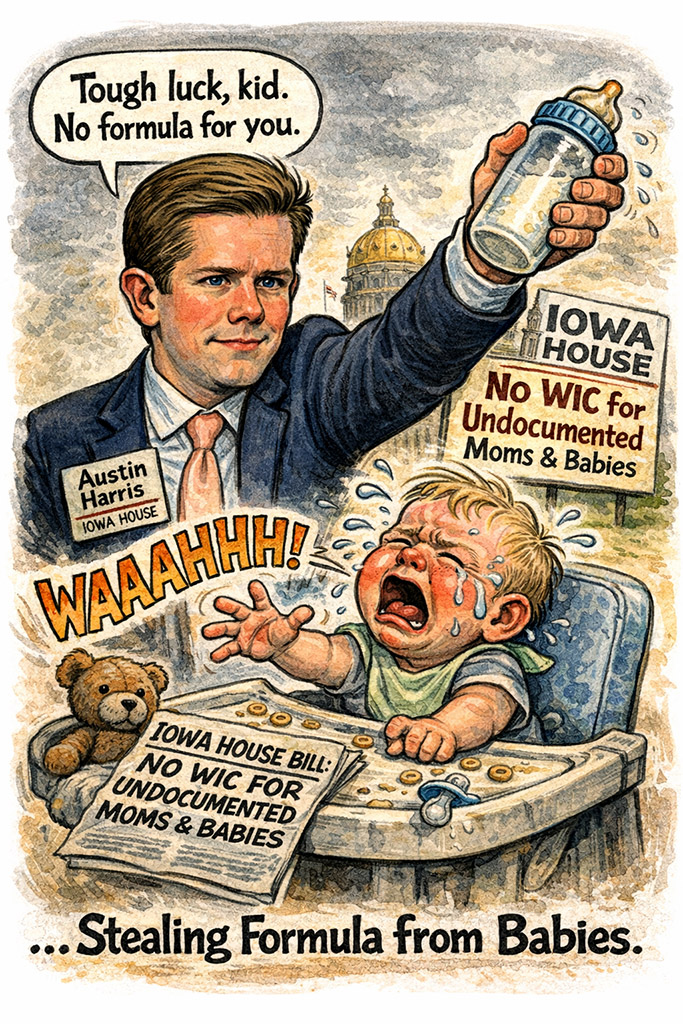
House Votes to Exclude Moms and Babies from Nutrition Assistance
House Votes to Exclude Undocumented Moms and Babies from Nutrition BenefitsIowa EvilAustin Harris: Enforce Immigration Law, Deny Nutritional Needs of Iowa's Most Vulnerable Residents The Iowa House has passed House File 2716, a wide-ranging public assistance bill that...
The Iran War and the Coming Farm Shock
The Iran War and the Coming Farm ShockWhy American Farmers Will Pay the Price The war with Iran is rapidly evolving into a global economic crisis, and American farmers are among the groups most likely to feel the consequences first. At the center of the disruption is...
Hinson Praises DOGE, a Costly Trump-Era Fraud
Ashley Hinson Praises DOGE as a Success. The Record Shows Chaos, False Savings and More Spending, Not Less. U.S. Rep. Ashley Hinson is still publicly praising the Trump administration’s so-called Department of Government Efficiency, or DOGE, calling it “critical” that...
North Dakota Voids Summit CO2 Storage Permits
Summit permit for CO2 storage voided as second judge finds North Dakota law unconstitutionalImage by Sergei Tokmakov | PixabayBy Jacob OrledgeNorth Dakota Monitor A North Dakota judge has revoked Summit Carbon Solutions’ permits for underground carbon dioxide storage,...
Iowa’s First Funnel Reveals the Legislature’s Priorities
Iowa’s First Funnel Reveals the Legislature’s Priorities: Control, Culture War, and Corporate Favor The first legislative funnel did not merely narrow the list of bills still alive in the Iowa Legislature. It clarified the governing philosophy driving the session. Of...
Legislature Kills Effort to Increase Water Pollution Fines
GOP senators vote down Democrats’ effort to increase fines for water pollutionSenate also passes bills related to life jackets, firefighting foam and an official state horse By CAMI KOONSIowa Capital Dispatch The Iowa Senate passed a bill Monday updating laws for the...
Iowa House Chooses Cruelty Over Governance
Iowa House Advances Anti-Trans and Anti-Accountability Bills in One More Culture-War Offensive Iowa Hate The Iowa House on Wednesday passed two deeply controversial bills that opponents say would harm already vulnerable communities while doing nothing to address the...