
The Iran War and the Coming Farm Shock
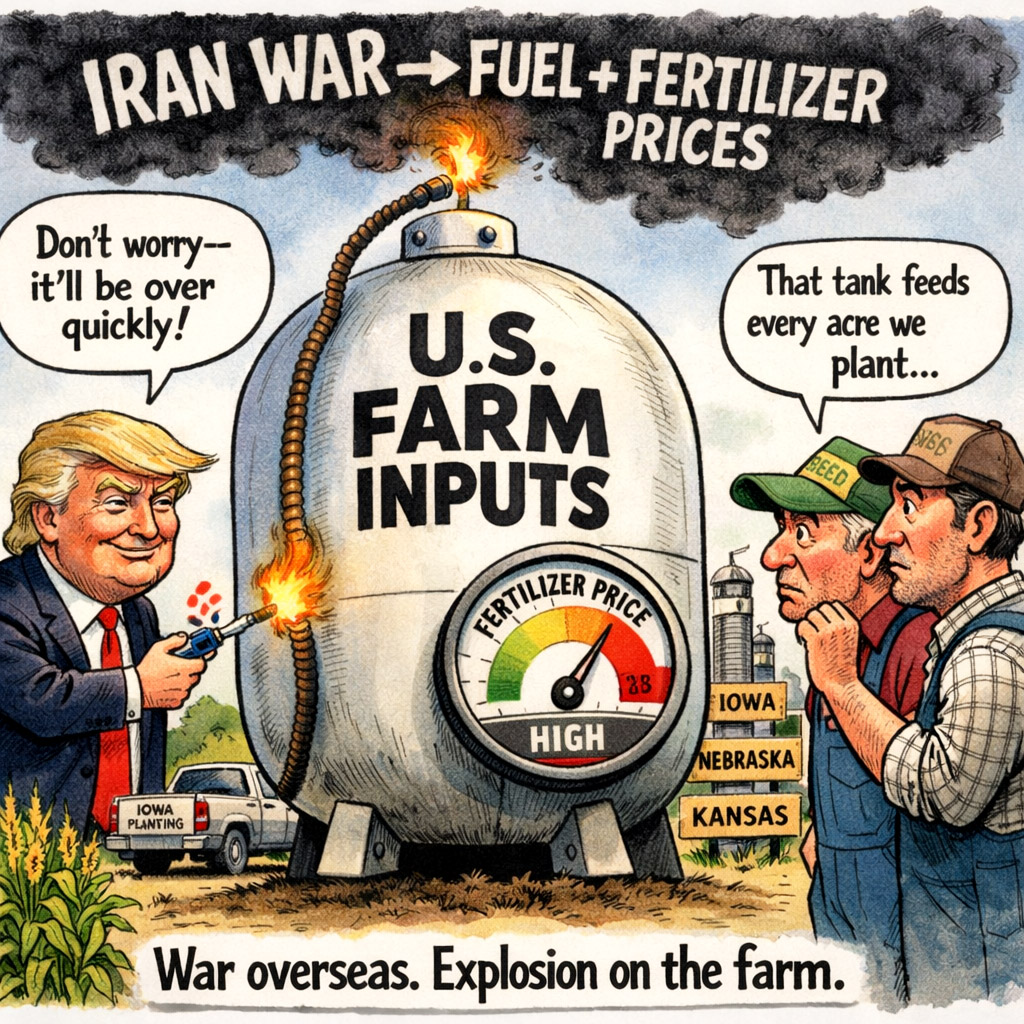
Why American Farmers Will Pay the Price
The war with Iran is rapidly evolving into a global economic crisis, and American farmers are among the groups most likely to feel the consequences first.
At the center of the disruption is the Strait of Hormuz, the narrow shipping corridor between Iran and the Arabian Peninsula that carries a large share of the world’s oil, natural gas, and fertilizer components. Roughly 20% of global oil supplies normally pass through the strait, making it one of the most critical energy chokepoints in the world.
With military conflict now threatening shipping in the region, tanker traffic has sharply declined, and oil prices have surged. Brent crude has jumped toward or above $100 per barrel, while gasoline prices in the United States have climbed quickly, already reaching around $3.58 per gallon nationally.
For farmers, that is only the beginning of the problem.
Fertilizer Prices Are Already Rising
The global fertilizer supply chain is heavily tied to the Persian Gulf. Nitrogen fertilizers, including urea and ammonia, depend on natural gas and chemical feedstocks exported from Gulf countries. A large portion of these materials move through the Strait of Hormuz.
In fact, nearly half of global urea exports transit the region, about one-third of the world’s nitrogen fertilizer trade passes through the strait, and around half of the world’s sulfur, used in phosphate fertilizers, also travels that route.
With shipping disrupted, fertilizer prices have already begun climbing sharply. Analysts warn that this could lead to higher farm input costs just as U.S. producers enter planting season. Egyptian urea prices, for example, have already jumped more than 25% in recent days, reflecting tightening global supplies.
Even if the United States imports relatively little fertilizer directly from the Middle East, global commodity markets ensure that disruptions anywhere affect prices everywhere.
Energy Costs Hit Farmers Twice
Energy shocks ripple through agriculture in two ways. First, farmers depend directly on fuel for tractors, harvesters, irrigation systems, and grain drying. Rising diesel prices can quickly erode already thin margins.
Second, energy prices determine the cost of fertilizer production. Nitrogen fertilizer manufacturing relies heavily on natural gas, which can represent up to 80% of production costs. When oil and gas prices spike, fertilizer prices almost always follow.
A Potential Second Wave of Food Inflation
Economists warn that fertilizer disruptions could produce a second wave of inflation, this time through food prices. Farmers facing higher input costs often respond in two ways, by reducing fertilizer use, which lowers yields, and passing costs forward, which raises food prices.
Either outcome will push grocery prices higher. Experts already warn that the conflict could trigger a broader food price shock like the agricultural disruption that followed Russia’s invasion of Ukraine in 2022.
Iowa and the Midwest Are Especially Exposed
The Midwest is particularly vulnerable because corn and soybean production rely heavily on nitrogen fertilizers. Iowa farmers already face a challenging economic environment with low commodity prices, rising machinery costs, high land values, and tight margins.
A sudden surge in fuel and fertilizer prices could push many operations into difficult territory, particularly smaller family farms.
The Political Dimension
There is also a political reality to this crisis. The same federal policies that launched the conflict may now create economic consequences that ripple through rural America. Higher farm input costs could quickly translate into higher food prices and lower farm incomes.
Historically, farmers have been among the most sensitive economic indicators of geopolitical conflict. Energy shocks, fertilizer shortages, and disrupted trade routes tend to hit agriculture early and hard.
The Bottom Line
If the Strait of Hormuz disruption continues, American farmers could face higher diesel prices and fertilizer costs, lower crop margins, and increased food inflation.
In short, the war with Iran may not just be a Middle East conflict. It may also become a farm crisis in the American Midwest.
Miller-Meeks Claims Credit for Unfinanced Iowa Steel Mill
Campaign follows the withdrawal of advertising support from a major Republican super PACDays after a major Republican super PAC withdrew advertising support, the Iowa congresswoman launched a campaign ad celebrating 1,700 jobs from a steel project that has yet to...
Iowa’s Fiscal Picture Improves?
The $1.1 Billion Budget Gap Tells Another StoryA modest increase in projected revenue does little to change Iowa's underlying budget problem, or the economic growth Republicans are counting on to solve it.Iowa's fiscal outlook is improving. At least, that's how Gov....
Energy Prices Push Inflation to 3.7% in September
Gasoline prices surge 34% over the past year as higher living costs continue to squeeze American householdsThe Federal Reserve is considering additional interest rate increases as American households face growing affordability challenges ahead of the midterm...
Lahn’s Running Mate Receives $540,000 Mystery Loan
The money is from an undisclosed LLC that had formed a week earlierA mysterious lender, a newly formed Illinois company, and a substantial private loan raise questions about the finances of Zach Lahn's running mate.Three weeks after Republican gubernatorial candidate...
Elon Musk’s Millions Are Helping Finance Iowa’s U.S. Senate Race
$31 million in Musk's super-PAC contributions have been spent to support the Ashley Hinton campaignTwo political organizations receiving $234 million from the billionaire since July have spent nearly $31 million supporting Ashley Hinson or opposing Josh Turek in...
Glyphosates Not Mentioned at Hinson Water Quality Event
Hinson Promises to Stand Up to Trump, but What About His Support for Monsanto's Roundup?After pledging to challenge Trump on policies harmful to Iowa, Hinson hosts a water-quality and cancer roundtable without addressing his administration's support for glyphosate.On...
Johnson Campaigns for Miller-Meeks Before GOP PAC Pulls Ads
Four Days After Johnson Campaigns for Miller-Meeks, GOP Congressional PAC Cuts FundingThe House speaker appeared with the Iowa Republican on Friday. By Tuesday, a major political organization aligned with his leadership was redirecting planned campaign spending...