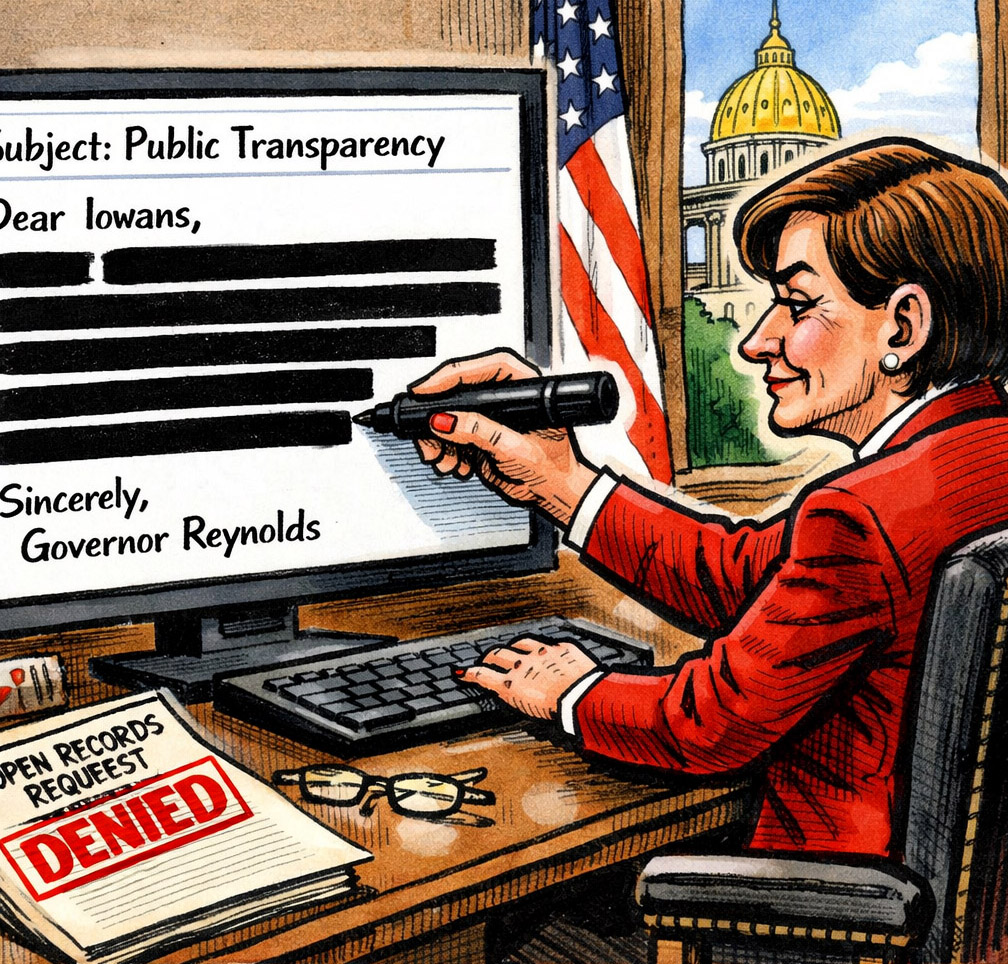
“Write Nothing You Wouldn’t Want Iowans to Read”: A Simple Rule Iowa Government Seems to Be Forgetting
When I was a child, writing thank-you notes to relatives across Iowa, my mother had a simple rule before she read it and sealed the envelope. “Don’t write anything you wouldn’t want your mother to read.”
It wasn’t about control. It was about judgment, accountability, and the understanding that words, once written, have consequences.
It is a lesson that applies far beyond childhood. It is, in fact, a principle that should sit at the very foundation of public service.
From Kitchen Tables to the Statehouse
Today, that same basic expectation to write with the assumption of public visibility is being tested in Iowa government.
Gov. Kim Reynolds is currently fighting the release of four internal emails requested by the Des Moines Register, asserting they are protected under “executive privilege.” A Polk County judge has, for now, allowed those emails to remain hidden while the court considers whether such a privilege exists under Iowa law.
That question alone should give Iowans pause. Because unlike at the federal level, where executive privilege is narrowly defined and frequently challenged, Iowa law does not clearly establish such a protection. The state’s open records framework has long leaned in the opposite direction: toward disclosure, not concealment.
The Question Isn’t Just Legal, It’s Cultural
Yes, the courts will decide whether executive privilege can be claimed here. But the deeper issue is cultural. Why is there such resistance to releasing four emails?
We do not know what is in them. And that is precisely the point.
When elected officials go to court to prevent disclosure rather than simply releasing routine communications, it invites speculation. Would the emails be politically damaging? Embarrassing? Contradictory to public statements? Or simply revealing how decisions are actually made behind the scenes?
Maybe none of those is true. But when transparency is resisted, trust does not hold steady, it erodes.
Transparency Is Not Optional
Public records laws are not a nuisance. They are not a technicality. They are a core mechanism of democratic accountability.
They exist for a simple reason. Government officials work for the public. Their records, in most cases, belong to the public. That includes emails.
Especially emails. Because in modern governance, email is where decisions are shaped, narratives are crafted, and strategies are formed.
To suggest that such communications should be broadly shielded under a doctrine not clearly recognized in Iowa law is to move the state away from transparency and toward selective visibility.
What Happens If This Standard Holds
If the court ultimately sides with the governor and establishes executive privilege in this context, the implications are significant. Future administrations could withhold internal communications more easily, and the burden shifts from government disclosure to public challenge. In short, transparency becomes conditional, not assumed.
And once that shift happens, it rarely reverses itself.
The Simple Standard Still Applies
The lesson from that kitchen table still applies. If you wouldn’t want it to be read by the public, don’t write it. That is not an unrealistic expectation. It is the baseline for public accountability.
No one is suggesting that every conversation must be public in real time. But when the work is done and when decisions are made, there must be a presumption that the public can see how and why.
That is how trust is built. And that is how it is lost.
Final Thought
This case may turn on legal definitions of whether Iowa recognizes executive privilege. But the larger question is simpler. Should transparency in Iowa be the rule, or the exception?
Four emails may not seem like much. But what is decided here will determine whether future Iowans see more, or less, of how their government works. And that is not a small matter.
Iowa Representative Targets Drake University with Baseless Claims
Iowa House Higher Ed chair raises vague “security concerns” over Drake’s routine academic partnerships The chair of the Iowa House Higher Education Committee is demanding records from Drake University about its academic partnerships with several Chinese universities,...
Republicans Acknowledge Pain from the Big Beautiful Bill
Facing Medicaid shortfall, Iowa GOP offers temporary tax patch while costs shift to families Republicans acknowledge pain from the Big Beautiful Bill An Iowa House panel has advanced legislation aimed at addressing a growing Medicaid funding shortfall by temporarily...
Proposed Renewal Energy Options to Mitigate Farming Risks
If Iowa Says It Supports Farmers, Why Make Renewable Energy Harder? A recent guest opinion in the Des Moines Register by Muscatine County landowner John Manjoine makes a straightforward argument, that community solar projects can provide steady income that helps keep...
Budget to Exceed Revenues by Over $1 Billion for Second Year
Iowa Budget to Exceed Revenues by Over $1 Billion for Second Year Iowa is on track to spend more than $1 billion beyond its expected revenues for the second consecutive year, according to the latest estimate from the state’s Revenue Estimating Conference. The panel...
Iowa House Continues Assault on Higher Education
Iowa House advances bills reshaping university curriculum, governance and DEI policies The Iowa House has approved a package of bills that would significantly reshape how the state’s public universities design their core curriculum, conduct presidential searches, and...
GOP’s “Intellectual Freedom” Is Neither Intellectual nor Free
Iowa GOP’s Push for “Intellectual Freedom” Is Neither Intellectual nor FreeAnalysisWhen politicians dictate what universities must teach, the result is not intellectual freedom, it is anti-intellectual political control of ideas. In recent legislative sessions, Iowa...