The Idea of Pluralism
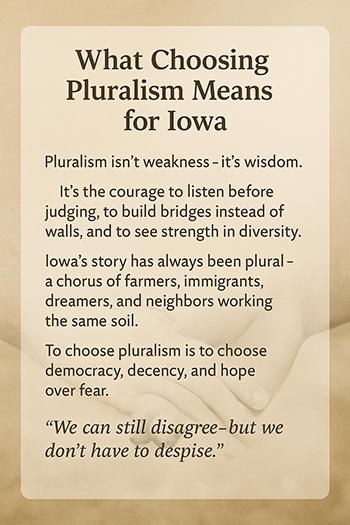
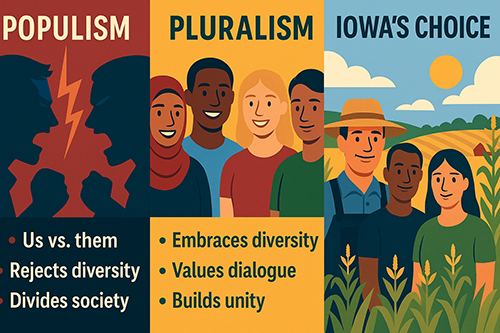
In an Iowa where “us-versus-them” rhetoric has grown louder, the idea of pluralism offers a healthier, stronger path forward. While populism thrives on the claim of a singular “people” and enemy “others”, pluralism celebrates a diverse, inclusive society in which many voices, beliefs and cultures can coexist.
For Iowans who trace their roots to Danish immigrants, Laotian refugees, and the many waves of newcomers who planted farms and built communities across the prairie, the spirit of pluralism is embedded in our history. Yet current political winds, driven by populist appeals, Christian-nationalist undercurrents and the so-called “Golden Triad” of power, seem intent on narrowing who counts as “us” and elevating an ideology where conformity beats complexity.
Here’s how pluralism stands in contrast – and why Iowa needs it now more than ever.
What is Pluralism?
Pluralism posits that in a free society multiple groups, ideologies and lifeways can coexist, compete, and help shape governance and community life.
Rather than subduing disagreement, pluralism invites negotiation, compromise and mutual respect.
It stands as a core principle of liberal democracy: power is distributed, no single group holds a monopoly, and the rights of minorities matter as much as the verdict of the majority.
How Populism Undermines Pluralism
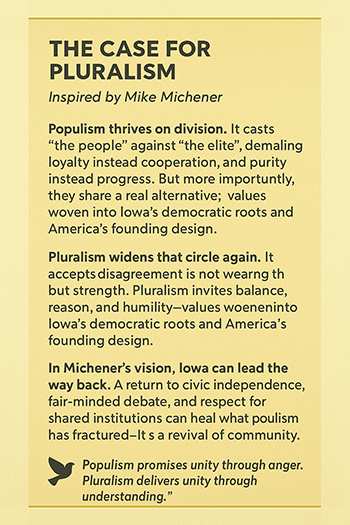
Populism tends to frame politics as “the people” vs “the elite” (or worse, vs “the other”), rejecting pluralistic institutions as corrupt or irrelevant.
It often dismisses the legitimacy of competing voices — seeing dissenters not as fellow citizens but as traitors or enemies. That means reduced space for dialogue, for minority voices, for compromise.
In Iowa’s context, when biotech companies, agribusiness interests, faith-based coalitions and rural communities all vie for influence, populist rhetoric (celebrating one “people” at the expense of others) threatens the nuanced balancing act that pluralism requires.
Why Pluralism Matters for Iowa
Agricultural diversity. Iowa’s overreliance on corn and soybeans is an economic risk; pluralism invites a broader portfolio – from immigrants bringing new crops to entrepreneurs building new industries.
Civic strength. Pluralism fosters robust civil society, where farmers, faith-leaders, business owners, refugees and students all have a voice. That strengthens democracy and guards against the concentration of power.
Social cohesion. When communities embrace difference rather than fear it, the deep Iowa tradition of “Iowa Friendly” can be restored — showing that welcoming newcomers doesn’t weaken us but enriches us.
Moral alignment. Instead of vertical morality thinking (“obedience to authority above all”), pluralism invites horizontal morality: caring for neighbors, fostering compassion, building communities rooted in relation.
How Iowa Can Make the Transition
Celebrate plural stories. Feature the histories of immigrant families, small-town farmers, refugee entrepreneurs and Native-American tribes in our public narrative.
Broaden economic policy. Support non-corn/soy diversification (ag-tech, renewable energy, value-added processing). Invest in communities that haven’t benefited from the corn-soy axis.
Protect institutional independence. Universities, local governments, faith groups should resist efforts to convert them into single-ideology vehicles (like the “Compact for Excellence in Higher Education” push).
Promote local dialogue. Host community forums across Iowa towns where different belief systems, cultural backgrounds and life experiences share space, learn from each other, and build networks of mutual trust.
Educate on democratic pluralism. Help citizens recognize that pluralism is not just “everyone does what they want” – it is structured engagement, accountability, and power sharing.
The Risk of Staying Stuck in Populism
If Iowa continues drifting towards populist, anti-pluralist impulses, the risks are real: economic stagnation, social polarization, weakened democratic institutions, and moral decay masquerading as righteousness. Iowa might lose not just its friendly identity but its viability as an inclusive, vibrant state.
But if Iowa embraces pluralism, we can reclaim our roots – the immigrant farms, the solidarity in community, the diversity of belief and enterprise – and rebuild a stronger, more resilient future. For the sake of our children, our farms, our values and our democracy, let’s choose pluralism.