Political Capture
The top-down playbookHow Anti-DEI and -Woke Took Over Iowa
Iowa’s anti-DEI movement didn’t emerge organically from public discontent. It was orchestrated.
Powerful figures in the governor’s office, the Board of Regents, and state agencies have aligned themselves – directly or indirectly – with the Christian nationalist and Project 2025 network, which sees DEI and “wokeness” as existential threats to their version of America.
This network reframed DEI not as a tool of fairness but as an “attack on faith and freedom.”
The rhetoric was imported from national talking points (think Heritage Foundation, Turning Point USA, and Alliance Defending Freedom).
It was then localized – rebranded as “protecting Iowa values” or “keeping politics out of education.”
The result: state boards and university leaders folded preemptively. Not because they were convinced – but because their funding, appointments, and futures depended on it.
Structural Weakness – Bureaucracy Without Backbone
Iowa’s universities, like many public systems, have been stripped of both autonomy and courage.
Once the legislature and the Regents began signaling hostility toward DEI, risk-averse administrators focused on self-preservation. They interpreted vague mandates – like “don’t promote divisive concepts” – in the broadest, most fearful possible way.
Departments were told to “review” programming, then quietly dismantled it. Faculty leaders were muzzled.
Students of color, LGBTQ+ students, and allies were effectively told: Don’t draw attention to yourselves.
The irony is painful – institutions designed to encourage and protect inquiry and inclusion became instruments of suppression, enforcing a chilling effect without even being ordered.
This is how authoritarianism operates when it wears a suit and carries a regent’s letterhead.
Cultural Inoculation – “We’re All the Same Here”
Because Iowa is racially homogeneous (over 90% white in most counties), DEI was always a fragile concept politically. Many Iowans sincerely see themselves as fair and kind – but their moral imagination is bounded by sameness.
When told that DEI implies “special treatment,” they reject it not from malice, but from a belief that “we already treat everyone equally.”
Christian nationalism and populism exploited this blind spot, equating “DEI” with “indoctrination” or “reverse racism.”
This wasn’t a hard sell in communities unused to diversity or systemic critique. So, anti-DEI became a moral comfort blanket – a way to affirm goodness without self-examination.
Moral Confusion – When Compassion Is Cast as Sin
Finally, there’s the moral inversion.
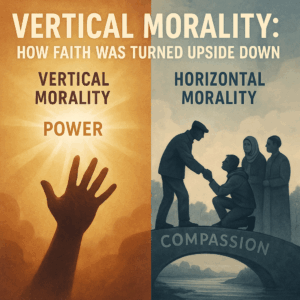
The rise of vertical morality – as we’ve discussed – replaced empathy with obedience. Under this system, kindness to outsiders becomes suspect if it contradicts the “will of God” or “law and order.” DEI, with its focus on empathy, shared humanity, and social repair, clashes with the authoritarian theology that sees hierarchy as divine order.
In that sense, opposing DEI is not only political – it is seen as a form of piety.
When a regent or lawmaker believes they are defending “God’s design for society,” reasoned arguments about fairness or economic opportunity simply bounce off.