
Brenna Bird’s Biofuel Balancing Act
By Iowa411 Editorial Board
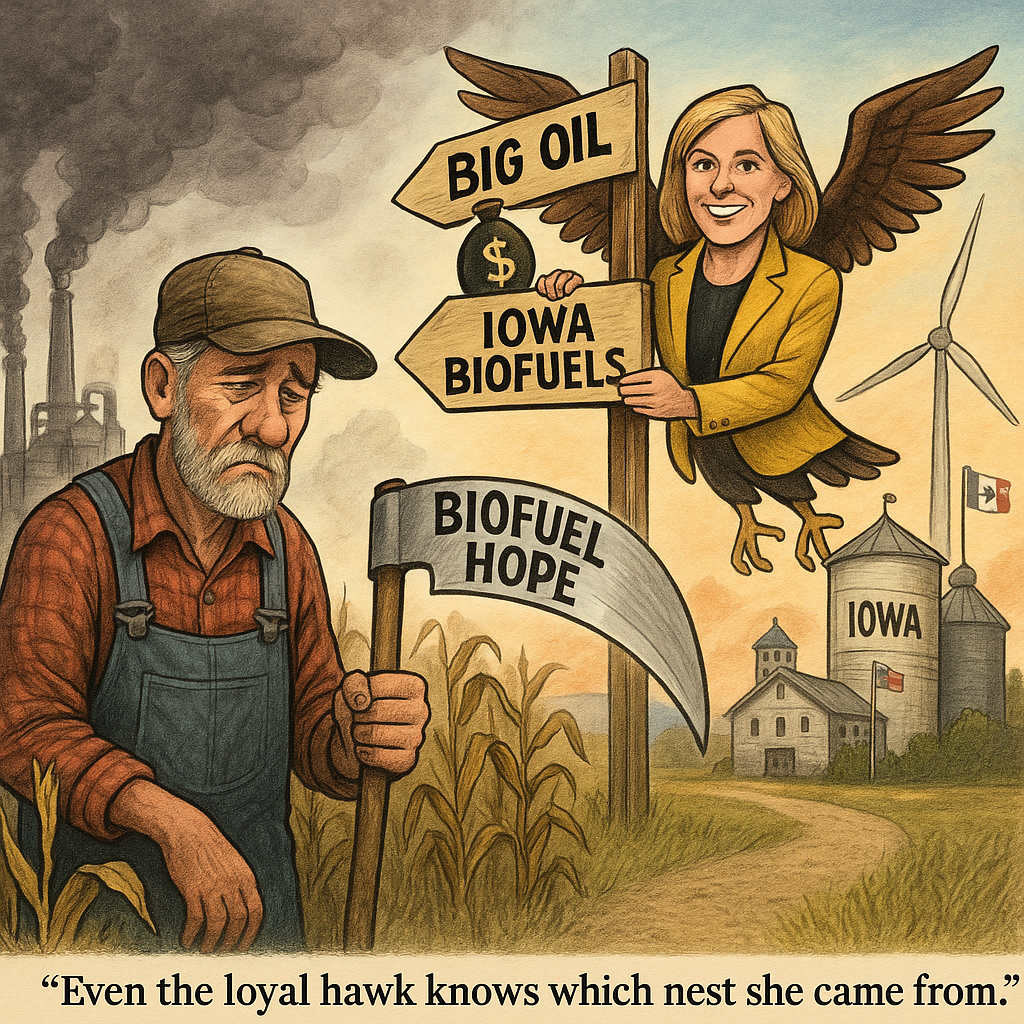
It’s not often that Iowa Attorney General Brenna Bird finds herself in a standoff with the fossil fuel establishment.
As one of the most loyal foot soldiers in the Trump political camp, Bird has built a public image on fighting federal oversight, defending traditional energy, and invoking the familiar anthem of “freedom from regulation.”
But last week, Bird turned a few heads – and perhaps singed a few bridges – when she joined the attorneys general of Nebraska and South Dakota in calling for a federal investigation into oil refiners suspected of exploiting the Renewable Fuel Standard (RFS).
In a sharply worded letter to the Justice Department, EPA, Department of Energy, and SEC, Bird accused some refineries of “gaming the system” by claiming economic hardship to qualify for small refinery exemptions – even as they reported strong profits and stock buybacks to investors.
For Iowa’s farmers, this was music to the ears. For Big Oil, it may have been an unwelcome change in tune.
The Iowa Imperative
The RFS isn’t just an obscure federal program – it’s the backbone of Iowa’s biofuel economy. It ensures that gasoline sold in the U.S. contains a set volume of renewable fuel, namely ethanol and biodiesel, creating steady demand for the state’s corn and soybeans.
When oil companies skirt those requirements under false claims of financial distress, Iowa loses twice: First, its farmers see lower crop demand and falling prices. And second, its biodiesel producers, many of them small or mid-sized operations, lose the market stability they depend on to keep rural communities afloat.
Bird’s stance, then, was as practical as it was political. In choosing to defend the RFS, she effectively chose Iowa over ideology – protecting one of the state’s most vital industries, even if that meant tangling with some of her own allies’ biggest donors.


A Populist Paradox
The move also marks a fascinating contradiction in Bird’s record. This is, after all, the same attorney general who has railed against electric vehicles as a “war on farmers,” sued the Biden administration over environmental regulations, and taken hardline positions to support fossil fuels.
Yet in this case, she’s not dismantling oversight – she’s demanding it.
She’s asking federal agencies to do the very thing she’s often criticized them for doing: investigate, regulate, and enforce.
It is a rare role reversal, and it underscores the peculiar balancing act required of Iowa politicians who straddle the worlds of energy politics and agricultural loyalty.
Ethanol and biodiesel are not natural fits within conservative orthodoxy. They rely on federal mandates, subsidies, and environmental carve-outs – all concepts typically shunned by the party’s free-market wing.
But in Iowa, they are sacrosanct. To oppose them is to oppose the state’s economic heartbeat – and few politicians are willing to take that gamble.
A Calculated Course – or a Corn-Fed Conviction?
The question now is whether Bird’s move reflects political instinct or genuine conviction. Is she reading the room – recognizing that support for local biofuels is the closest thing Iowa has to bipartisan consensus – or is she genuinely recalibrating her sense of who the “good guys” are in this fight?
Either way, it’s a savvy maneuver.
With Iowa’s 12,000 biodiesel jobs, $3.5 billion in annual economic activity, and 350 million gallons of production on the line, the issue isn’t abstract. It’s about protecting rural livelihoods, small businesses, and the stability of a sector that has powered the state’s economy for decades.
Still, there’s risk in defying powerful national interests. Big Oil has long bankrolled Republican campaigns, including many aligned with the same political movement Bird represents. Whether she’ll face subtle pushback or silent distancing remains to be seen.
The Iowa Way Forward
If nothing else, Bird’s pivot reminds us that political courage sometimes sprouts in unexpected soil. By siding with farmers and biofuel producers over multinational oil refiners, she’s placed Iowa’s prosperity – and a little old-fashioned fairness – ahead of partisan purity.
In an era when too many public officials see every issue through a red-or-blue filter, Bird’s decision looks refreshingly green – in every sense of the word.
For now, she’s earned a nod of appreciation from the fields that built this state. And perhaps a warning glance from the refineries that forgot where America’s energy truly begins: in the heartland, where corn and conscience still share the same rows.