An Alternative to Public Education
Charter schools are expanding across Iowa faster than at any point in the state’s history. After a 2021 law made it easier for outside organizations – including private foundations – to start publicly funded charter schools, the number of charters has grown from two to 10, with more on the way. Des Moines Prep, which opened this fall, is one of the newest.
Like many charter schools, Des Moines Prep promotes admirable goals: college preparation, strong relationships with local businesses, and individualized learning. For many families, especially those who feel their local school is underperforming or under-resourced, this can feel like hope.
That part is real.
But the growth of charter schools also raises questions that are no longer theoretical in Iowa – they are now practical, financial, and deeply civic.
What Iowa Charter Schools Are (and Are Not)
| Charter Schools | Traditional Public Schools |
|
|
|
|
|
|
|
|
|
|
The key issue is not whether charter schools can work. Many do.
The issue is who makes decisions, who is served – and who loses resources when funds follow the student.
The Funding Question: When One Bucket Feeds Two, Both Run Low
Public schools are funded by state appropriations, local property taxes, and federal support
When a student leaves a public school for a charter school, the funding leaves too. But the public school must still continue with ongoing expenditures to perform basic functions like operate buses, maintain buildings, pay staff, offer special education services, and comply with state mandates.
So public schools lose money faster than they can reduce costs. This is how district budgets get squeezed – even if only a few students leave each school. And that is why superintendents across Iowa are sounding alarms.


The Religious School Question: Iowa’s Line Is Shifting
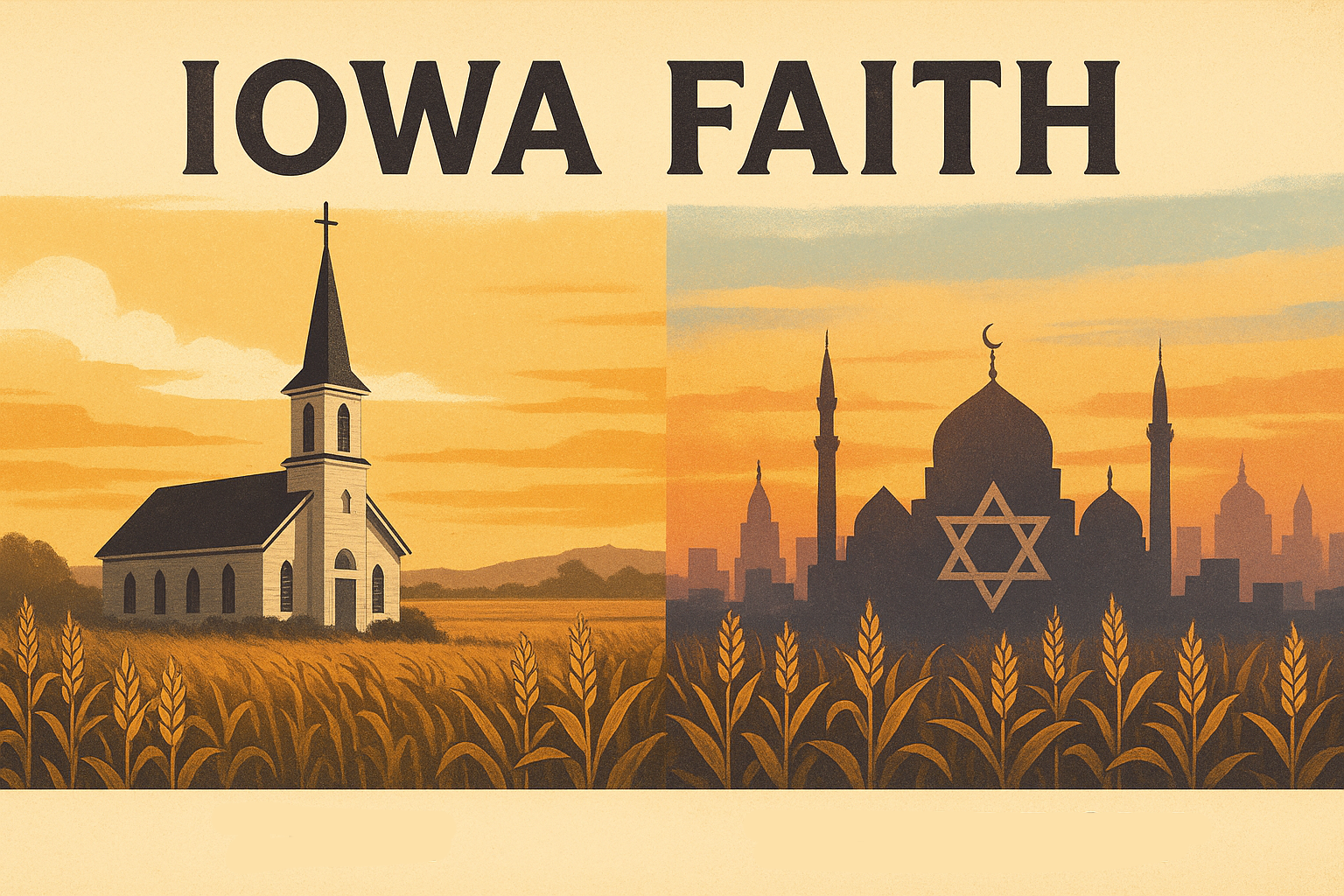
Some charter schools in Iowa are secular – Des Moines Prep appears to be one of them. But others are explicitly religious or operated by religious organizations.
When public money is used to fund religious education, we are no longer funding public education – we are funding sectarian education with taxpayer dollars.
This fact is Constitutionally contested, politically intentional, and a core goal of Christian Nationalist activism.
And in addition to pushing for government funding of religious education, Christian Nationalists also advocate for anti-DEI laws, anti-LGBTQ curriculum restrictions, the push to sign Trump’s Higher Ed Compact, and the erosion of public university autonomy.
So, yes – charter expansion is not a neutral education reform. It is part of the Golden Triad’s attempted re-engineering of Iowa civic culture.
Why Some Parents Choose Charter Schools
The reasons to select a charter school for your children’s education are valid and deserve respect. Charter schools can offer smaller environments, perceived safety or culture alignment, more one-on-one attention, a disconnection with district bureaucracy, and academic specialization.
But these benefits for individual families must be weighed against impacts to community schools, those students who stay behind, and the long-term strength of public education.
The Social Impact: What Happens When Kids Learn in Separate Worlds
If religiously oriented charter schools grow, their students will increasingly learn only among those who already share their beliefs. As a result, exposure to diverse viewpoints and beliefs decreases. Empathy weakens across differences, and civic identity fractures. This is the same problem we discussed with homeschooling – but scaled to entire districts.
When students grow up in parallel educational worlds, Iowa loses shared civic identity, shared community spaces, and a shared understanding of what it means to be an Iowan.
That is how democracy erodes quietly – not through conflict, but through separation.
The Bottom Line
Charter schools are not inherently good or bad. They can offer innovation and needed alternatives and pull apart the shared commons created by public schools.
The question is not: “Should parents have choices?” They already do. The real question is: “Should public money be used to fund private and religious institutions when serious conflicts exist and public schools are already under strain?” And “Who benefits when public schools weaken?”
The answer is not Iowa children.