Summary
Today’s news briefs cover pension regulation disputes, a Menards consumer settlement, teachers’ funding demands, and analysis of the long-term decline of corn ethanol.
Iowa AG Defends State Authority Over Worker Pensions
Iowa Attorney General Brenna Bird has joined nine other states in filing an amicus brief defending states’ authority to regulate the transfer of employee pension obligations to state-regulated insurance companies.
The brief responds to a federal lawsuit brought by retirees challenging a company’s decision to shift pension responsibilities from a traditional pension plan to an insurance-backed annuity structure.
Bird argues that state insurance regulators are better equipped to oversee these transfers and protect retirees, calling additional federal oversight “unnecessary.”
Iowa Insurance Commissioner Doug Ommen supported the position, noting that insurance regulators routinely supervise long-term obligations such as annuities and life insurance.
States joining Iowa include Alabama, Arkansas, Idaho, Indiana, Louisiana, Montana, Nebraska, Oklahoma, and Texas.
Our Take
This dispute highlights a growing tension between state insurance regulation and federal pension oversight. While pension risk transfers have generally been stable, critics worry that shifting oversight could weaken protections over time.
For Iowa retirees, the stakes are long-term financial security – not ideology. Transparency and independent oversight matter more than which level of government holds the pen.
Iowa Settles Menards Lawsuit Over Misleading Rebates and COVID Price Gouging
Iowa will receive $446,832 as part of a $4.25 million multistate settlement with Menard Inc. over claims the retailer misled customers through its “11% OFF” advertising and engaged in price gouging during the COVID-19 pandemic.
The lawsuit alleged that Menards’ widely promoted discounts were rebates requiring customers to complete forms and make future purchases, rather than immediate price reductions at checkout. The settlement also addressed alleged price increases on essential items such as rubbing alcohol and gloves during pandemic-related disruptions.
Under the agreement, Menards must clearly disclose rebate terms, give consumers at least one year to submit claims, update rebate tracking information promptly, and refrain from price gouging during emergencies.
The settlement was co-led by Iowa, Minnesota, Wisconsin, and Illinois, with additional participation from Arizona, Kansas, Michigan, Nebraska, Ohio, and South Dakota.
Our Take
This case underscores how fine print can quietly undermine consumer trust, especially during times of crisis. The settlement doesn’t ban rebates – but it does force transparency. For Iowans navigating rising costs, clarity matters as much as savings.
Iowa Teachers Push Educator Bill of Rights, Seek 5% Funding Increase
The Iowa State Education Association (ISEA) has unveiled an Educator Bill of Rights ahead of the 2026 legislative session, calling for fair pay, manageable workloads, safe learning environments, and protections against burnout.
Union leaders argue that chronic underfunding has contributed to overcrowded classrooms, staffing shortages, and widening achievement gaps. The group is also seeking a 5% increase in supplemental state aid, saying additional funding is necessary to hire counselors, nurses, paraprofessionals, and educators.
Republican lawmakers, including Rep. Gary Mohr, cautioned that funding decisions will depend on available resources and will be addressed early in the session.
The union also called for protections for the Iowa Public Employees’ Retirement System (IPERS), which lawmakers say is not currently targeted for changes.
Our Take
This debate is less about ideology than capacity. Iowa’s schools are being asked to do more, with fewer people and tighter budgets. Whether lawmakers act will signal how seriously the state views education as infrastructure rather than an expense.
What a Slow Fade of Corn Ethanol Could Mean for Iowa
Summary of an analysis by strategist Michael Barnard
The U.S. corn ethanol industry – long a pillar of Iowa’s farm economy – is entering a period of gradual but consequential decline, according to a detailed analysis by climate futurist Michael Barnard.
Ethanol thrived under specific conditions: rising gasoline demand, federal blending mandates, and a vehicle fleet dominated by internal combustion engines. Those conditions are changing.
Gasoline demand has plateaued and begun to fall, driven by efficiency gains, hybrid vehicles, electric vehicles, and post-pandemic travel patterns. Even modest EV adoption reduces gasoline consumption sharply because each EV eliminates an entire household’s fuel demand.
Higher ethanol blends such as E15 offer only limited relief, while export markets face growing competition as countries build their own ethanol capacity or shift toward electrification. Sustainable aviation fuel once looked promising, but recent policy changes have reduced incentives, slowing investment.
Barnard outlines several plausible scenarios over the next 20 years:
- Flat demand under slow EV adoption
- 20–35% decline under moderate electrification
- 40–50% decline if EV adoption accelerates and export markets contract
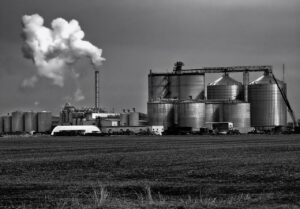
For Iowa, the implications are significant. Ethanol plants anchor many rural communities, supporting local corn prices, trucking, equipment dealers, and tax bases.
A sustained decline would pressure land values, farm income, and small-town economies. Some plants may adapt by diversifying into biochemicals, protein concentrates, or carbon capture, while others may consolidate or close.
Barnard also notes a longer-term possibility: declining ethanol demand could free up marginal cropland for conservation, grasslands, wetlands, or rewilding – particularly where corn production is already economically fragile.
Our Take
If true, this would not be an overnight collapse, but a structural transition. Ethanol gave Iowa stability, not wealth, and that stability matters. Still, ignoring long-term signals risks leaving farmers and rural communities unprepared.
Perhaps the most significant threat on the horizon is a decline in exports due to global electrification that is thriving in major markets like China.
The question isn’t whether change is coming – it’s whether Iowa plans for it or reacts too late.