Summary
Carbon Capture Edition
Iowa’s carbon capture debate intensified this week as courts, legislators, and landowners clashed over pipeline permits, eminent domain, and long-term risks.
A judge paused a key lawsuit against Summit Carbon Solutions while the company seeks to amend its permit, citing new legal barriers in South Dakota.
Meanwhile, GOP leaders proposed expanding pipeline corridors to reduce eminent domain use, a move critics say sidesteps the core issue.
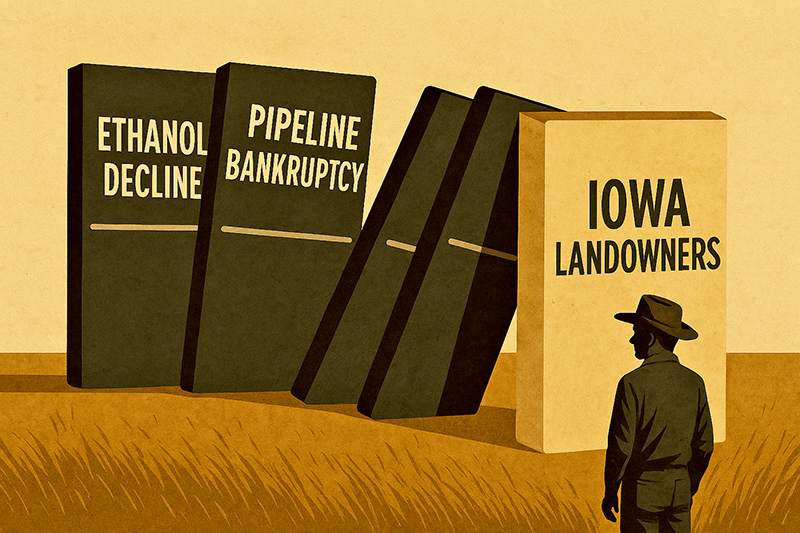
At the heart of the controversy is ethanol, the linchpin of carbon capture economics in the Midwest. If ethanol demand declines, pipeline viability collapses.
And if pipeline companies go bankrupt, Iowa could be left with taxpayer liabilities, abandoned infrastructure, permanent easements, and no safety guarantees.
Across all fronts, the fight over carbon capture is revealing deeper questions about land rights, regulatory oversight, and Iowa’s energy future.
Judge Pauses Lawsuit Against Summit While Permit Changes Proceed
A Polk County judge paused a lawsuit filed by landowners, counties, and the Sierra Club against Summit Carbon Solutions while the Iowa Utilities Commission (IUC) considers Summit’s request to amend its pipeline permit.
The original permit required Summit to secure approval in North and South Dakota before building in Iowa. But South Dakota has since banned eminent domain for CO₂ pipelines, forcing Summit to seek a more flexible permit that allows access to “one or more” sequestration sites without naming a state.
Judge Scott Beattie ruled that the court should not evaluate the original permit while Summit’s amendment is pending, calling the South Dakota law “influential” and the current facts “outdated.”
Opponents argued that Summit still fails to meet the definition of a common carrier and that pausing judicial review based on a hypothetical permit change is unfair. Summit did not comment, but pipeline opponents vowed to continue fighting through all available channels.
Our Take
This ruling delays accountability and gives Summit breathing room to reframe its project. And it also exposes how fragile the company’s legal foundation is.
The fact that a single state law can void a multi-state pipeline permit shows how tenuous the “public use” justification really is. Iowa landowners are right to be wary: the legal chessboard is shifting, but the threat to their land remains.
GOP Senator Proposes Wider Corridor for Pipeline Easements
Senate Majority Leader Mike Klimesh announced plans to introduce legislation in early 2026 that would allow carbon pipeline developers to seek voluntary easements up to 10 miles outside the IUC-approved corridor.
He said the goal is to reduce reliance on eminent domain by giving companies more flexibility to find willing landowners. Klimesh acknowledged past intra-party conflicts over the issue and emphasized “loyalty” as a guiding principle in Senate leadership decisions.
The Sierra Club and landowner advocates immediately criticized the proposal, arguing that corridor expansion does not protect those already targeted and fails to address the core issue: the use of eminent domain by private corporations.
Attorney Brian Jorde called the plan “window dressing” unless eminent domain powers are removed entirely. Critics also raised concerns about political retaliation within the Senate over pipeline votes.
Our Take
Klimesh’s proposal reframes the debate without resolving it. Widening the corridor may reduce eminent domain use in theory, but it still leaves the hammer hanging over landowners’ heads.
Until Iowa lawmakers confront the fundamental question of “should private pipeline companies have eminent domain powers at all?” these legislative tweaks will feel like sidesteps, not solutions.
Carbon Capture Explained, and Why Ethanol Is the Linchpin
Carbon capture, utilization, and storage (CCUS) involves collecting CO₂ from industrial sources, compressing it, and injecting it underground for long-term storage.
Ethanol plants are the most viable source for CCUS in the Midwest because their CO₂ is extremely pure and cheap to capture. That purity makes ethanol central to pipeline economics and to the federal 45Q tax credit system that funds most carbon capture projects.
But ethanol’s future is uncertain. As electric vehicles grow and fuel standards evolve, demand may decline. And with it, the viability of CO₂ pipelines.
Other industries produce CO₂, but it’s far more expensive to capture. Direct air capture is possible but not yet cost-effective. Without ethanol, pipeline developers lose their primary CO₂ source and their financial justification.
Our Take
Carbon capture in Iowa is not a climate strategy – it is a subsidy strategy. The entire pipeline model depends on ethanol being profitable and politically protected.
If ethanol falters, the pipelines become stranded assets. That’s why landowners are right to question the long-term logic behind these projects. The climate case is thin; the financial case is brittle.
Why Carbon Capture Pipelines Use Eminent Domain, and How Iowans Are Fighting Back
Carbon capture pipelines have become one of Iowa’s most polarizing political battles, not because of the technology itself but because private companies are seeking to use eminent domain to secure land from unwilling owners.
Pipeline developers argue they need long, uninterrupted routes to transport compressed CO₂ from ethanol plants to underground storage sites. They claim the projects qualify as “public use” because they lower ethanol’s carbon intensity and bring federal 45Q tax credits into the state.
But critics counter that these pipelines are privately owned, subsidy‑driven ventures that do not function as public utilities and rely on the uncertain long‑term viability of ethanol.
The pushback has been unusually broad and bipartisan. Dozens of counties have passed ordinances or resolutions opposing eminent domain, while landowners and advocacy groups have filed lawsuits challenging whether CO₂ pipelines meet the constitutional definition of public use.
Grassroots coalitions that unite conservative farmers, environmentalists, and local officials have organized town halls, coordinated legal strategies, and helped landowners resist survey access.
The political pressure has been intense enough to fracture traditional alliances in the Iowa Legislature, with many rural Republicans breaking ranks to oppose eminent domain for private pipelines.
At its core, the conflict is about more than carbon capture. It is a fight over who controls Iowa’s land, how much risk rural communities (and all Iowa taxpayers) must bear for speculative energy projects, and whether private corporations can override local decision‑making.
For many landowners, the idea that a for‑profit company could seize generational farmland for a project whose economic future is uncertain is unacceptable. And they are making clear that Iowa’s land will not be surrendered quietly.
Our Take
The eminent domain fight exposes a deep tension between Iowa’s agricultural identity and the ambitions of private pipeline developers.
The companies frame their projects as climate solutions, but the landowners see a subsidy‑driven industry attempting to use public‑power tools for private gain.
The bipartisan resistance is telling. When conservative farmers and progressive environmentalists stand shoulder‑to‑shoulder, it signals that something fundamental is at stake.
Until Iowa lawmakers confront the core question of whether private CO₂ pipelines deserve eminent domain authority at all, the conflict will only intensify.
What Happens If Pipeline Companies Go Bankrupt?
Carbon pipeline developers are private, subsidy-driven companies, not public utilities. That means they can go bankrupt, dissolve, or sell assets, leaving behind orphaned infrastructure with no responsible owner.
Most pipeline developers are shell entities designed to shield parent companies from liability. Iowa has not required bonding or insurance to cover abandonment risks, despite warnings from environmental and legal experts.
CO₂ pipelines require constant monitoring and maintenance, and a rupture can create deadly low-oxygen plumes.
Yet Iowa has no clear framework for handling abandoned pipelines or enforcing long-term safety obligations.
If a company fails, easements remain on land titles, potentially for decades. Landowners may be liable for accidents, and cleanup costs could fall to counties or taxpayers.
Our Take
This is the hidden danger in Iowa’s carbon pipeline debate. The long-term liability – legal, financial, and environmental – could fall squarely on landowners and taxpayers if these companies collapse.
Without strong bonding requirements and regulatory oversight, Iowa is gambling with its future. The pipelines may be temporary, but the risks are permanent.