Summary
Today’s Iowa411 brief spans foreign policy, information integrity, trade policy, and Iowa civic debates.
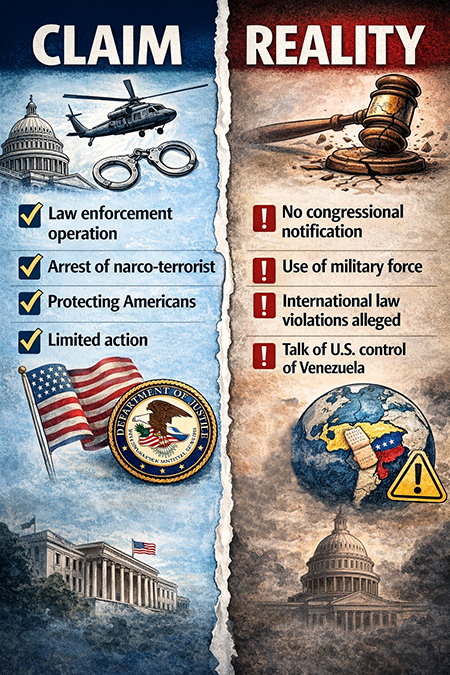
The Venezuela coverage highlights sharp questions about executive power and international legality after the U.S. seizure of Venezuela’s leader, with Iowa Republicans largely praising the operation and Democrats warning about constitutional limits and war escalation.
In parallel, Nigeria-related coverage shows how simplified persecution narratives amplified by advocacy groups and partisan media can shape U.S. military action despite more nuanced conflict realities documented by major analysts.
On the economic front, China’s new beef safeguards add another layer of volatility to global commodity markets, potentially affecting U.S. producers through trade friction and substitution effects.
Across all stories, a common throughline emerges – political messaging versus verifiable reality. Whether it’s selling intervention as “law enforcement,” framing Nigeria’s violence as a single religious storyline, or asserting trade measures are purely technical, the details matter.
And when they are distorted, public consent is manipulated. The “What Iowans Are Saying” section reinforces that Iowans are actively contesting policy choices where health, safety, rights, and economic power intersect.
Venezuela raid and Iowa political reactions
U.S. forces carried out strikes in Venezuela on January 3, 2026, and captured President Nicolás Maduro and his wife. It later transported them to the United States for prosecution on allegations tied to drugs/terrorism-related charges.
President Trump framed the operation as a law-enforcement mission conducted with military support, while also publicly suggesting the U.S. would “run” Venezuela during a transition, a claim that immediately widened the legal and geopolitical controversy.
Iowa’s top Republican officeholders and members of Congress largely praised the operation in public statements, emphasizing narcotics, “narco-terrorism,” and public safety.
Several Democrats (and some protest groups) focused on constitutional process, particularly the absence of congressional notification/authorization and the risk of escalation into another open-ended conflict.
Our Take
Two issues matter most here: legality and credibility of the stated rationale. On legality, experts cited in major reporting raised serious doubts that a criminal indictment (even for drug trafficking) provides a lawful basis for cross-border use of force, and noted the lack of the usual international-law predicates (host-state consent, UN authorization, or a clear self-defense rationale).
The administration’s mixed messaging, such as calling it an “arrest” while simultaneously talking about governing Venezuela and access to its natural resources, undercuts its own legal posture. Regime control is not law enforcement.
On political accountability, Iowa officials who publicly endorsed the action assumed the burden of defending not only the outcome, but the process and downstream consequences. If the operation expands (occupation by another name, prolonged instability, retaliation, or humanitarian fallout), their early cheerleading will be part of the record.
Conversely, if the administration’s goal truly was a narrow apprehension with a rapid handoff to legitimate international mechanisms, it must demonstrate that restraint quickly and transparently. Something that would be complicated by its own public statements.
Nigeria airstrikes and the “persecution narrative” driving U.S. policy
Conservative faith-based organizations that have lobbied the Trump administration around claims of Christian persecution in Nigeria reacted positively to U.S. airstrikes conducted on Christmas Day. Public statements reflected optimism that the strikes represented concrete protection for Christians, while some observers warned of retaliation risks and escalation.
However, credible analytical reporting and conflict-monitoring work describe Nigeria’s violence as multi-causal and geographically complex. It is driven by overlapping insurgency, banditry, kidnapping-for-ransom, communal land/resource conflict, separatist agitation, and governance failures.
Christians are among victims in certain regions, but the “Christian genocide” framing is widely contested as an intentional oversimplification that ignores the large number of Muslim victims and non-religious drivers of violence.
Our Take
The core problem is not whether Christians suffer (many do), but whether U.S. intervention is being justified with a selective, ideologically useful storyline rather than a rigorous diagnosis of Nigeria’s security landscape.
The International Crisis Group analysis is explicit. Narratives that assert a nationwide, faith-targeted slaughter misread the conflict dynamics and risk worsening sectarian divides. Especially if policy is framed as “saving Christians” rather than protecting all civilians.
There is also a policy integrity issue: when advocacy groups “sell” a simplified persecution narrative to build U.S. political pressure, it can become a tail-wagging-the-dog driver of military action. Regardless of whether that action is strategically sound or humanitarian in outcome.
Even when strikes are coordinated with Abuja, an intervention marketed domestically as a religious rescue mission risks fueling retaliation, polarizing communities, and distorting incentives for local governance reforms that Nigeria urgently needs (security capacity, accountability, policing, land/livestock reforms).
China imposes new curbs on beef imports
China is imposing an additional 55% tariff on beef imports above quota levels under “safeguard measures,” with a 2026 quota reportedly set at 2.7 million metric tons and the policy slated to last three years with gradually rising quotas.
Beijing’s stated rationale is protection of its domestic cattle industry following an investigation that concluded imports were harming domestic producers.
The move comes amid tight global beef supply conditions that have been pushing prices higher in many markets. Analysts expect China’s import volumes to decline in 2026 relative to what they would have been absent the safeguards, at least at the margin above quota thresholds.
Our Take
This is classic industrial policy with a predictable trade-off. China is attempting to stabilize domestic producer economics by restricting marginal import growth. But doing so can raise domestic prices, shift sourcing patterns, and invite friction with major exporters.
For Iowa411 readers, the key watch-items are whether this becomes part of a broader “managed trade” posture affecting other proteins/commodities, and whether downstream substitution effects (pork/poultry demand, feed demand, consumer price sensitivity) create second-order impacts relevant to U.S. agriculture.
What Iowans Are Saying: Letters to the Editor (short summaries)
Letters to the editor published in this morning’s Des Moines Register
SNAP “junk food” restrictions. The writer argues the Register’s editorial tone was unnecessarily snarky and contends the state should not subsidize candy/soda with SNAP-like benefits, framing the issue as public health and personal responsibility rather than punishment.
Corporate welfare critique. The writer claims most welfare functions as “corporate welfare,” arguing public spending on junk food primarily benefits corporate shareholders and that the larger problem is systematic transfer of taxpayer money to corporations.
Cannabis policy and federal waiver. The writer argues Iowa should pursue a federal waiver for its medical cannabis program to reconcile state-federal conflict, noting that rescheduling alone does not fix legal inconsistency and describing the current setup as untenable for patients.
Wind setbacks and bald eagles. The writer argues wind restrictions “to protect eagles” are misplaced, claiming agriculture and development cause larger habitat and mortality impacts, and urges counties to avoid using wildlife protection as a pretext for overly restrictive ordinances.
Pesticide-free lawns. The writer urges Iowans to stop cosmetic pesticide use, citing health risks to children and pets and encouraging participation in a pesticide-free pledge initiative.
AI regulation and election integrity. The writer argues regulation of AI/deceptive media is necessary, references federal efforts to challenge state AI rules, and calls for state safeguards and clearer federal-state boundaries to protect elections.
Our Take
Taken together, the letters reveal a consistent civic tension: who decides “the rules of the game,” and who bears the consequences.
Whether it’s nutrition policy, cannabis legality, renewable energy siting, pesticide exposure, or AI governance, the recurring theme is mistrust that current systems allocate risk and cost fairly, and are often perceived as protecting institutions (corporations, governments, powerful industries) more than households and communities.