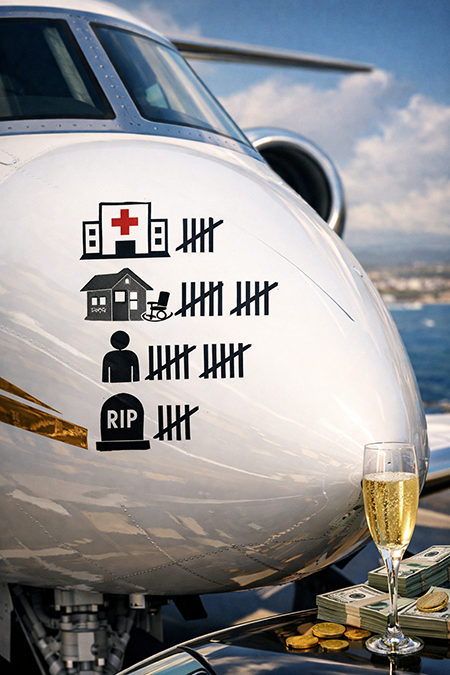
An Accounting of Iowa’s Human and Services Losses
This page exists for one reason: to keep an honest count.
In recent years, sweeping federal and state policy choices have reduced public investment in healthcare, long-term care, and basic social supports while delivering historic tax benefits to the wealthiest Americans. These decisions were framed as fiscal responsibility or economic growth.
The consequences, however, are not abstract.
They are visible in closed hospitals, shuttered nursing homes, lost care, and avoidable suffering across Iowa communities.
This page is a public ledger of those losses.
What This Page Tracks
We will document and update the following impacts as they occur:
Hospital Closures. Rural and community hospitals that reduce services or shut their doors entirely.
Nursing Home Closures. Long-term care facilities that are forced to close or downsize, displacing residents and families.
Loss of Care Access. Estimated numbers of Iowans who lose access to healthcare or long-term care services as a direct result of funding reductions.
Human Cost. Deaths and serious harm that is attributable to delayed, denied, or inaccessible care where credible reporting exists.
Each entry is grounded in public reporting, official notices, or documented community impact. Where estimates are used, they are identified as such.
What the Symbols Mean
The accompanying graphic borrows from an old, uncomfortable tradition: tally marks once painted on military aircraft to count confirmed kills.
Here, the symbols mark something very different. Each icon represents a real loss tied to policy decisions.
Hospital icon – a hospital closed or services eliminated
Nursing home icon – a long-term care facility closed
Human figure – a documented loss of care for individuals or families
Gravestone – a death plausibly linked to loss of access or care.
They appear not on a battlefield vehicle, but on the polished nose of luxury, wealth, and excess. A private jet which the Big Beautiful Act allows a 100% bonus deduction for its owner. And that applies to new or pre-owned aircraft.
That contrast is intentional.
Why This Exists
Budgets are moral documents.
When billions are redirected upward, the costs do not disappear. They are shifted. They land in emergency rooms that never reopen, in families scrambling for care hours away, and in quiet suffering that rarely makes headlines.
This page rejects abstraction. It does not argue ideology. It does not predict outcomes. It counts what is happening and has already happened.
What This Page Is. And Is Not.
This page is a record. A witness. An accountability tool.
This page is not a partisan attack, a projection or forecast, or a substitute for investigative journalism. It exists alongside reporting, not in place of it.
Updates and Transparency
This ledger will be updated as new closures and impacts are confirmed. Sources are cited wherever possible. And corrections are welcomed and will be noted.
Because if we are going to make “big, beautiful” promises about policy, we should also be willing to count the damage when those promises fail.
Why Counting Matters
Losses that go uncounted are easy to deny. Losses that are named are harder to ignore.
This page is not about vengeance; it is about memory. And memory, when kept honestly, is a form of responsibility.
Key 2025 and 2026 Hospital Service Reductions and Closures
-
- MercyOne Siouxland Medical Center (Sioux City): Indefinitely paused its open-heart surgery program, citing recruitment issues and financial pressure.
- UnityPoint Health Finley Hospital (Dubuque): Ended inpatient care for pediatric patients, though emergency care continues.
- MercyOne Clinics: A Southeast Iowa clinic (Ottumwa) is closing, with services ending in February 2026, and a previous closure in eastern Iowa in late 2025.
- Pella Regional Medical Clinic (Ottumwa): Reduced family practice operations starting in January 2026, citing staff recruitment challenges.
- Rural Hospital Risks: As of late 2025, 20 rural hospitals in Iowa are at risk of closing, with five at immediate risk, particularly threatening access to care, with MercyOne Newton Medical Center and Manning Regional Healthcare Center specifically noted.
- Future Reductions: Southeast Iowa Regional Medical Center (Fort Madison) is set to close its inpatient labor and delivery unit by the end of 2026.