Summary
Across these stories runs a consistent thread; centralization of authority paired with decentralization of responsibility. Whether it’s rewriting historical statutes mid-lawsuit, bypassing medical oversight, reframing public health through ideology, or demanding loyalty over expertise, Iowa’s legislative direction increasingly mirrors national trends that prioritize control over credibility.
In contrast, the most constructive proposal of the day, Democratic-led water quality incentives, lacks momentum not because of flaws, but because it challenges entrenched economic power rather than cultural anxieties.
Iowa’s greatest risks right now are not external threats or moral decline, but policymaking untethered from evidence, accountability, and institutional humility.
GOP Gubernatorial Forum Highlights Deep Ideological Uniformity, Strategic Anxiety
Four of the five Republican candidates seeking Iowa’s gubernatorial nomination appeared at a forum in Eldridge, outlining nearly identical conservative policy positions while differentiating themselves primarily by tone, background, and electability arguments. Absent was U.S. Rep. Randy Feenstra, widely perceived as the money-backed frontrunner.
Adam Steen, former head of Iowa’s Department of Administrative Services, openly questioned Feenstra’s viability against Democratic frontrunner Rob Sand, warning Republicans may be forced to “drag him across the finish line.” Steen framed the election as a “battle of good versus evil,” a theme echoed by some attendees and candidates.
All four candidates endorsed constitutional carry, anti-abortion policies, tax reductions, opposition to eminent domain for private companies, and expanded parental control over medical decisions. Differences emerged around style and emphasis. Eddie Andrews stressed bipartisan appeal; Zach Lahn focused on cultural restoration and skepticism of corporate agriculture; Brad Sherman emphasized civil liberties and education on freedom; and Steen leaned heavily on executive experience and moral framing.
Public health discussions revealed a notable blend of legitimate concerns (water quality, cancer rates) alongside scientifically dubious claims, including references to cloud seeding. Vaccine policy discussion centered on parental authority, often framed as resistance to government overreach.
Our Take
The forum revealed less a contest of ideas than a contest of rhetoric. While candidates expressed genuine concern about Iowa’s rising cancer rates and rural decline, solutions ranged from evidence-based (water studies, pediatric cancer funding) to conspiratorial.
The repeated framing of governance as “good versus evil” risks further eroding pragmatic policymaking and replacing it with moral absolutism. Notably absent was any serious engagement with healthcare access, workforce shortages, or data-driven public health policy.
Legislature Moves to Eliminate Iowa City Historical Center Amid Lawsuits and Transparency Concerns
A Senate subcommittee advanced legislation removing the statutory requirement to maintain a State Historical Society research center in Iowa City, effectively consolidating Iowa’s historical archives in Des Moines. The move follows the premature closure of the Iowa City facility, ongoing litigation, and a temporary partnership with the University of Iowa Libraries to maintain limited public access.
Critics, including historians, donors, archivists, and legislators from both parties, warn that Des Moines lacks sufficient climate-controlled space and staffing to absorb the collections. State officials acknowledge that only about 40% of the Iowa City archives would be transferred, with the remaining 60% potentially sold, dispersed, or discarded.
Opponents raised alarms about the lack of transparency, incomplete inventories, and the fragility of the UI partnership, which can be terminated if state law changes. Supporters cite an $800,000 budget shortfall and argue consolidation will improve digital access and reduce taxpayer burden.
Our Take
Budget constraints are real, but the handling of this closure raises serious red flags. Eliminating statutory protections after litigation begins suggests governance by retroactive justification rather than deliberation.
Concentrating historical authority in one location also concentrates control over what is preserved, prioritized, and interpreted.
History isn’t just storage, it’s stewardship. And stewardship requires trust, transparency, and independence. Right now, Iowa has none of the three.
Federal Removal of Enslaved Persons Exhibit Fuels Fears of Narrative Control
A National Park Service exhibit in Philadelphia honoring enslaved people held by George Washington was dismantled following a Trump executive order titled “Restoring Truth and Sanity to American History.” The order mandates removal or revision of interpretive materials deemed inconsistent with “shared national values.”
The site was the only federal location documenting enslaved individuals by name. Its removal sparked lawsuits, protests, and fears that historically marginalized narratives are being systematically erased. Philadelphia’s mayor filed suit, citing a 2006 agreement requiring advance notice of changes.
Activists worry the materials, now removed to an undisclosed location, could be destroyed or permanently suppressed.
Our Take
When governments redefine “truth” through executive order, history becomes politics by other means. The removal of documented, sourced historical material, especially under vague standards like “national values,” is not preservation; it’s curation by ideology.
When viewed alongside Iowa’s archival consolidation, a troubling pattern emerges: fewer centers, fewer voices, and more centralized control over collective memory.
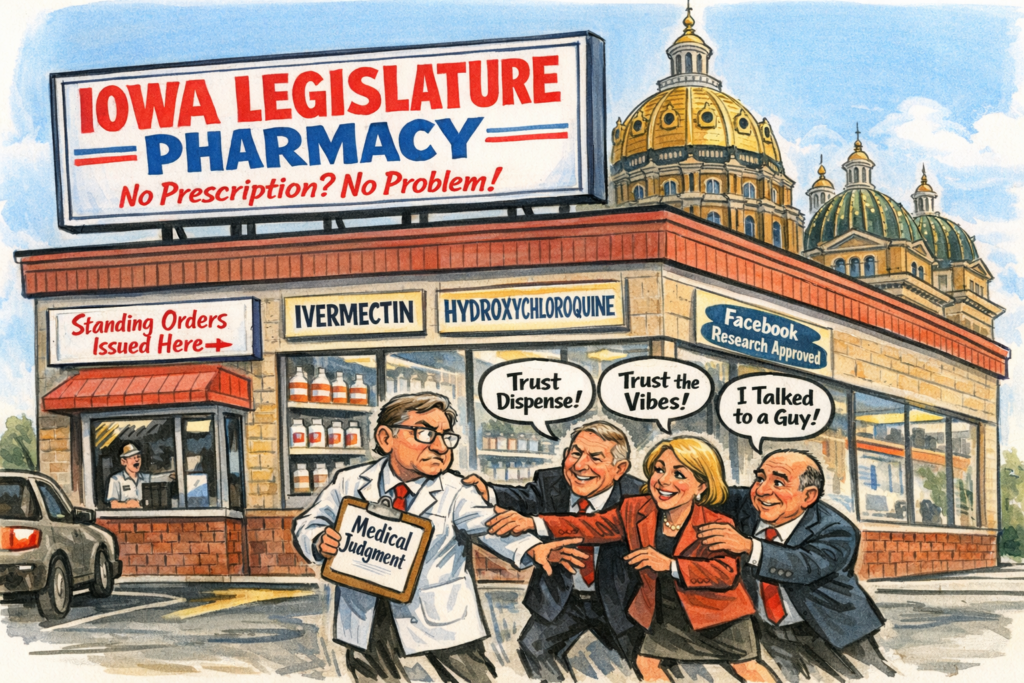
Iowa Advances Ivermectin OTC Bill Despite Medical Opposition
Iowa House Republicans advanced a bill requiring the state’s public health medical director to issue a standing order allowing pharmacists to dispense ivermectin and hydroxychloroquine over the counter to adults. Without prescriptions, medical screening, or recordkeeping.
Medical professionals and pharmacists overwhelmingly opposed the bill, warning it undermines clinical judgment and patient safety. The bill grants pharmacists civil and criminal immunity and prohibits them from refusing to dispense or documenting transactions.
Gov. Kim Reynolds has publicly expressed support, citing anecdotal accounts rather than clinical evidence. The FDA continues to warn against ivermectin’s misuse in humans, citing documented cases of hospitalization and death.
Our Take
This is not “medical freedom.” It is legislative malpractice.
Forcing pharmacists to dispense powerful drugs without oversight strips healthcare professionals of their ethical obligations and replaces evidence-based medicine with political signaling.
That lawmakers would override medical consensus while claiming to defend “ethics” underscores a dangerous inversion: ideology over competence, narrative over safety.
Read our editorial on this topic here.