Legislators’ Cult Sycophancy Ignores Iowans’ Health and Safety
There are policy disagreements, and then there are proposals that attempt to legislate medicine by ideology. Iowa House File 2056 belongs in the second category.
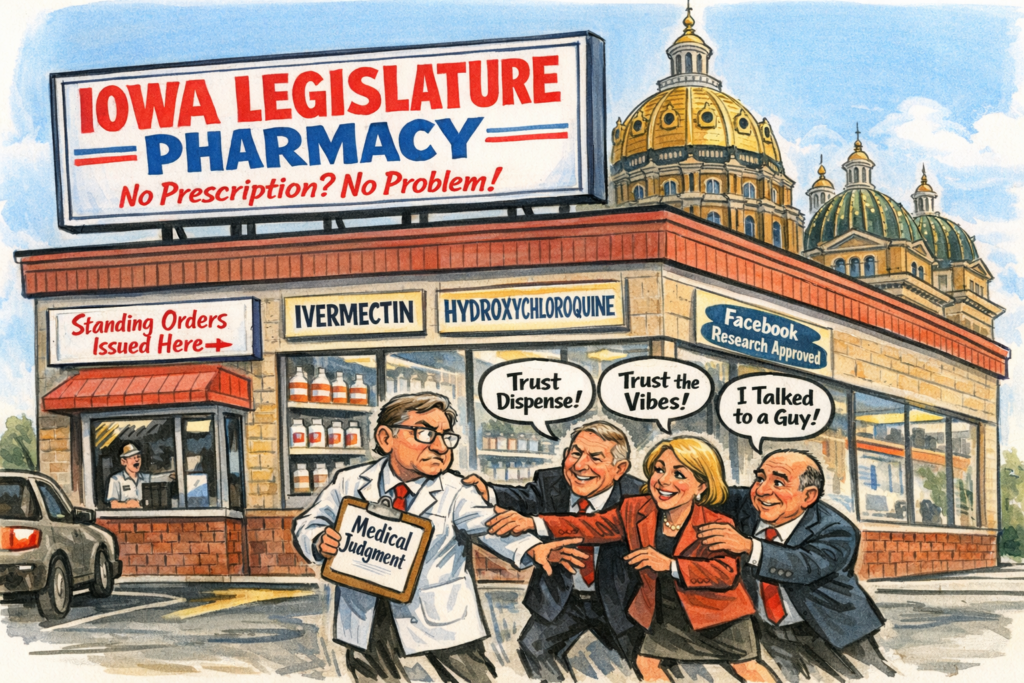
The bill would require Iowa’s state medical director to establish a standing order for dispensing hydroxychloroquine and ivermectin and then compel pharmacists to dispense them to adults upon request, without a prescription, without an appointment, and—most alarming—without allowing the pharmacist to use professional judgment, and apparently without maintaining a record of the encounter.
This is not “medical freedom.” It is state-mandated clinical negligence, backed by political mythology of a cult that the scientific record has already closed.
Science is no longer ambiguous
Hydroxychloroquine: the “curtains close” conclusion
The hydroxychloroquine story is now a case study in how politics can wreck clinical science. Early in the pandemic, hydroxychloroquine was investigated because it had in-vitro signals and a long history of use for malaria and autoimmune disease.
But as better studies accumulated, especially randomized, controlled trials, the clinical benefit for COVID-19 did not appear. The FDA revoked the EUA in June 2020 and cited lack of efficacy and serious safety concerns, including cardiac risks.
Bottom line: hydroxychloroquine is not recommended for COVID-19 treatment or prevention by mainstream medical authorities, and its risks are not theoretical.
Ivermectin: higher dose, longer duration, still no benefit
Ivermectin went through a similar arc. Early lab findings and small trials fueled hype; later, larger and better-designed studies did not show meaningful clinical benefit. The FDA has not authorized or approved ivermectin for preventing or treating COVID-19.
The fact that ivermectin is relatively well tolerated at standard doses does not make it appropriate, because an ineffective therapy can still cause harm by delaying effective care and reinforcing misinformation. That point is explicitly recognized in medical commentary and guideline discussions.
What makes the Iowa bill uniquely dangerous is not just the drugs, it’s the forced workflow
If HF2056 simply said “patients may request consultation about these drugs,” it would still be misguided, but the real threat is that it appears to strip away the safety system that pharmacy practice is built upon.
It compels dispensing (“shall dispense”)
The bill language reported and reflected in the introduced text requires dispensing under a standing order. That is a profound shift. Pharmacists are not retail clerks, they are licensed clinicians whose job includes preventing dangerous drug use.
It undermines clinical screening
Hydroxychloroquine can prolong QT interval and raise risk of serious arrhythmias in susceptible patients, and it has known toxicity profiles that typically require monitoring when used chronically. Ivermectin misuse can produce neurotoxicity and other adverse effects, especially at excessive doses. Which is exactly the kind of “internet protocol” behavior pharmacists normally intercept.
It blocks documentation and continuity of care
The reporting on HF2056 indicates pharmacists could not even maintain a record of the encounter. That is catastrophic from a safety standpoint. You cannot manage interactions, misuse, repeat requests, or coordinated care if you are forbidden to document.
It tries to solve liability with legal immunity
The bill’s approach to risk is not to prevent harm, but to pre-excuse harm by granting immunity. That does not protect patients; it protects the policy authors from consequences while putting pharmacists in moral and professional conflict.
This is bad policy even if you ignore COVID entirely
Even if COVID disappeared tomorrow, this bill would still be a governance failure because it establishes a precedent. Legislators can override clinical judgment, force dispensing, suppress documentation, and immunize the system from liability.
That is the architecture of unsafe care.
If the Legislature wants to expand access to legitimate OTC medications, there is a rigorous pathway for that: evidence, safety labeling, pharmacovigilance, and controlled implementation. HF2056 bypasses those guardrails and substitutes ideology for medical standards.
“But Tylenol has side effects too” is not a serious comparison
Yes, common OTC drugs have risks. But there is a difference between OTC drugs with clear indications, robust consumer labeling, predictable dosing, and decades of pharmacovigilance in self-directed use
and prescription drugs being forced into OTC-like access for a use that evidence does not support, with heightened misuse risk, and with professional screening disabled.
That is not “the same.” It is the opposite of how safe medication systems work.
The likely real-world outcomes if HF2056 becomes law
Should this bill become law, Iowa can count on the following to happen.
More misuse (repeat requests, multi-pharmacy acquisition, high-dose protocols found online).
More adverse events and poison-control type presentations (especially if dosing escalates).
Delayed use of effective therapies when they are indicated.
Further erosion of trust in evidence-based medicine.
A chilling effect on pharmacists, who will be forced into a role that contradicts the profession’s core safety function.
And all of this for what?
A policy designed to validate a pandemic-era narrative that has already collapsed under clinical evidence.
The core problem: the Legislature is attempting to practice medicine without a license
It attempts to convey that Iowans should not need an MD to see the issue.
The facts are that these drugs are not proven for COVID, the bill forces dispensing, and blocks safeguards and documentation. And the bill protects the system from liability instead of protecting patients.
That is not health policy. It is political theater with a pharmacy counter as the stage.