
Summary
Today’s Iowa411 stories reveal a Legislature increasingly focused on asserting authority, shifting costs, and redefining “freedom” in ways that favor centralized power and corporate interests. From mandating symbolic compliance with gubernatorial flag orders to underfunding public schools while claiming fiscal responsibility, the through-line is control without accountability.
Even when policy moves appear consumer-friendly, such as defending farmers’ right to repair or exploring new energy models, the details suggest a familiar Iowa pattern: benefits are narrowly targeted, while risks and costs are broadly socialized. Farmers gain relief, but environmental protections remain vulnerable. Energy innovation is encouraged, but without clear safeguards for ordinary ratepayers.
Taken together, these developments underscore a governing philosophy that prioritizes authority, optics, and short-term political wins over transparent standards, long-term investment, and equitable outcomes. Iowa isn’t lacking ideas, it lacks policies designed first and foremost for the people who live here, not the institutions that seek to manage them.
Bill Would Require Counties to Follow Governor’s Flag-Lowering Orders
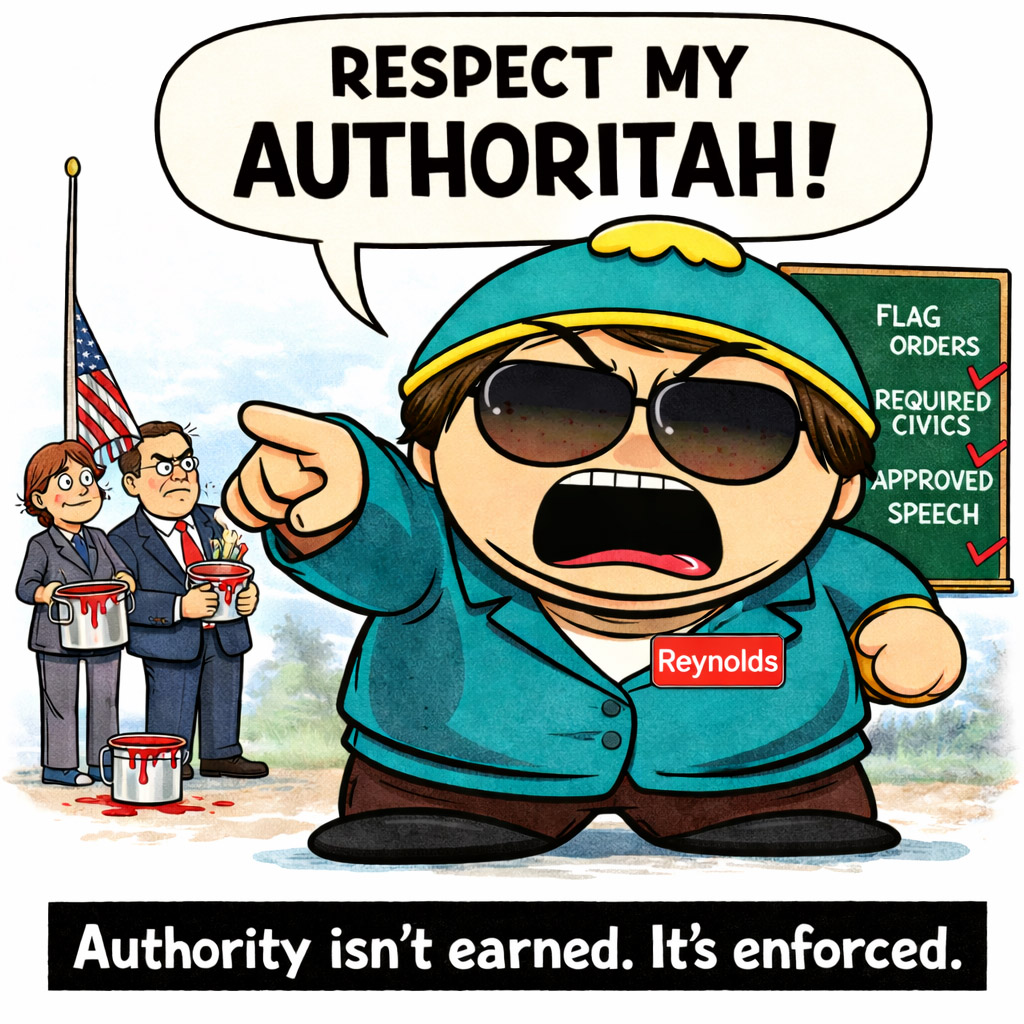
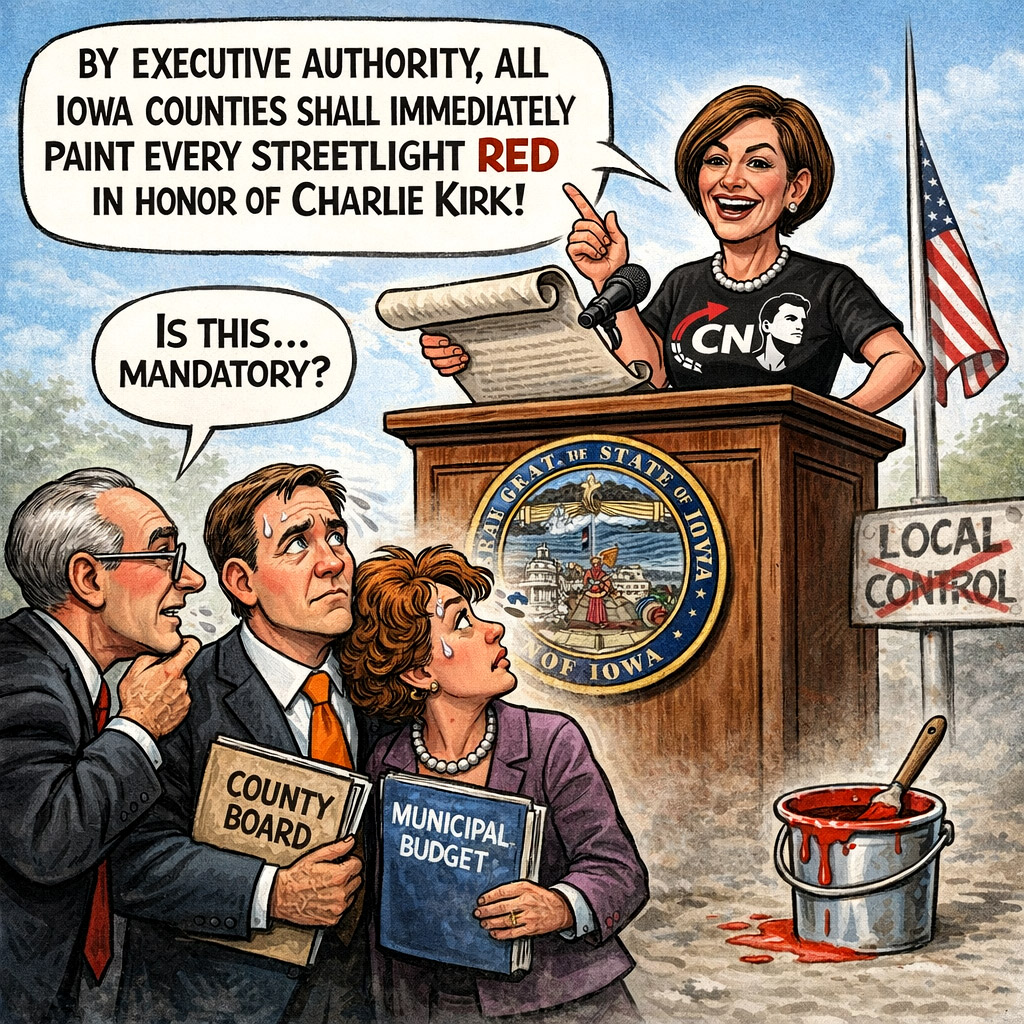
House lawmakers advanced legislation that would require Iowa counties and public buildings to comply with flag-lowering proclamations issued by the governor. The proposal follows Johnson County officials’ refusal to lower flags at the direction of Gov. Kim Reynolds after the death of conservative activist Charlie Kirk.
House Study Bill 634 would authorize the Iowa attorney general to pursue legal action for violations. Supporters argue the bill ensures consistency and respect across the state, noting that past governors have ordered flags lowered for individuals across the political spectrum.
Opponents and skeptics raised concerns about the lack of clear standards governing who qualifies for such honors and warned that the bill could politicize symbolic state actions. Some groups also expressed concern about unintended consequences for schools or local officials who may inadvertently fail to comply.
Our Take
This is an extraordinary amount of legislative effort devoted to enforcing symbolic obedience. Instead of setting neutral, nonpartisan standards for flag honors, the bill centralizes authority and threatens legal action to compel compliance.
That’s not about respect; it is about control. When lawmakers prioritize enforcing loyalty rituals over addressing real problems, it says a lot about where power, not governance, sits in Iowa today.
Senate Panel Advances 1.75% Per-Pupil Funding Increase for K-12 Schools
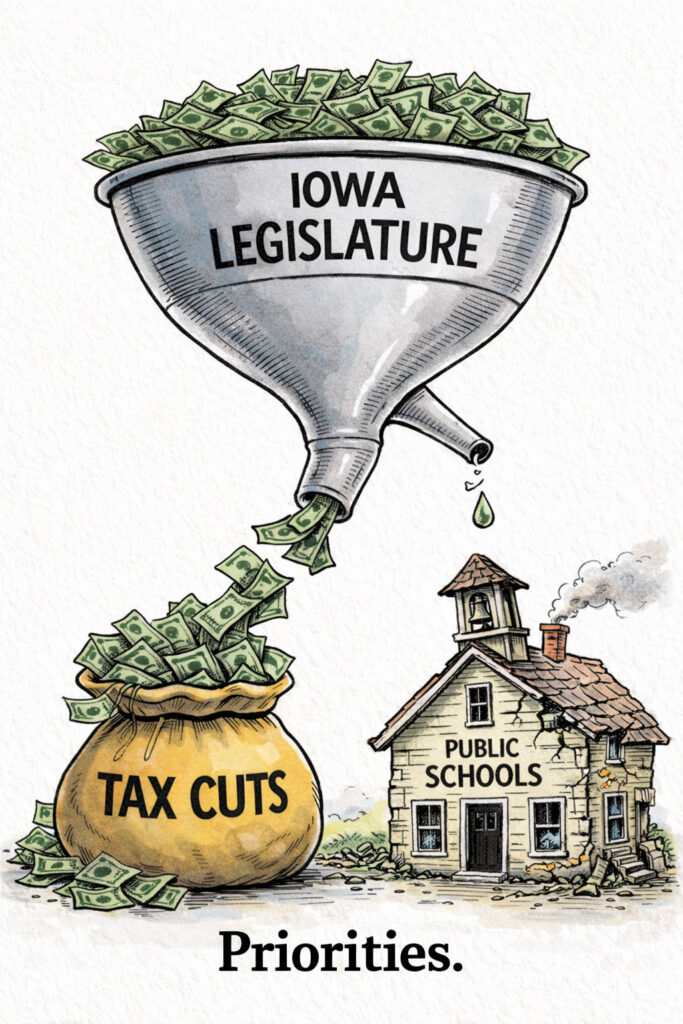
Iowa Senate Republicans advanced legislation proposing a 1.75% per-pupil funding increase for K-12 schools for the 2026–2027 school year. The figure falls below Gov. Reynolds’ 2% proposal and well below education groups’ calls for a 5% increase to keep pace with inflation and rising costs.
Education advocates testified that the proposed increase would result in larger class sizes, program cuts, aging facilities, and increased pressure on local property taxes. Representatives from rural and urban school groups warned that more than 200 districts would be forced onto “budget guarantee,” shifting costs to local taxpayers rather than solving the underlying funding gap.
Republican lawmakers framed the proposal as a starting point, citing state revenue constraints and the need to begin budget planning early, though Democrats argued the plan continues a long-running trend of underfunding public education. Read more of our thoughts on this here.
Our Take
Calling chronic underfunding a “starting point” doesn’t change the math. Iowa schools are being asked to do more with less, again, while inflation quietly erodes classroom capacity.
This is not fiscal discipline; it is cost-shifting. The state saves money by pushing the burden onto local communities, parents, and students, all while claiming concern about taxes and competitiveness.
EPA Clarifies Clean Air Act Does Not Block Farmers’ Right to Repair
The U.S. Environmental Protection Agency issued a clarification stating that the Clean Air Act does not prohibit independent repairs of off-road diesel equipment, including farm machinery. The agency emphasized that manufacturers can no longer cite emissions rules to restrict access to repair tools or software.
The clarification followed a request from John Deere and comes amid ongoing litigation accusing the company of unfairly limiting farmers’ ability to repair their own equipment. EPA officials said the guidance protects farmers’ rights without weakening emissions standards, noting that the law explicitly allows temporary disabling of emissions controls for repairs.
Federal officials framed the move as a cost-saving measure for farmers, while critics warned that it coincides with broader efforts by the administration to roll back environmental authority, including reconsideration of long-standing climate protections.
Our Take
This clarification is a genuine win for farmers, full stop. But it also highlights a familiar pattern of corporations invoking regulation when it suits them and rejecting it when it doesn’t.
Protecting the right to repair doesn’t require dismantling environmental safeguards, and Iowa should be wary of efforts that use farmers as political cover for broader deregulatory agendas that benefit manufacturers more than rural communities.
House Panel Advances Bill Allowing Customer-Based Energy Solutions
House lawmakers advanced legislation that would allow customer-based power plants and energy storage systems, often referred to as virtual power plants, to operate in Iowa. Supporters argue the systems could help manage peak electricity demand more cheaply than building new gas-fired “peaker” plants.
Utilities including MidAmerican Energy and Alliant Energy opposed the bill, warning it could raise costs for non-participating customers by shifting infrastructure expenses onto remaining ratepayers. Clean energy advocates countered that data from other states shows demand-response systems could significantly reduce overall system costs.
Lawmakers from both parties acknowledged concerns, with some calling the proposal innovative but premature, while others said rising utility costs make experimentation necessary.
Our Take
The framing here matters. This bill is being sold as a consumer benefit, but the reality is that very few “customers” can meaningfully participate without substantial capital.
Meanwhile, utilities warn that costs don’t disappear, they get redistributed. Without strong guardrails, this risks becoming another policy that favors large corporate users and data-center-scale customers while everyday Iowans pick up the tab.


Legislature advances mandate requiring ideologically driven civics courses at state universities
A separate Republican-backed proposal, Senate File 2033, would require all Iowa public university students to complete mandatory general education courses in American history and government as a condition of graduation. The bill also mandates that newly created university “civics centers” design the courses, run lecture and debate series, and submit annual reports to lawmakers and the governor.
While supporters frame the bill as strengthening civic literacy, university officials and lawmakers raised significant concerns about cost, staffing, transfer credit compatibility, and legislative overreach. Estimates suggest implementation could cost more than $6.6 million statewide and require dozens of new faculty hires. But no funding mechanism is included in the bill.
The legislation also includes language restricting courses that focus on “subgroups of Americans,” a term left undefined by the bill’s sponsor when questioned. Critics argue this ambiguity could effectively prohibit legitimate academic inquiry into race, gender, labor, immigration, or other core topics in American history.
Our Take
This is not about free inquiry. It is about compelled ideology. Forcing students to take state-designed courses, taught through legislatively favored centers, while restricting how history can be framed is the opposite of intellectual freedom. This is curriculum control dressed up as civic education, imposed without funding, definitions, or respect for academic independence.
Charlie Kirk-related lawsuits expose contradictions in GOP “free speech” claims
In the wake of the 2025 killing of conservative activist Charlie Kirk, Iowa became a focal point in a national debate over public employee speech. At least 10 Iowa public employees, mostly teachers and university staff, were investigated or disciplined over social media posts reacting to Kirk’s death, with several filing lawsuits alleging First Amendment violations.
As courts review these cases, judges are applying long-established Supreme Court precedents governing public employee speech, including Garcetti v. Ceballos, Connick v. Myers, and Pickering v. Board of Education. Central to the analysis is whether employees spoke as private citizens on matters of public concern, and whether their speech caused actual, demonstrable workplace disruption.
Legal experts warn that disciplining employees in response to political backlash risks creating a “heckler’s veto,” where speech is punished not for operational harm but because it angers powerful figures or online mobs.
Several cases remain unresolved, and outcomes have varied depending on how courts interpret disruption and job-relatedness.
Our Take
Here’s the contradiction: the same political actors claiming to “expand” speech rights in schools are pressuring public employers to punish speech they dislike.
When free speech protects conservative viewpoints, it’s sacred. When it protects critics, it’s suddenly “disruptive.” That selective application is precisely what the First Amendment was designed to prevent.