
Summary
Today’s stories share a single theme: Iowa’s governing majority is expanding power while weakening the public systems that protect people. Whether it’s eliminating school vaccination requirements, stripping local civil rights protections, mandating “reforms” in higher education, or reshaping workforce training, the common thread is not practicality, it is control.
The legislature’s approach increasingly resembles an ideological project rather than problem-solving. Public schools are underfunded, universities are squeezed, and local communities are told they cannot protect residents the state has chosen to exclude. Meanwhile, lawmakers market these actions as “freedom,” even when the result is less safety, less stability, and fewer rights for Iowans.
In the background, agriculture’s warning signs continue to flash red: unstable markets, rising costs, and policy chaos are pushing farmers toward deeper debt and greater risk.
Taken together, these developments point to a state drifting away from long-term investment and toward short-term political wins, and with real consequences for Iowa’s health, workforce, and reputation.
Iowa House GOP advances bill ending school vaccination requirements
Iowa House Republicans advanced legislation that would eliminate all vaccination requirements for students attending school. House File 2171 would strike long-standing immunization rules covering diseases like measles, polio, whooping cough, chickenpox, and rubella, while still allowing families to opt in voluntarily. Supporters framed the bill as a “parental authority” measure, arguing education should not be linked to vaccination status.
Public health and medical professionals strongly opposed the proposal, warning it would increase the risk of outbreaks and endanger medically vulnerable children who depend on herd immunity. Iowa’s vaccination rates have already been declining, with fully vaccinated students dropping from 95.6% in 2020–21 to 92.7% in 2025–26, below the approximate 95% threshold typically associated with herd immunity for highly contagious diseases.
Our Take
This is not “freedom.” It is a direct assault on public health using the language of personal choice. Schools are group environments, and that is the entire reason vaccination requirements exist: to prevent outbreaks in the exact setting where outbreaks spread fastest.
The logic of this bill is the same logic driving Iowa’s broader culture-war agenda: “If I don’t want it for my child, then no one should have it.” The result is predictable: more disease, more strain on an already stressed health system, and more risk for children who don’t have the privilege of being healthy.
Iowa House Republicans propose changes for apprenticeship, workforce training
House Republicans unveiled the “Iowa Skilled Workforce Act,” a proposal aimed at addressing workforce shortages by expanding apprenticeship and trade training programs. The plan would increase funding for the 84E Apprenticeship Act from $3 million to $4.5 million and would also provide funding for physical expansion of training facilities at community colleges and in union/nonunion private programs, though total dollar amounts were not specified.
The proposal includes additional changes such as modifying apprentice-to-trainer ratios for plumbing and HVAC programs and allowing workers with 3,000 hours of trade experience to teach in related programs without additional licensing.
GOP leaders, particularly Rep. Taylor Collins, framed the proposal as shifting higher education resources away from “nonpractical degrees” and toward direct workforce preparation.
Our Take
Apprenticeships are valuable. Trade education is essential. But the political subtext here is hard to miss: this isn’t just workforce development; it is an attempt to reshape higher education around ideology.
The problem is that Iowa lawmakers repeatedly propose “reforms” without publishing credible data showing the current system is failing or what the actual measurable gap is.
Iowa needs skilled trades and educated professionals and research universities. When lawmakers talk about cutting programs with “less than 10 students,” what they often mean is programs they don’t like.
Second state-university tuition freeze bill moves through Iowa House subcommittee
A House subcommittee advanced another tuition-freeze proposal targeting Iowa’s public universities. House Study Bill 549 would freeze tuition increases for first-year resident undergraduate students entering during or after 2027. It is separate from another proposal already moving through the legislature that would freeze tuition for all undergraduate students.
The Iowa Board of Regents remains registered as undecided but raised concerns about sustainability, noting other states and institutions that adopted tuition freezes later ended them due to declining state support. Regents staff suggested one possible way to sustain the freeze would be an upfront fee of around $1,800, though Rep. Taylor Collins expressed disinterest in that approach.
Our Take
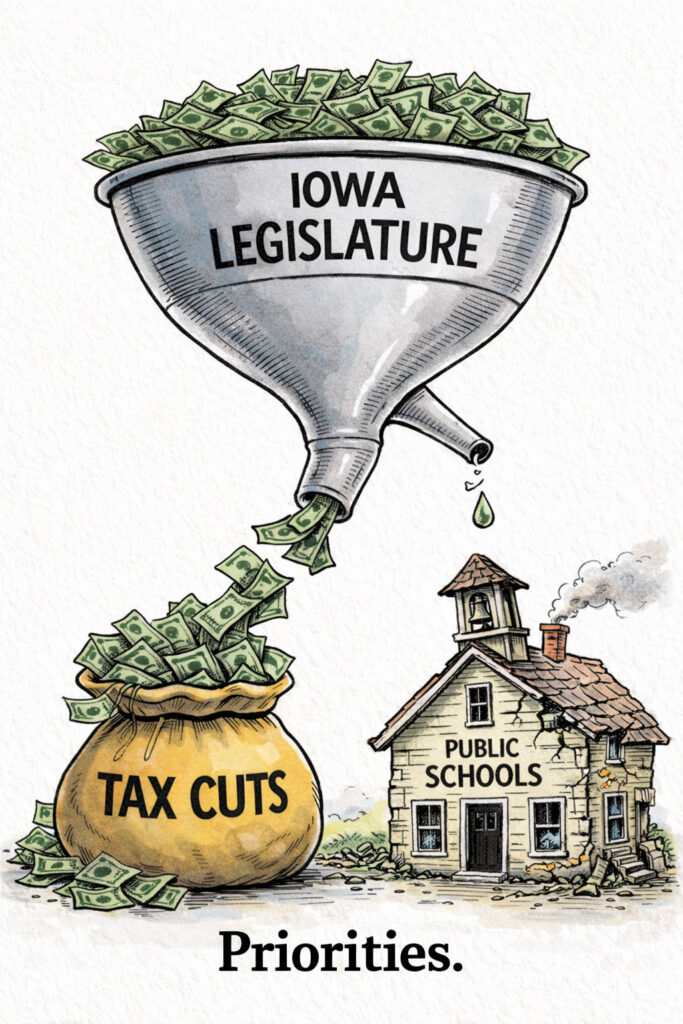
Freezing tuition without increasing state investment is not affordability policy, it’s a slow squeeze. This looks like part of a broader strategy to underfund public schools and starve universities, then claim the institutions are “broken” and need to be reshaped.
Iowa’s legislature wants the political credit for “lower tuition,” but it also wants the power to force universities to cut programs and comply with ideological mandates. That’s not affordability. That’s leverage.
Iowa bill would bar local governments from enacting trans civil rights
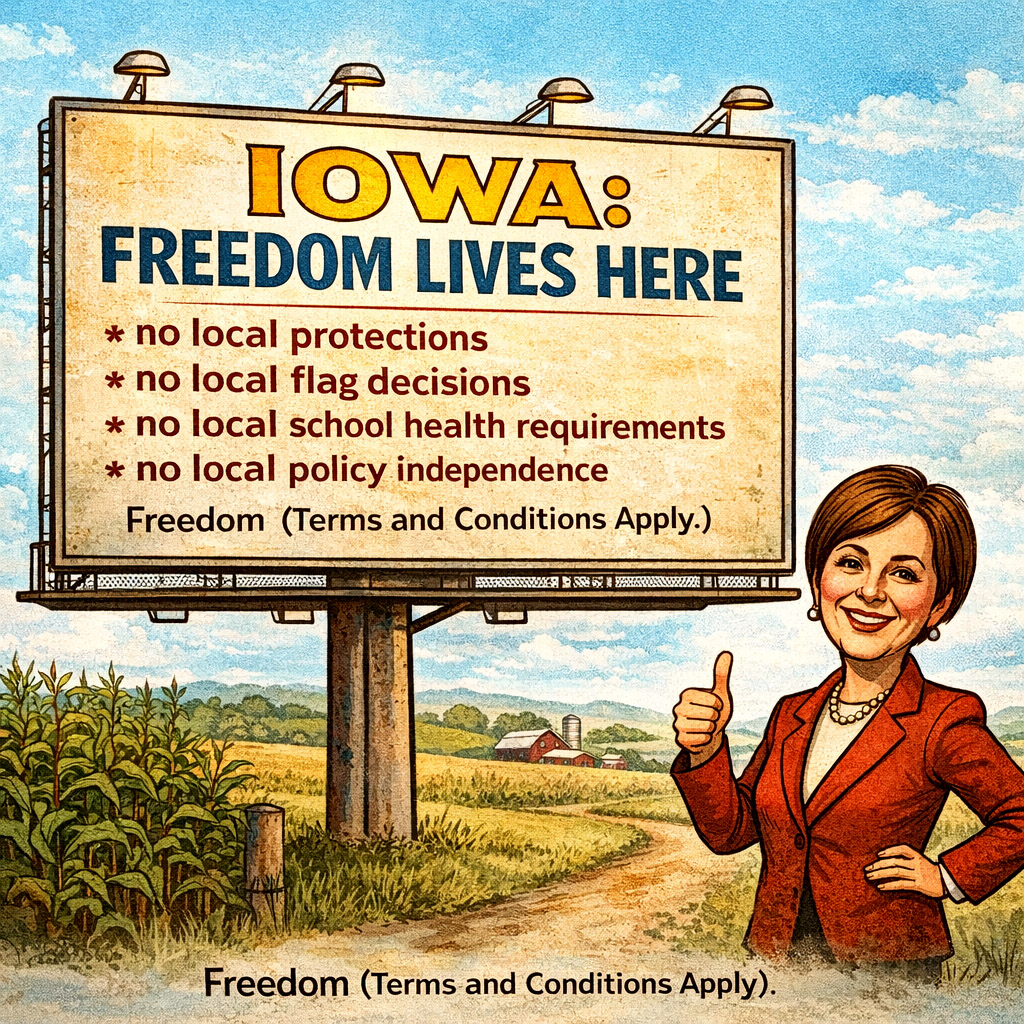
Gov. Kim Reynolds proposed legislation that would prevent Iowa cities and local governments from adopting civil rights protections broader than the Iowa Civil Rights Act. While the bill does not explicitly mention gender identity, it is widely understood as targeting local ordinances and resolutions that protect transgender and nonbinary residents from discrimination in housing, employment, education, and public accommodations.
The bill would override efforts by communities such as Iowa City, Coralville, Johnson County, and others that have attempted to maintain protections after Iowa removed gender identity as a protected class in 2025. Supporters argue the measure prevents a “patchwork” of local rules for businesses and schools. LGBTQ advocates argue it is a direct attack on local control and civil rights.
Our Take
This is state-level power being used to make discrimination easier and local protection harder.
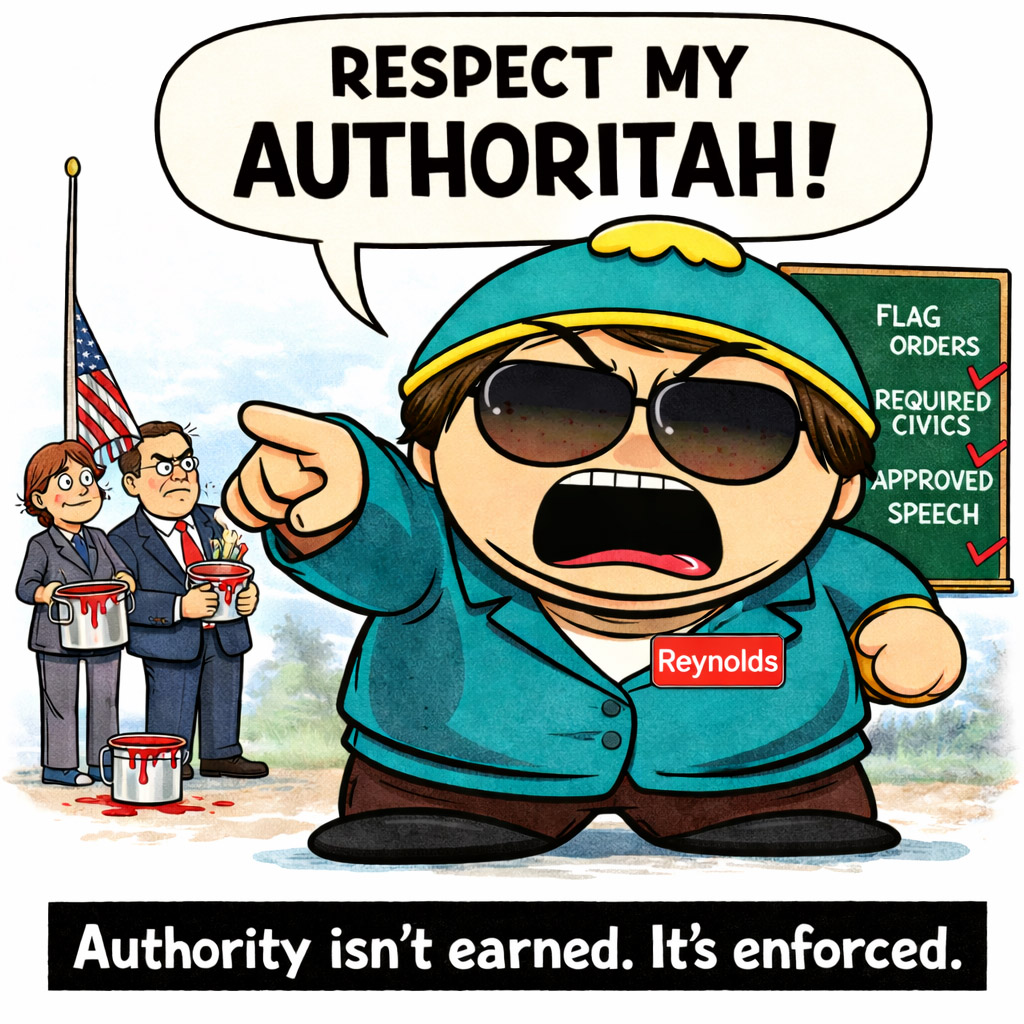
Iowa lawmakers repeatedly claim they support “local control,” until local communities use that control to refuse lowering their flags to honor an ideological zealot or protect people the legislature dislikes. Then the same politicians suddenly decide local governments can’t be trusted.
The pattern is consistent. Pick a vulnerable group, strip protections, and then prevent communities from repairing the damage. This is not about policy coherence, it’s about enforcing ideological conformity.
(And yes: history shows what happens when governments normalize targeting “approved” out-groups. That is why civil rights laws exist in the first place.)
Farm leaders warn of ‘collapse of American agriculture’ in dire letter
A growing number of agricultural leaders are warning that U.S. farmers face worsening financial conditions, with some calling the situation a potential “widespread collapse of American agriculture.”
The warnings come amid rising input costs (seed, fertilizer), weak commodity prices, and continued disruption to exports caused by trade disputes. Immigration crackdowns have also increased labor costs and contributed to crops rotting in fields.
Reports show a sharp increase in farm operating loans and a surge in farmers expecting bad financial conditions in the near term. A $12 billion federal aid program is expected to reach growers this month, but economists warn it will cover only a fraction of losses.
Our Take
This is the predictable result of chaotic policy: trade disruption, labor instability, and short-term bailouts that do not address the structural problem. Iowa lawmakers and national politicians often treat farmers as a political symbol, but farmers don’t survive on symbolism.
They survive on stable markets, predictable labor, and credit conditions that don’t punish them for forces beyond their control. If agriculture enters a prolonged downturn rural Iowa will feel it in schools, hospitals, main streets, and local tax bases, not just in the fields.


Legislature advances mandate requiring ideologically driven civics courses at state universities
A separate Republican-backed proposal, Senate File 2033, would require all Iowa public university students to complete mandatory general education courses in American history and government as a condition of graduation. The bill also mandates that newly created university “civics centers” design the courses, run lecture and debate series, and submit annual reports to lawmakers and the governor.
While supporters frame the bill as strengthening civic literacy, university officials and lawmakers raised significant concerns about cost, staffing, transfer credit compatibility, and legislative overreach. Estimates suggest implementation could cost more than $6.6 million statewide and require dozens of new faculty hires. But no funding mechanism is included in the bill.
The legislation also includes language restricting courses that focus on “subgroups of Americans,” a term left undefined by the bill’s sponsor when questioned. Critics argue this ambiguity could effectively prohibit legitimate academic inquiry into race, gender, labor, immigration, or other core topics in American history.
Our Take
This is not about free inquiry. It is about compelled ideology. Forcing students to take state-designed courses, taught through legislatively favored centers, while restricting how history can be framed is the opposite of intellectual freedom. This is curriculum control dressed up as civic education, imposed without funding, definitions, or respect for academic independence.
Charlie Kirk-related lawsuits expose contradictions in GOP “free speech” claims
In the wake of the 2025 killing of conservative activist Charlie Kirk, Iowa became a focal point in a national debate over public employee speech. At least 10 Iowa public employees, mostly teachers and university staff, were investigated or disciplined over social media posts reacting to Kirk’s death, with several filing lawsuits alleging First Amendment violations.
As courts review these cases, judges are applying long-established Supreme Court precedents governing public employee speech, including Garcetti v. Ceballos, Connick v. Myers, and Pickering v. Board of Education. Central to the analysis is whether employees spoke as private citizens on matters of public concern, and whether their speech caused actual, demonstrable workplace disruption.
Legal experts warn that disciplining employees in response to political backlash risks creating a “heckler’s veto,” where speech is punished not for operational harm but because it angers powerful figures or online mobs.
Several cases remain unresolved, and outcomes have varied depending on how courts interpret disruption and job-relatedness.
Our Take
Here’s the contradiction: the same political actors claiming to “expand” speech rights in schools are pressuring public employers to punish speech they dislike.
When free speech protects conservative viewpoints, it’s sacred. When it protects critics, it’s suddenly “disruptive.” That selective application is precisely what the First Amendment was designed to prevent.