Summary
Today’s stories are not separate developments. They are components of an emerging strategy of ideological governance of higher education through administrative control, curricular mandates, and financial leverage.
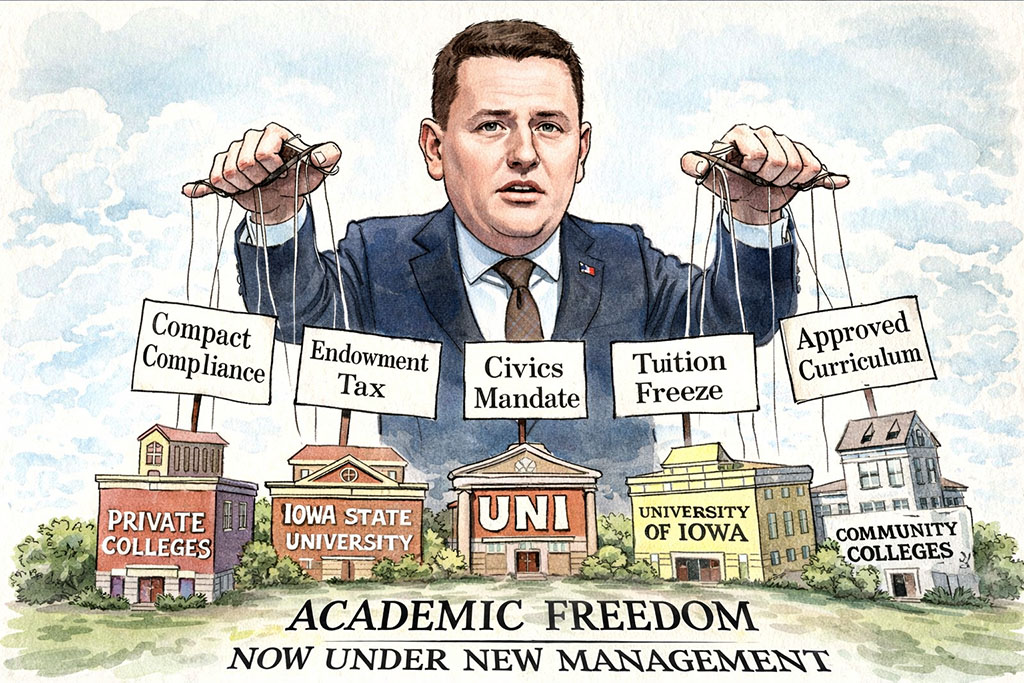
Iowa Rep. Taylor Collins is the connective tissue who is not merely “introducing bills.” He acts as a coordinating operator for pushing curriculum requirements into public universities, pressuring private universities to voluntarily comply, and advancing mechanisms that weaken institutions’ independence if they resist.
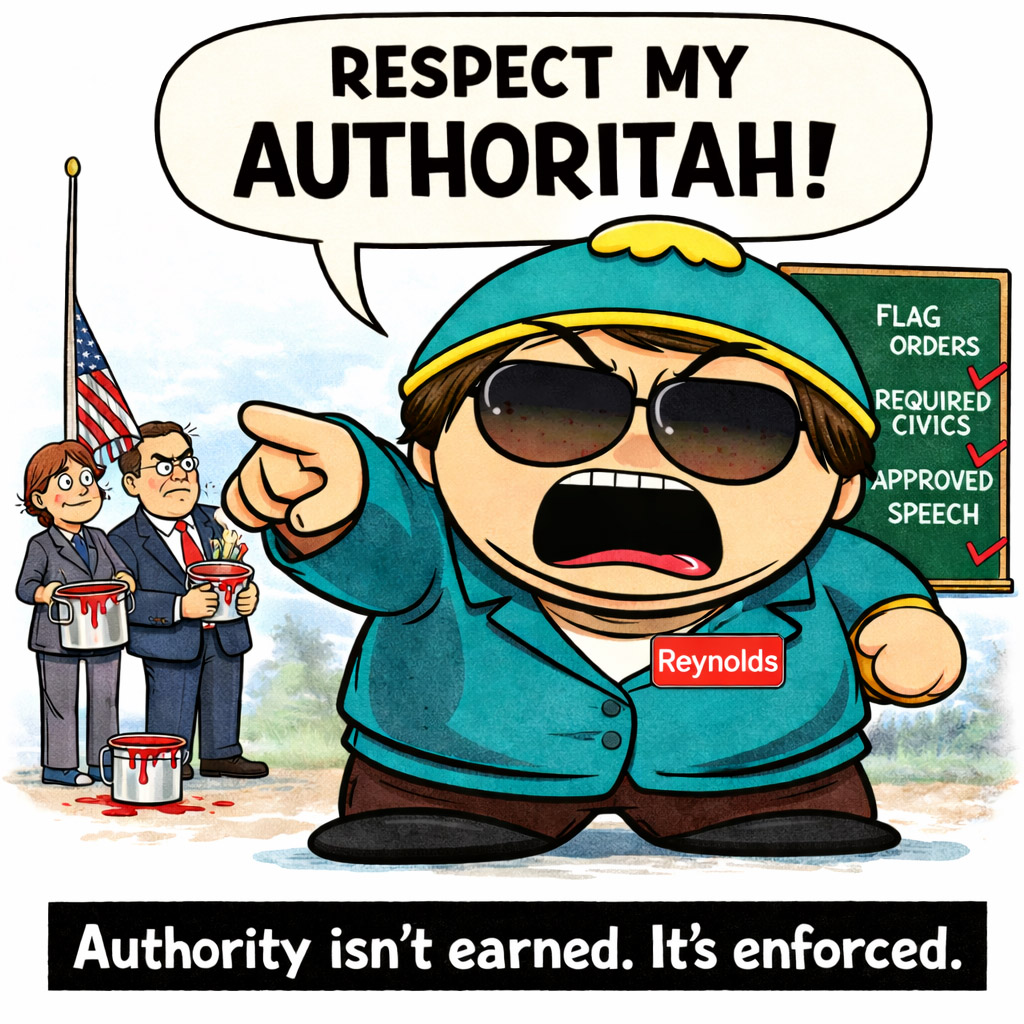
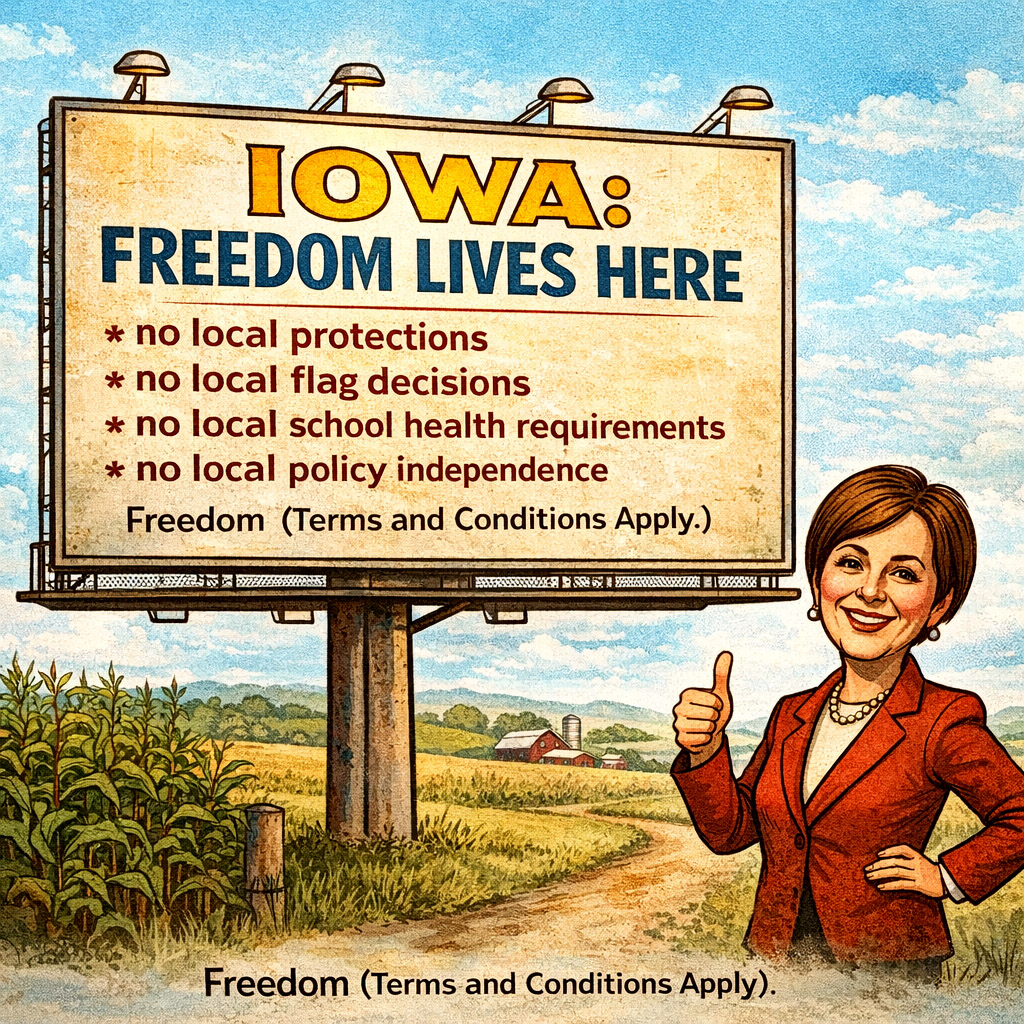
The most important theme is not civics, it is institutional submission. Collins is creating a new operating model where Iowa’s universities and colleges are expected to align with a political worldview, one that closely mirrors the national Trump/Project 2025 posture toward education: DEI rollback, “anti-woke” curriculum framing, centralized oversight, and enforcement mechanisms built into funding.
The Mellon-funded UNI Humanities Hub stands out as the counterpoint: a real-world example of modernizing education without ideology by connecting humanities education to internships, workforce skills, and community benefit. But instead of being celebrated, initiatives like this are likely to become legislative targets in the culture war.
The endowment tax bill and the Trump compact bill reveal the enforcement layer. If universities resist, lawmakers can pressure them financially, restructure their scholarship systems, and force them into national compliance frameworks. That is not a free market of ideas. It is a slow conversion of higher education into a politically managed institution with Collins as the catalyst.
Iowa lawmaker asks private universities to adopt his civics education agenda
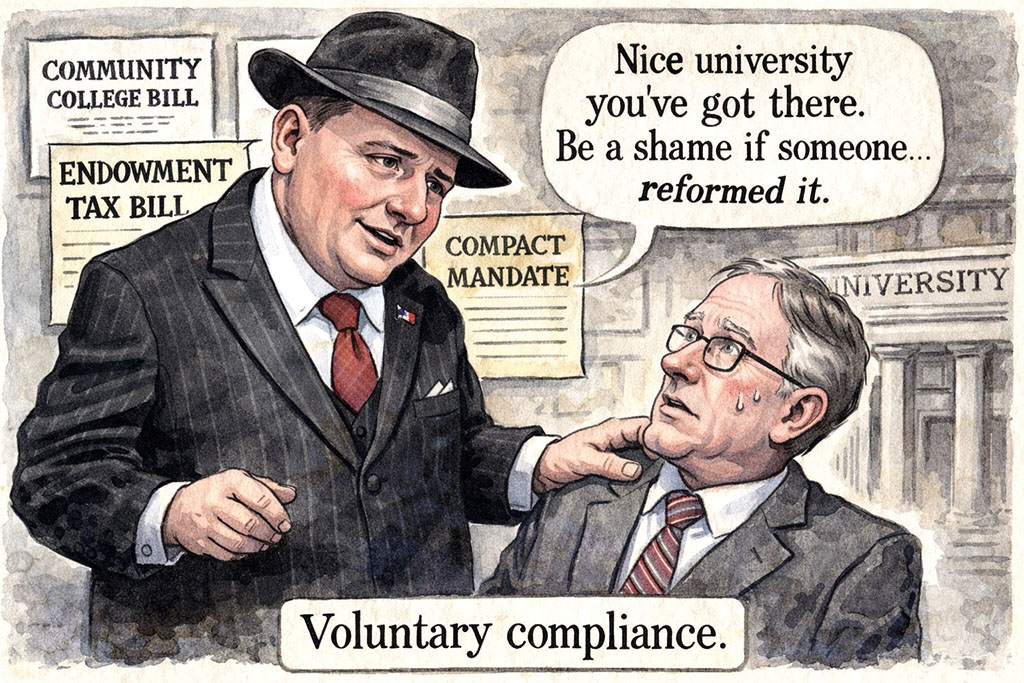
Rep. Taylor Collins, chair of the Iowa House Higher Education Committee, sent a letter urging Iowa’s private universities to voluntarily adopt the same civics and American history course requirements he is currently pushing for public universities governed by the Iowa Board of Regents.
Collins framed the request as a response to what he called a long-term erosion of Americans’ knowledge of history, civic responsibility, and founding principles. His letter describes his proposal as “forthcoming law,” even though the legislation has not yet passed. Collins also suggested that community colleges will build parallel courses to match the public university requirements, and argued private institutions should align as well to ease credit transfers for students moving between colleges.
The Iowa Association of Independent Colleges and Universities pushed back, emphasizing that private university curriculum decisions belong to the institutions themselves. The association’s president noted that civic learning is already embedded in many private colleges through community engagement and volunteering models, rather than mandated courses.
Our Take
This story is less about “civics” and more about power and control. Collins is attempting to normalize the idea that the Legislature, and by extension, one ideological faction, should dictate what “acceptable education” looks like, even at institutions outside state governance.
The most telling phrase is not his civic rhetoric. It’s the implied expectation that private institutions should “fall into line” with a policy that isn’t even law yet. That is not leadership. It’s political pressure, and it resembles the early stages of a broader strategy: define the “correct” version of history, then enforce it through funding, regulation, and reputational threats.
And yes: the timing strongly suggests Collins is building leverage. The community college restructuring threats, the tuition freezes, the endowment tax, and the curriculum mandates all work like pieces of a coordinated toolkit and not independent ideas.
Trump administration drops legal appeal over anti-DEI funding threat to schools and colleges
The Trump administration moved to dismiss its appeal of a federal court ruling that blocked the U.S. Department of Education’s anti-DEI campaign, which threatened to cut federal funding for schools and colleges maintaining certain diversity, equity, and inclusion practices.
A federal judge in Maryland previously struck down the administration’s “Dear Colleague” guidance, finding it violated First Amendment protections and failed procedural requirements. The guidance had broadly warned institutions they could lose funding if race was considered in admissions, hiring, scholarships, or other aspects of campus life.
The lawsuit was filed by the American Federation of Teachers. Advocacy groups described the dropped appeal as a meaningful victory for public education and a sign that the administration’s legal posture is increasingly difficult to defend.
Our Take
This is a rare piece of good news, but it’s not the end of the war. It is a tactical retreat.
The underlying agenda remains intact. Redefine DEI as “illegal discrimination,” then use funding threats and compliance demands to force universities to abandon diversity initiatives and speech protections. The courts blocked one method, but the political movement behind it is still active and evolving.
For Iowa, this matters because it undercuts a key justification being used by state lawmakers, that the claim that DEI crackdowns are necessary, legally required, or inevitable. They are not. The courts are increasingly treating these policies as the government overreach into speech and academic governance that they are.
University of Northern Iowa receives $2.4 million grant to launch Humanities Hub
The University of Northern Iowa received a five-year, $2.4 million grant from the Mellon Foundation to establish the UNI Humanities Hub. The initiative will expand paid internships, strengthen the humanities’ role in the university and community, and integrate career-readiness into humanities curricula.
UNI plans to support 250 paid internships over the grant period, starting with 30 placements in the first year and scaling to 60 annually by year four. The hub will centralize efforts across disciplines including history, languages, communication and media, philosophy, and world religions.
UNI leaders described the grant as a major investment in students and the mission of a regional public university, emphasizing the role of humanities in developing adaptable skills such as communication, creativity, and civic engagement.
Our Take
This is exactly the kind of strategic, common-sense modernization that Iowa’s universities should be doing. And it directly contradicts the Legislature’s narrative that humanities are “impractical” or useless.
The humanities are not the enemy of workforce development. They are often the foundation of the skills employers claim they cannot find, like writing, persuasion, ethical reasoning, cross-cultural communication, and systems thinking.
And politically? A Mellon Foundation grant is almost guaranteed to trigger backlash in today’s climate. Not because of what UNI is doing, but because the word “humanities” has been turned into a proxy target for “liberalism.” That makes this story a preview of what comes next: not just budget pressure, but ideological retaliation.
Iowa lawmakers move bill to tax some university endowments
A bill in the Iowa House would impose a tax on certain university endowments, initially targeting endowment values over $250 million with a 15% annual tax. Subcommittee chair Rep. Taylor Collins said an amendment is expected to raise the threshold to $500 million and lower the tax rate to match Iowa’s corporate tax rate.
Revenue from taxes on public university endowments would go into Iowa’s Workforce Grant Incentive Fund. For private universities, the bill would create a new account within the Iowa Tuition Grant program to support students pursuing high-wage, high-demand degrees.
University representatives warned the proposal would weaken scholarship funding and reduce long-term financial stability. Regents’ officials noted that most endowment spending supports scholarships and could be depleted over time. Private university advocates argued that the bill sets a troubling precedent by taxing nonprofit endowments.
Our Take
This is not “reform.” It is punishment disguised as policy.
Endowments are not idle cash piles. They are structured, donor-restricted funds designed to generate scholarships and long-term stability. Taxing them is essentially taxing scholarship capacity, which means Iowa students would pay the price.
And it’s hard to miss the timing. UNI receives a high-profile humanities grant, and shortly after, lawmakers introduce a mechanism that would weaken the financial independence of universities.
That looks less like coincidence and more like a signal: if universities don’t obey the ideological agenda, the Legislature will target their funding structures next.
Collins is positioning the Legislature as the rightful allocator of university money, which is a profound shift. The message is clear: universities may exist, but only under political supervision.
Bill to have state universities join Trump administration compact moves ahead
A bill advanced in an Iowa House subcommittee that would require Iowa’s three public universities to sign onto the Trump administration’s Compact for Academic Excellence in Higher Education by the end of 2026.
The compact includes requirements such as freezing tuition, altering admissions and hiring practices, and promoting “ideological balance” while also explicitly emphasizing protections for conservative ideas. Iowa lawmakers proposed the bill after urging the Iowa Board of Regents to join the compact in 2025.
Opponents argued the compact represents federal overreach and conflicts with academic freedom. Supporters suggested the universities already comply with many of its provisions, and the Board of Regents registered as undecided.
Our Take
This is one of the clearest examples yet of what’s happening with respect to higher education in the state. Iowa lawmakers are trying to force public universities into a national ideological compliance framework built by Trump’s administration.
The compact is marketed as “excellence,” but its structure reads like political management of universities: enforce standardized testing, reshape hiring, reshape admissions, and create speech rules that sound neutral while privileging one ideology.
Even more striking, this is being done by the same political faction that routinely complains about federal interference. When federal power is used to enforce their worldview, suddenly it becomes “reform.” That contradiction isn’t incidental, it’s the tell.