
The “Former Liberal” Script, and How to See Through It
Every era has its professional persuaders: people who don’t report the news, don’t analyze it carefully, and don’t even attempt to understand their opponents. Instead, they sell political identity as a product.
A recent Des Moines Register guest opinion column is a textbook example. The author follows a familiar script: I used to be a Democrat. I protested. I worked with the Greens and Ralph Nader. I know the left. Then comes the punchline: Democrats are now intolerant, Marxist, anti-Christian, anti-white, anti-woman, and fundamentally un-American.
The column is written with pretended moral certainty and rhetorical heat that is engineered to spread. Not because it’s accurate, but because it is emotionally optimized. It is not an argument; it is a recruitment tool.
The Persuasion Trick: “I Used to Be One of You”
The writer spends an unusual amount of time building credibility through biography. That is not evidence; it is credentialing. The message is: You can’t call me biased. I used to be on your side.
But a political journey does not prove current claims are true. People can be sincere and still be wrong, especially when they move from personal experience into sweeping accusations about tens of millions of Americans.
The Core Technique: Defining Democrats as Their Worst Fringe
The column repeatedly treats “Democrats” as if the party is essentially made up of disruptive protestors, campus shout-downs, vandals, anti-white activists, open-border radicals, and church attackers.
Even if some of those behaviors exist somewhere, the rhetorical move is clear: it takes the most inflammatory examples available and presents them as the definition of an entire political coalition. That is not analysis. It is false stereotyping propaganda.
“Marxist” as a Smear Word
The author repeatedly uses the label “Marxist Democratic activists,” but never defines Marxism or shows evidence that Democrats are advocating Marxist economic principles of abolition of private property, revolutionary class politics, or worker control of industry.
Instead, “Marxist” is used as a catch-all insult for civil rights advocacy, DEI, immigration debates, and trans rights. That is not Marxism. It is culture-war vocabulary designed to provoke disgust.
Moral Absolutism Masquerading as Fact
The column repeatedly presents contested political positions like abortion and gender as objective truth while dismissing opposing views as madness. That style is not careful reasoning; it is rhetorical conversion that takes partisan beliefs and frames them as universal reality.
Even readers who agree with the author should recognize the method as intellectually careless and sloppy, asserting certainty without evidence.
The Most Revealing Part: What Is Omitted
A column claiming Democrats are uniquely intolerant should, in good faith, acknowledge obvious counterexamples on the modern right: election denialism, book bans, intimidation, political violence, attacks on journalists, and Iowa’s aggressive push to restrict schools, libraries, universities, civil rights protections, and local control.
The column does not mention any of it. That omission is not accidental, it is strategic. The moment the author admits major intolerance on the right, the column collapses into what it should have been: a complex discussion of civic decline across the board.
What the Column Is Really Selling
The author is not trying to persuade moderates. He is reassuring conservatives that they are the righteous defenders of America, Christianity, and truth while portraying Democrats as immoral enemies.
That is the modern opinion economy where outrage sells and nuance does not.
Why It Matters
Iowa is dealing with a growing problem. Ideological flame throwers flooding the public square with content that looks like argument but is built on fallacies. The damage is cumulative, teaching people to think in caricatures, distrust neighbors, and treat politics as moral warfare.
Building that environment makes authoritarianism easier to sell, because once a population is convinced the other side is evil anything becomes justifiable.
The Good News
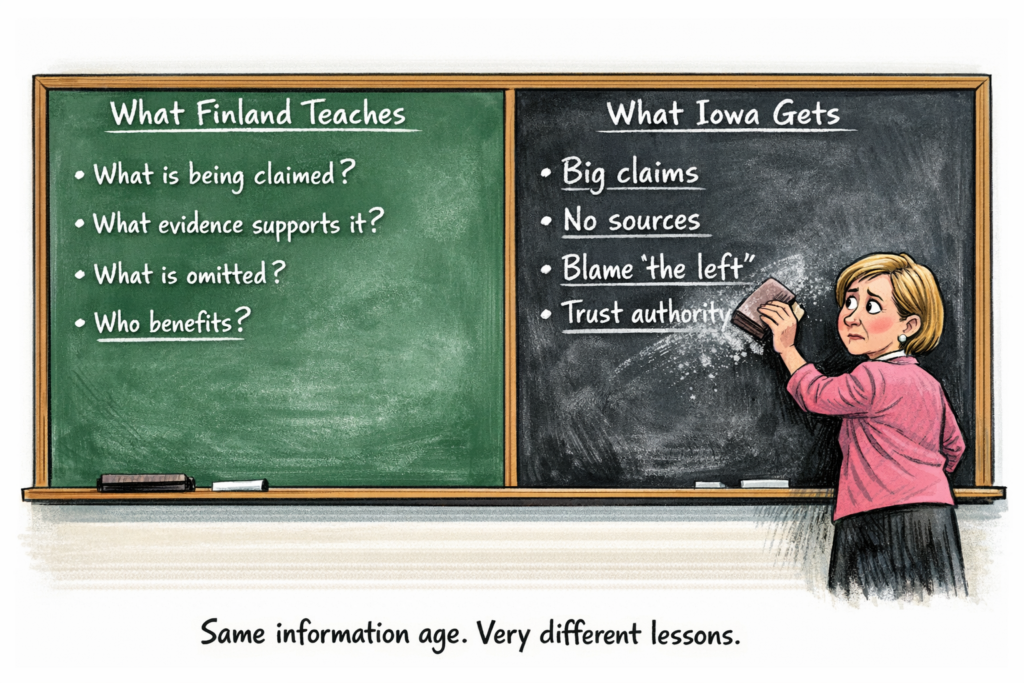
Propaganda-style opinion writing is easy to identify and dismantle. Ask for definitions. Ask for evidence. Watch for generalizations. Look for what was omitted. Notice when emotions are being used as substitutes for facts.
Critical thinking still works. And that is exactly why ideological persuasion writing works so hard to make people stop using it.
J.W. Calder is Iowa411’s managing editor. His email is jcalder@iowa411.com.