
There is a pattern in Iowa politics that has become so consistent it is no longer plausible to call it coincidence.
When ordinary Iowans face harm, whether in nursing homes, on highways, in rural neighborhoods, or in their own bodies, Iowa’s political leadership repeatedly responds not by strengthening safeguards, but by weakening accountability.
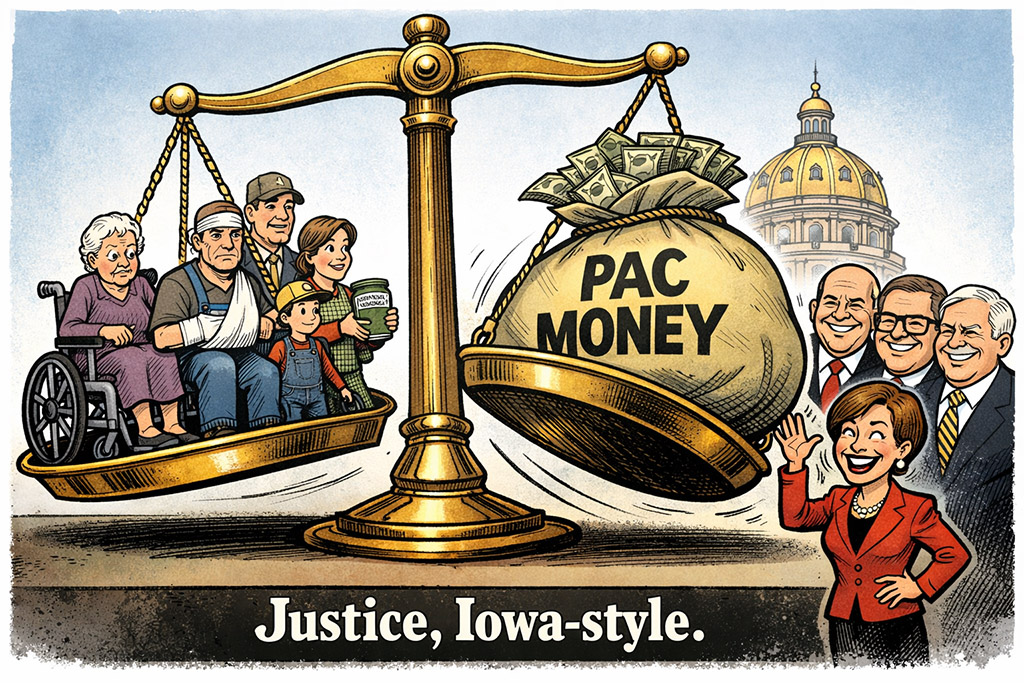
The state does not just fail to protect residents. It often goes a step further by using its power to protect the industries responsible for the harm. All while taking large campaign contributions from those same industries.
That is not “limited government.” It is government deployed on behalf of the powerful.
The Nursing Home Example: Where the Moral Clarity Is Impossible to Ignore
Start with nursing homes. Few issues make the governing priorities of Iowa leaders more obvious than how they treat the elderly, the disabled, and families desperate for basic dignity and safety in care facilities.
Staffing levels are widely recognized as the single most important factor in nursing home quality. Understaffing leads directly to neglect, preventable injury, and death. This is not an ideological debate. It is operational reality. Yet the nursing home industry has fought minimum staffing standards for years, and Iowa’s political leadership has consistently been a reliable ally in blocking meaningful safeguards.
The same pattern shows up in Iowa’s refusal to pass legislation guaranteeing residents the right to use in-room cameras (“granny cams”) to protect themselves from abuse and neglect. Iowa facilities can prohibit cameras, and lawmakers have rejected reforms year after year.
And when stories emerge showing how surveillance footage has helped document neglect, theft, abuse, and even deaths, the legislature still refuses.
At some point, the question is no longer “why can’t Iowa fix this?” The question becomes: Who benefits from Iowa not fixing it?
The Talking Points Are Always the Same
When Iowans ask for basic protections, we hear the same scripted responses from the industry and its allies. They use excuses like “Privacy concerns,” “Too burdensome,” “Too expensive,” “Too much red tape,” and “We can’t regulate our way into better outcomes.”
But the reality is simpler. The legislature is not protecting residents from abuse. It is protecting the industry from oversight.
And when campaign contributions flow from nursing home PACs and lobbying groups into the same politicians who block reforms, the public has every right to call this what it is, a system that rewards the powerful while exposing the vulnerable.
Zoom Out: This Isn’t Just Nursing Homes
If nursing homes were the only case, maybe Iowa could treat it as a tragic oversight or a complex policy fight. But it is not the only case. It is part of a broader governing model that can be summarized as privatize profit and socialize harm.
Farm Chemicals, Cancer and the War on Liability
Iowa has one of the highest cancer rates in the country. That fact is now widely reported, studied, and debated.
But when public attention shifts toward environmental causes like chemical exposure, fertilizer runoff, pesticide drift, and contaminated water, the state’s political leadership tends to pivot away from the industries that are most likely to face scrutiny.
Instead of demanding stronger safeguards and accountability, Iowa lawmakers repeatedly flirt with legislation designed to reduce corporate exposure to lawsuits and liability. In other words, rather than confronting the problem, the state works to make it harder for injured Iowans to seek justice.
If a chemical product is truly safe, companies should have nothing to fear from accountability. And when the legislature rushes to shield industries from legal consequences, it sends a clear signal: The priority is not public health. The priority is protecting corporate balance sheets.




Trucking Liability and the Price of “Reform”
The same pattern plays out with trucking industry liability. When a semi crash destroys a family, the question should be straightforward: what happened, who was negligent, and how do we ensure accountability and prevention?
But in many states, and increasingly in Iowa, the policy response becomes a “tort reform” conversation: caps, restrictions, and new legal hurdles.
This is sold as a way to reduce insurance costs and keep businesses operating. But it also functions as something else: A government-assisted discount on the cost of harming people.
The public is told the reforms are necessary for the economy. And the victims are told to accept less.
Hog Confinements: Local Communities Sacrificed for Big Ag
Then there is industrial livestock confinement, where the “socialize harm” model becomes literally visible and measurable.
Neighbors experience polluted water, air quality impacts, constant stench, manure spills, property value losses, and degraded quality of life. And when communities ask for stronger local control or enforcement, the state often responds by limiting their authority.
This is not freedom. This is forced exposure.
The people most affected are not the corporate operators. They are rural Iowans — families who live next to the facilities and have no practical way to escape.
The Common Thread: Accountability Is Treated as the Enemy
Across all these issues, Iowa leaders repeatedly treat oversight, regulation, enforcement, and liability not as safeguards, but as threats. Accountability is framed as “government overreach,” victims are framed as obstacles to business, and the industries creating the harm are treated as partners.
This Is Not Conservatism. It Is Capture.
There is a phrase for what happens when government becomes aligned with the industries it is supposed to regulate: Regulatory capture. And when campaign contributions are part of the equation, it becomes something worse. A legalized corruption system where the public interest loses to the donor class.
The officials involved may insist they are simply being “pro-business,” but what they are building is not a pro-business state. It is a pro-corporate state.
There is a difference.
A pro-business state protects the conditions that allow communities to thrive, like healthy residents, strong schools, clean water, safe roads, dignified elder care, and a workforce that wants to live there.
A pro-corporate state protects the largest players from consequences, even when their operations injure the public.
The Iowa Test: Who Benefits, Who Pays?
Iowans do not need partisan loyalty to understand this pattern; they only need a simple test.
When you see a bill or a policy proposal, first check to see if it reduces oversight or enforcement and if it weakens local control. Does it restrict lawsuits or liability, or block transparency tools like cameras or reporting?
If the answer is yes to any of these, ask the second question, “who benefits, and who pays? When corporations benefit and ordinary Iowans pay, you are looking at Iowa’s corporate protection model in action.