Summary
Today’s stories share a common thread of who gets protected by policy, and who absorbs the risk. In Washington, Congress pushed back on sweeping HHS cuts and preserved much of the nation’s public health and research infrastructure, an example of government acting as a stabilizer.
In Iowa, lawmakers move in the opposite direction on two fronts: using statute to shape medical counseling on abortion pills in ways physicians say conflict with evidence, and advancing a bill that opponents argue would shield conversion-therapy-like interventions from child welfare scrutiny.
The throughline for Iowans is downstream impact. When policy becomes ideology-coded, especially in medicine, it can accelerate clinician flight, reduce access to care, and shift consequences onto families who have the fewest options.
Whether it’s public health funding or clinical standards, the question remains the same: does law follow evidence and harm reduction, or does it force the evidence to follow politics?
Iowa lawmakers target abortion pills with bill limiting mail orders
Iowa Senate Republicans advanced legislation that would sharply restrict access to medication abortion by requiring patients to be seen and given the drugs in person, effectively targeting telehealth and mail-order prescriptions of mifepristone and related medications. The bill also mandates that physicians inform patients about so-called “abortion reversals,” a claim medical advocates say is not supported by science and would require the collection of state data on complications from medication abortion.
Supporters framed the bill as a safeguard against “black market” pills and a measure to enhance informed consent. Democrats and medical groups countered that the proposal is aimed less at safety and more at further restricting abortion access after Iowa’s six-week ban, while forcing clinicians to provide non-evidence-based information.
Separately, anti-abortion demonstrators rallied at the Capitol for a different bill that would treat abortion as homicide, including criminal penalties—an effort the subcommittee chair said was unrelated to the medication-abortion proposal.
Our Take
This bill is policy-by-ideology masquerading as “patient protection.” The most concerning feature is the requirement to recite “reversal” information that major medical authorities dispute, turning state law into a script that can override clinical standards.
Add civil liability risk for physicians and you have a predictable outcome. More providers leave, fewer replace them, and patients lose access to routine reproductive and OB/GYN care, especially in rural Iowa, where the workforce pipeline is already strained.
Congress rebuffs Trump push to slash $33B from health, human services
Congress passed a major HHS funding package that largely rejected President Trump’s proposed $33 billion reduction to health and human services programs. Instead of accepting the proposed cuts, negotiators increased or maintained funding for key public health priorities: NIH received a funding increase (including targeted boosts for Alzheimer’s and type 1 diabetes research), and CDC funding was preserved rather than cut.
Congress also rejected proposed deep reductions to SAMHSA and kept LIHEAP (low-income home energy assistance) funded, despite the administration calling it unnecessary.
The bill, approved by all four of Iowa’s U.S. representatives, emerged from rare bipartisan agreement after months of negotiation following a partial government shutdown. While lawmakers preserved most public health funding, the final package did eliminate the CDC’s Social Determinants of Health program, which supporters say helps address non-medical drivers of health outcomes and critics label as “social engineering.”
Our Take
This is Congress reasserting the “power of the purse” in practical terms by keeping core health infrastructure intact rather than letting budget ideology hollow it out. For Iowans, the stakes aren’t abstract. Public health funding touches rural hospitals, disease surveillance, opioid response, and heating support during harsh winters.
The one notable policy signal is that even in a bipartisan deal, “social determinants” remains a political target, despite its real-world relevance to health outcomes.
Advocates rally against ‘conversion therapy’ bill in Iowa House
An Iowa House subcommittee advanced a bill that opponents say would effectively legalize or shield conversion therapy practices for minors by narrowing what can be considered child abuse or endangerment in cases involving a parent’s response to a child’s gender dysphoria. The bill adds carveouts affecting foster and adoptive placement considerations and custody disputes and includes language stating that seeking mental health services intended to steer a child to live “consistent with” their sex at birth is not abuse.
LGBTQ advocates and clinicians warned that conversion therapy is broadly discredited and associated with increased risks of depression, anxiety, homelessness, and suicide. Supporters argued the bill protects religious parents from discrimination and prevents the foster/adoptive pipeline from shrinking.
The bill now moves to the full House Judiciary Committee.
Our Take
This is a familiar legislative pattern: take a contested cultural debate and convert it into legal immunity language that reduces oversight. Regardless of how supporters frame it, the practical effect is to protect certain interventions from scrutiny even when major medical organizations warn about harm.
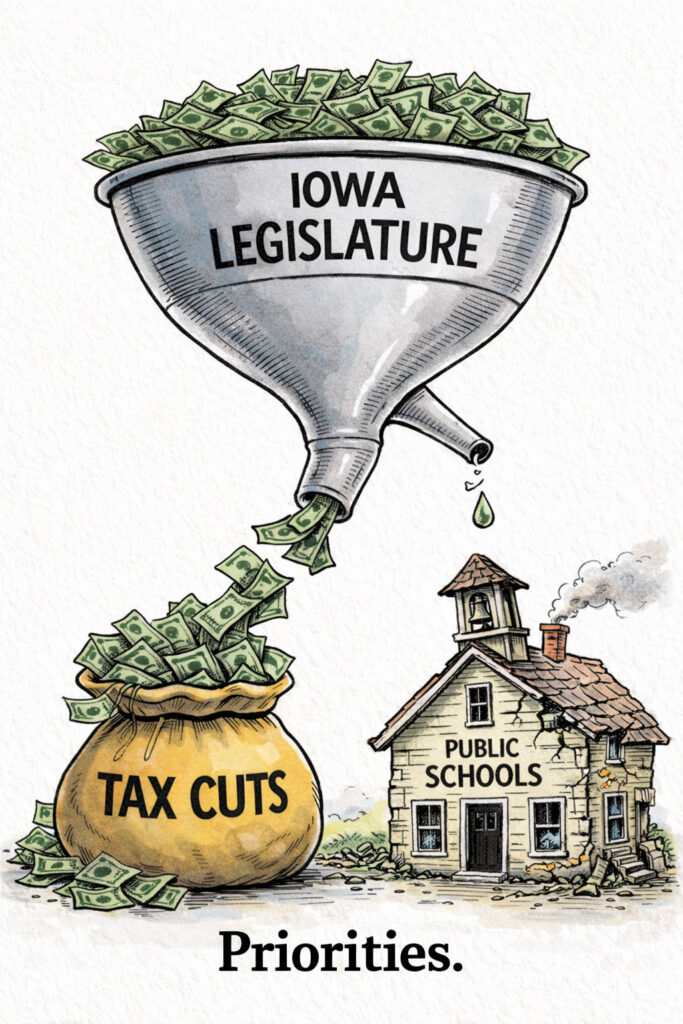
Iowa is not short on problems that require serious governing. Spending legislative bandwidth on non-essential activities that carve out protections for discredited practices is a choice that signals priorities. Or a lack thereof.