Summary
Today’s stories highlight a troubling theme in Iowa governance. A legislature that is increasingly focused on ideological control, market protection for favored interests, and political theater, all while Iowa’s real-world public priorities continue to deteriorate.
The “Charlie Kirk” educator-license bill is the clearest example. Rather than reinforcing existing professional standards in a neutral way, lawmakers are attempting to write a retroactive, person-specific speech punishment into state law; a move that looks less like safeguarding schools and more like using government power to police political expression.
Meanwhile, Iowa’s approach to economic and consumer policy remains inconsistent. In the EV direct-sales debate, lawmakers are confronted with a basic question: Do Iowans have the right to buy a vehicle directly from a manufacturer, or will state law continue to protect the dealership model regardless of consumer preference?
And in the “Bring Da Bears to Iowa” bill, the legislature once again drifts into headline-driven fantasy proposals while Iowa faces unresolved crises in water quality, health care access, and public education outcomes.
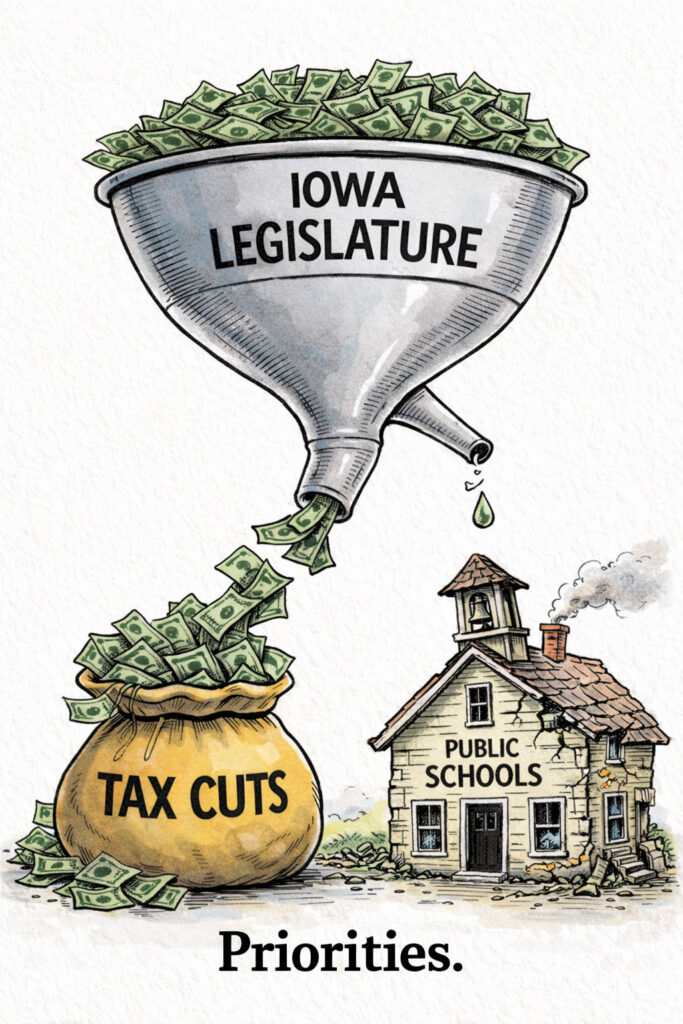
Finally, Gov. Reynolds’ charter school funding proposal continues the broader strategy of Iowa’s GOP to fragment public education while starving the traditional system of resources and credibility. Charter schools can serve a legitimate role, especially for students needing alternative pathways, but Iowa’s policy trend is not balanced reform.
It is a steady transfer of funding and political support away from the public system that must serve every child toward parallel systems that are increasingly treated as the future. The common thread across all four stories is a governing posture that prioritizes politics and power over stability, transparency, and public trust.
Iowa House GOP advances “Charlie Kirk” educator license revocation bill
Iowa House Republicans advanced legislation that would require the Iowa Board of Educational Examiners to revoke or deny educator licenses for publicly “celebrating” political violence, including language explicitly naming the “unlawful killing of Charles J. Kirk.” The bill follows the September 2025 assassination of Charlie Kirk, a conservative activist often aligned with Christian nationalist messaging, and a wave of investigations and firings involving public employees who posted inflammatory reactions on social media.
Supporters argue the bill protects public trust in education and ensures teachers remain fit to serve in positions of responsibility. The bill’s text requires that the speech show “moral turpitude,” disrupt the learning environment, and undermine public confidence. And it includes example phrases such as “good riddance” and “he deserved it.”
But major education stakeholders and multiple lobbyists testified against the bill, calling it unconstitutional and redundant. They argued Iowa already has disciplinary mechanisms for ethics violations and misconduct and warned the bill would violate established First Amendment protections for public employees. The proposal also applies retroactively to Sept. 10, 2025, raising additional legal and due-process concerns.
Our Take
This bill is not a serious public safety measure. It is a political weapon dressed up as professional regulation. It is designed to punish speech, not prevent violence.
If lawmakers were acting in good faith, they would write a neutral policy that applies evenly to all political violence, without naming a single conservative celebrity by name and retroactively criminalizing speech already being litigated in court. That is not governance; it is ideological retaliation.
Iowa’s legislature is drifting into a dangerous posture as it uses state power to police thought and speech, particularly when it involves criticism of conservative figures. That is exactly the type of government conservatives once claimed to oppose.
Iowa Senate bill would allow Tesla, Rivian, Lucid to sell directly to Iowans
A bill advancing in the Iowa Senate would allow certain electric vehicle manufacturers, including Tesla, Rivian, and Lucid, to bypass the state’s traditional dealer franchise system and sell vehicles directly to consumers in Iowa. Supporters argue Iowa is among the most restrictive states for EV direct sales, forcing residents to travel out of state to buy or even speak with company representatives in person.
The proposal would create a limited exception for EV manufacturers that have never had a franchise agreement with an Iowa dealer. EV representatives framed the bill as a consumer freedom issue, arguing Iowans should be able to choose how and where they purchase a vehicle.
Auto dealers and dealer associations strongly oppose the measure, arguing the current system exists to protect consumers. They contend dealers serve as advocates for buyers in warranty disputes, create competition on price, and prevent manufacturers from controlling retail pricing.
Our Take
This is a rare moment where Iowa lawmakers must decide whether they represent Iowans, or an entrenched industry structure.
Dealer networks absolutely provide some consumer value, especially around service and warranty leverage, but the argument that consumers must be protected from buying directly from a manufacturer is increasingly weak in a world where people buy everything else online, including major appliances and even mortgages.
If the legislature blocks this, the public should ask one simple question: whose “protection” is being prioritized here – the buyer’s, or the dealer’s revenue model?
“Bring Da Bears to Iowa” bill proposes incentives for an NFL stadium
A group of Iowa Republican state senators introduced legislation that would expand Iowa’s MEGA economic development program to include financial incentives for construction of a National Football League stadium that would be specifically aimed at attracting the Chicago Bears if the team relocates.
The bill would allow the Iowa Economic Development Authority to approve incentives for an NFL stadium project, positioning Iowa as a competitor while Illinois and Indiana debate their own stadium proposals. Sponsors argue a professional sports team would bring tourism, jobs, and national visibility to Iowa.
The proposal follows other Iowa GOP bills targeting Illinois politically, including a separate bill floated this session that would create a committee to consider transferring Illinois border counties into Iowa (a proposal that has not advanced).
Our Take
This is what happens when a legislature becomes addicted to performative politics. Serious problems pile up as lawmakers chase fantasy headlines.
Iowa has urgent issues that are not being solved, like water quality, rural health care collapse, education decline, workforce shortages, and public infrastructure. But instead of doing the hard work, lawmakers propose stadium fantasies designed to generate clicks and partisan applause.
This bill isn’t about economic development. It’s about signaling. And it’s a signal that Iowa’s leadership is increasingly detached from reality.
Reynolds proposes new charter school funding expansion bill
Gov. Kim Reynolds is proposing legislation that would increase state funding for public charter schools, bringing their funding closer to what traditional public school districts receive. The bill would extend funding tied to Area Education Agency services, including special education, media, and technology services, to charter schools.
It would also allow charter students greater access to services and activities through their resident public school districts, including driver education, athletics, and concurrent enrollment courses. Additionally, the bill would allow time spent teaching at a charter school to count toward moving from an initial teaching license to a standard license.
Reynolds framed the proposal as a fairness issue: if charter schools are public schools serving students, the state dollars should follow the student fully. Charter school leaders say additional funding could support student needs, including trauma-informed supports and career readiness programs. Iowa currently has 19 public charter schools with statewide enrollment of around 1,172 students.
Our Take
This bill is not just about charters; it’s about continuing the Iowa GOP’s long-term strategy of weakening the traditional public school system while expanding alternative pipelines.
Charter schools can serve legitimate purposes, especially for students who need nontraditional pathways. But Reynolds’ broader agenda has not been neutral; it has consistently redirected money and policy attention away from public school districts while simultaneously underfunding them relative to inflation and burdening them with mandates.
Here’s the deeper issue: Iowa keeps expanding “choice” while refusing to adequately fund the system that must educate everyone, including the students that private and charter systems can reject, discourage, or fail to serve well.
This is not reform. It is fragmentation. And it is falsely being sold as “fairness.”