Summary
Today’s briefs share a through-line: power, accountability, and whose freedoms get protected in practice. At the state level, House Republicans are giving a platform to a total abortion ban that would criminalize clinicians with life-in-prison penalties, an approach that transforms healthcare judgment into legal risk management. Whatever one’s moral view of abortion, criminalization is an instrument with predictable collateral of fewer providers, more defensive medicine, and wider gaps in access. Especially in rural Iowa where staffing is already fragile.
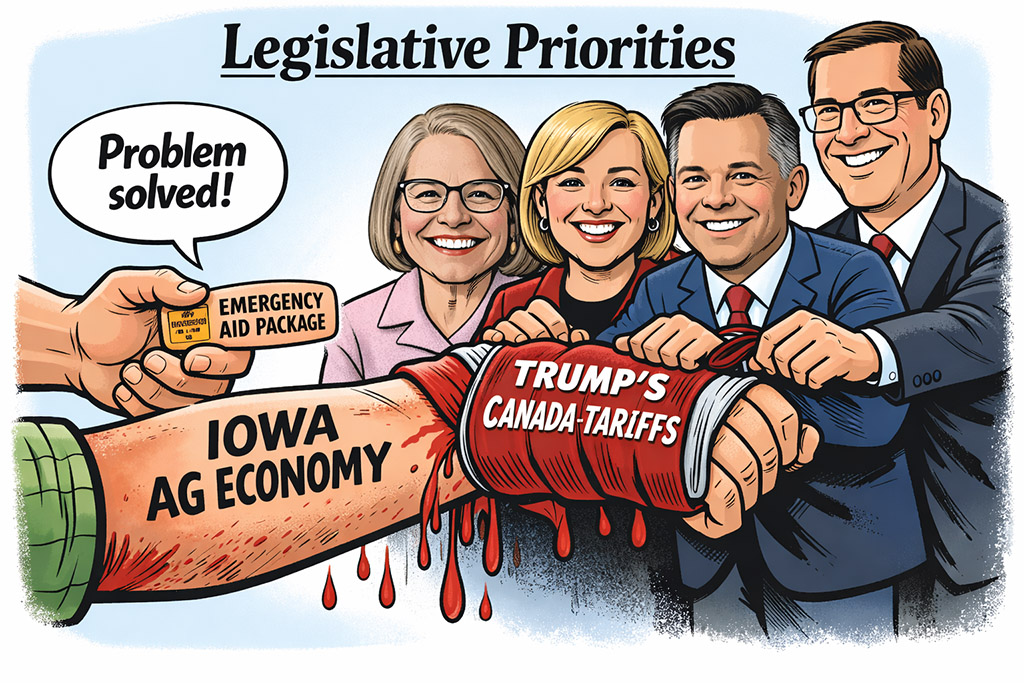
At the federal level, Iowa’s House delegation lined up behind Trump’s Canada tariffs despite mounting concerns that tariffs function like a broad-based tax on inputs and consumers and despite Iowa’s unique exposure as an export-heavy, agriculture-centered state that depends on stable cross-border supply chains. The vote underscores a widening Republican divide between ideological/strategic tariff enthusiasm and traditional conservative skepticism about executive-driven taxation.
Finally, the Steen stories preview what the 2026 governor’s race may become: a contest over whether Iowa’s core public systems (schools, healthcare, infrastructure, and the rules that govern them) are improved through targeted reform or weakened through suspicion-driven narratives that presume “waste” without specifying where it is.
If there is a common civic lesson across all four items, it’s that Iowans should insist on receipts: definitions, data, proposed statutory language, and realistic impact analysis; not slogans.
Iowa House GOP sets hearing on bill banning all abortions
House Republicans have scheduled a Feb. 17 subcommittee hearing on House File 2332, a proposal that would ban abortions by defining life as beginning at conception and adding abortion to Iowa’s homicide statute. Under the bill, performing an abortion would be a Class A felony punishable by life in prison for doctors, with an additional provision making an “attempt” that does not result in an abortion a Class B felony. The bill exempts pregnant people from prosecution and includes exceptions for miscarriage management, ectopic pregnancy, IVF, and certain emergency medical conditions, including preserving the life of the pregnant patient.
The hearing is the first formal step for the bill, and it arrives as Iowa is already operating under a six-week ban (with exceptions) that took effect after court challenges. House leadership has not committed to supporting the total ban, with Speaker Pat Grassley indicating he wants more feedback and further review, while Democrats argue the proposal is far outside where Iowans are and would further restrict healthcare decision-making.
Our Take
This is not a symbolic tweak. It is a maximalist legal escalation with enormous downstream effects: clinician risk, patient access, hospital recruitment/retention, and what is left of Iowa’s broader medical reputation.
Even when exemptions exist on paper, criminalization tends to shift real-world medicine toward defensive practice, delay, and referral out of state.
If lawmakers claim this is about “life” or “safety,” the burden is on them to grapple with predictable system impacts, especially the ongoing strain on OB/GYN access, rather than treating healthcare as a culture-war proving ground.
Iowa Representatives vote to keep Canada tariffs
All four Iowa Republicans in the U.S. House, Mariannette Miller-Meeks, Ashley Hinson, Zach Nunn, and Randy Feenstra, voted to support President Trump’s tariffs on Canada. A House majority nevertheless voted to overturn the tariffs (219–211) after six Republicans joined Democrats to reverse the emergency declaration used as the policy’s foundation. The issue now moves to the U.S. Senate, where the outcome is uncertain, and any final reversal will likely face a presidential veto if it reaches Trump’s desk.
The political and economic stakes are acute for Iowa. Critics argue tariffs are raising input costs, particularly potash-based fertilizer imports from Canada, and adding pressure to an already challenging farm economy. The story also highlights a growing intra-party split, with some Republicans framing tariffs as a consumer tax and arguing Congress should reclaim tariff authority under Article I.
Our Take
Iowa’s delegation is effectively betting that party alignment and presidential loyalty outweigh risk to an Iowa economy deeply exposed to trade retaliation and input-price shocks. If tariffs are the tool, the public deserves transparent accounting: who pays, who benefits, what the timeline is, and how “emergency” powers are being used to bypass Congress. Iowans can handle hard trade choices; what they can’t afford is policy by posture. Especially when the costs land first on producers and rural communities.
Governor candidate Adam Steen says public education dollars need scrutiny
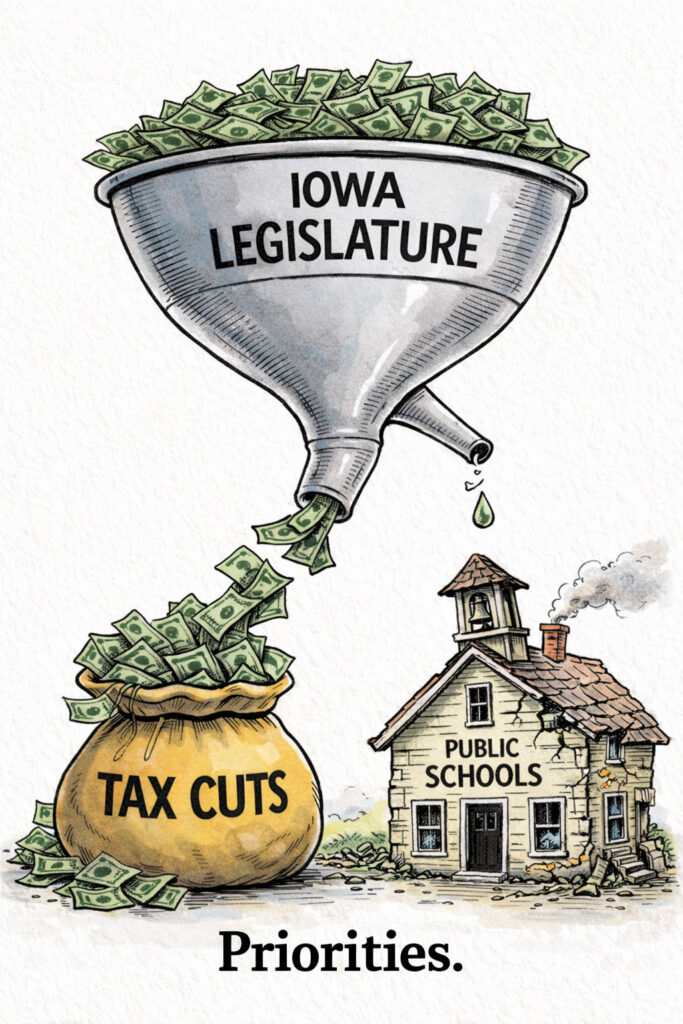
GOP gubernatorial candidate Adam Steen told a conservative audience that public education funding should be scrutinized for “waste,” and he advocated for zero-based budgeting across state government. He argued that incremental budgeting can conceal unnecessary spending and suggested there may be money going into schools “that we don’t know about” and doesn’t need to be there. At the same time, Iowa lawmakers are debating K-12 funding increases that education advocates say fail to keep pace with inflation.
Steen also positioned himself as supportive of public schools (noting his children attend them) while criticizing “requirements and standards” he says are imposed on teachers. He reiterated opposition to DEI emphases, called for refocusing on basics, and pledged to protect and potentially expand Education Savings Accounts (ESAs) that route taxpayer dollars to private education.
Our Take
“Scrutinize for waste” is easy politics; governing requires specifics. If Steen’s claim is that schools are bloated, the public deserves a concrete breakdown: what line items, what categories (instruction, special education, transportation, administration), what mandates drive costs, and what he would cut. Plus the educational and community consequences. Zero-based budgeting can be a discipline tool, but it can also become a blunt instrument if used to justify predetermined cuts without grappling with fixed costs, legal obligations, and the fact that many “staff” increases are student-facing supports, not “administration.”
Steen stresses business resume and alignment with Trump
On the campaign trail, Steen emphasized private-sector experience with investment banking work and entrepreneurial efforts to argue it makes him a “people-first, America-first business guy” with a faith foundation. He explicitly framed his candidacy as aligned with President Trump and positioned himself as someone who would “work alongside” Trump, contrasting that with expected Democratic nominee Rob Sand. Steen also signaled comfort with both “MAGA” and “MAHA” factions.
On policy, he said he opposes eminent domain for carbon sequestration pipelines while supporting voluntary private negotiations between landowners and companies. With an open-seat governor’s race and a crowded GOP primary, the message functions as both a brand statement and a coalition pitch to different wings of the Republican base.
Our Take
A resume pitch isn’t a governing plan. “Business mindset” can mean accountability and execution, or it can mean reducing public institutions to profit-and-loss slogans that don’t fit public obligations.
The test is policy clarity: how he would manage tradeoffs, how he defines “freedom” when it collides with local control or individual rights, and whether alignment with Trump is a strategy for Iowa outcomes or a shortcut for primary politics.
His eminent-domain stance is notably cleaner than many candidates’, but again, voters should demand details on implementation and exceptions.