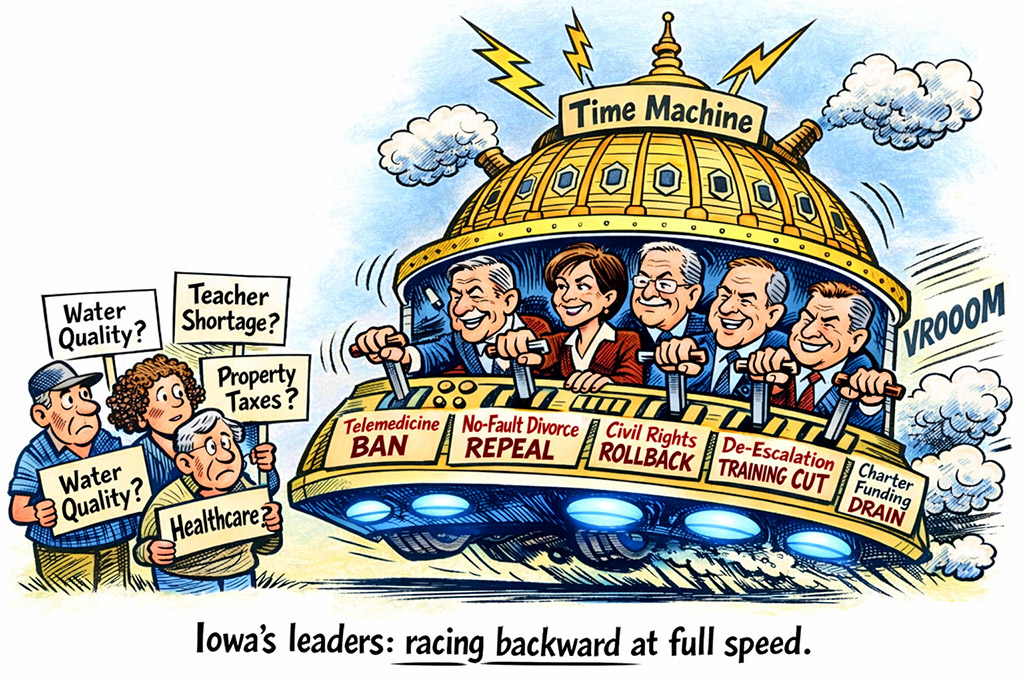
Summary
Across these three stories, Iowa’s political direction comes into focus. A centralization of power upward, and transfer of risk downward.
The first story highlights the Iowa Legislature spending precious time on social rollback bills that propose to restrict reproductive access, reshape divorce law, and limit civil rights and local authority. Whether one agrees with any individual bill, the broader pattern is unmistakable: the state is using law not just to govern, but to culturally and ideologically discipline. That is not forward-looking policymaking; it is an attempt to rebuild yesterday’s Iowa using today’s coercive tools.
The charter school story shows the same pattern in a different arena. The issue isn’t whether charters should exist, it’s whether the state is quietly rewriting the financial architecture of public education. When public funding follows students to charters but districts remain responsible for fixed costs, public schools enter a slow squeeze: fewer teachers, fewer programs, lower morale, and then further enrollment loss. The result is not a marketplace. It’s a socially engineered, managed decline.
Finally, the pipeline explosion story underscores what happens when regulation becomes reactive instead of preventative. If companies can operate for years without permits and face limited penalties, the public isn’t protected, it’s exposed. And when disasters occur, taxpayers and local emergency responders become the de facto backstop. That’s the underlying Iowa question right now: Who bears the risk – corporations or communities?
Republicans, trying to turn back the clock, waste our time | Opinion (Register Editorial)
The Des Moines Register editorial argues that Iowa Republicans have shifted legislative attention away from complex but urgent policy issues (like property tax reform) and toward a wave of socially conservative bills aimed at “turning back the clock.” Because property tax proposals are exempt from the Feb. 20 funnel deadline, the editorial says the Legislature has used the remaining time to advance culture-war bills.
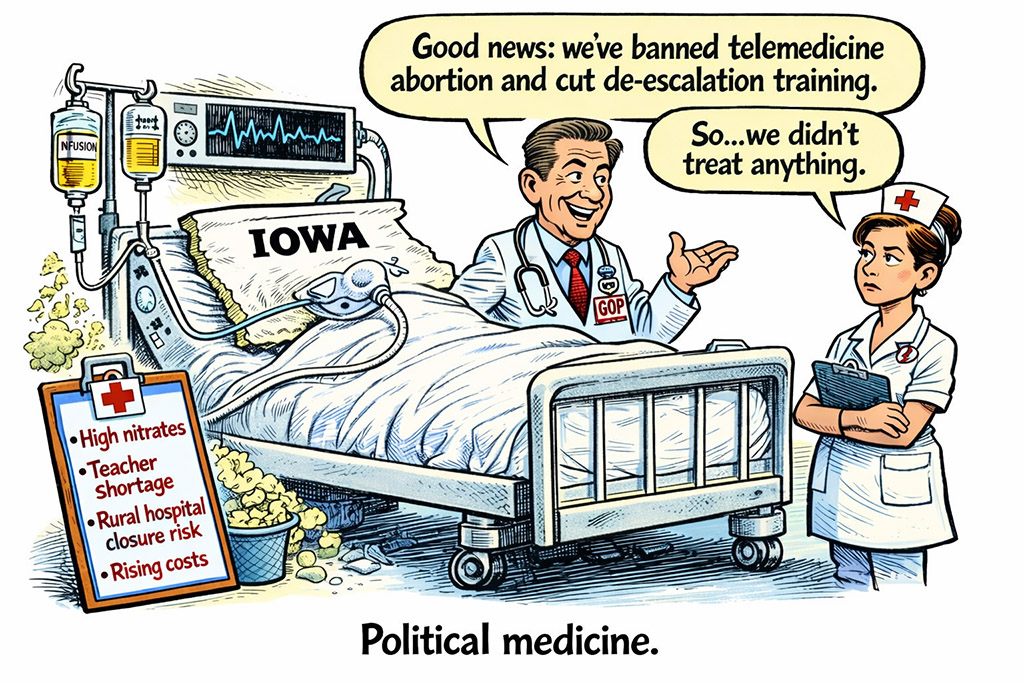
The editorial highlights bills targeting telemedicine abortion access, promoting marriage-before-children messaging in schools, and allowing couples to waive no-fault divorce protections. It argues these proposals attempt to “change society” through law but are poorly matched to modern realities such as Iowa’s low birth rate and broader economic pressures.
The editorial also criticizes bills that would roll back civil rights and local control, especially legislation removing requirements for law enforcement training in de-escalation and bias prevention, training enacted unanimously in 2020 after George Floyd’s death. It concludes these proposals are unproductive and urges lawmakers to focus instead on forward-looking priorities like water quality and workers’ rights.
Our Take
This is not “small government conservatism.” It’s centralized social engineering that attempts to use state power to force personal life choices, restrict local decision-making, and strip protections that have existed for decades.
And the attack on de-escalation training is especially alarming. Whatever one thinks about DEI debates, de-escalation is basic public safety. It protects citizens and officers. Removing it is the legislative equivalent of ripping seatbelts out of squad cars because someone doesn’t like the politics of traffic laws.
Reynolds’ charter school bill advances in House
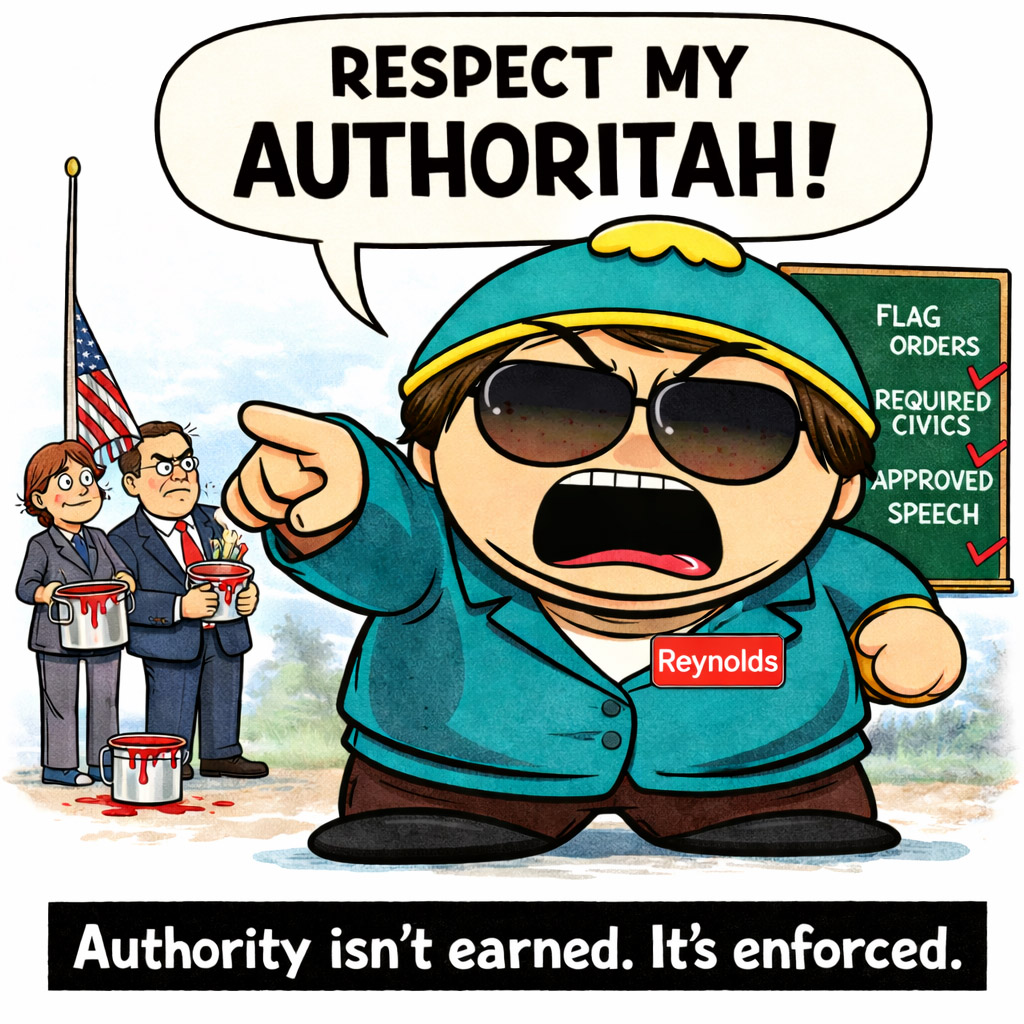
Gov. Kim Reynolds’ charter school bill advanced out of a House subcommittee, moving it closer to full committee review. The bill would allow all state per-pupil funding to follow a student from their home public school district to a public charter school.
Critics raised concerns about the funding mechanics, especially whether dollars earmarked for teacher hiring should be transferred to charter schools with students. They warned this could reduce public school districts’ ability to retain and pay teachers, particularly in larger districts where charter enrollment could reach significant levels.
Supporters of the bill, including charter school advocates, argued it would expand educational opportunities and allow charters to offer more programs. The bill also includes provisions requiring districts to allow charter students access to concurrent enrollment courses and athletics, and it makes charter schools an option for student teaching placements.
Our Take
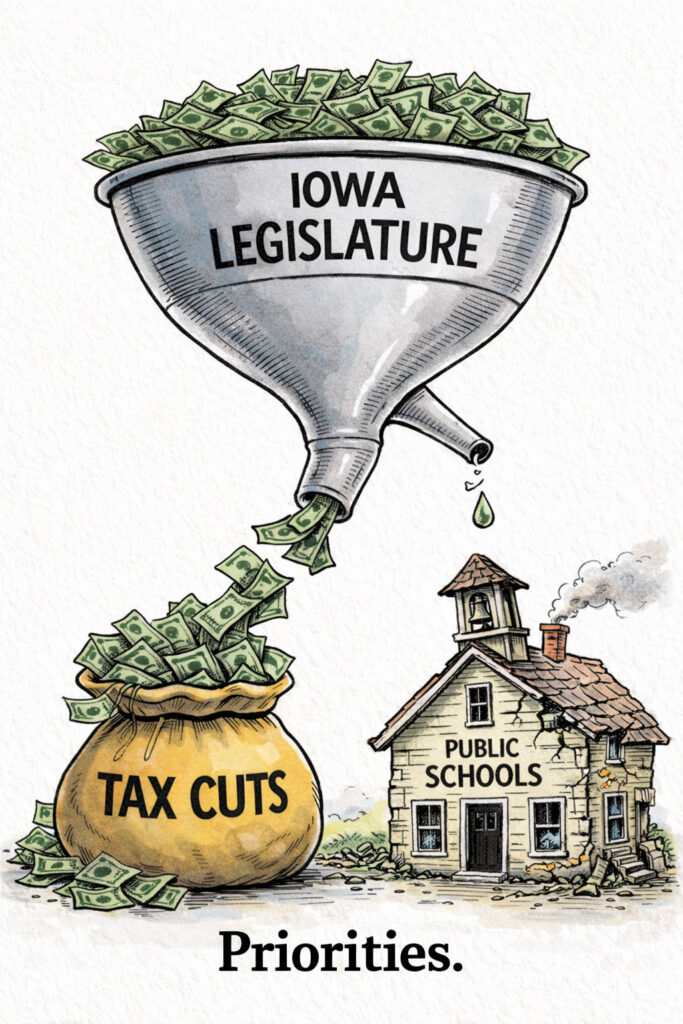
This isn’t “choice” in the abstract. This is a structural funding shift. When you make money portable but keep public schools responsible for fixed costs, you don’t create competition. You create destabilization.
Iowa already has a major public-private education funding controversy. This bill follows the same pattern: expand alternatives, then backfill nothing, and let local districts absorb the damage. And the teacher-funding question is not a technical detail; it’s the entire ballgame. If teacher dollars follow students out, districts are left with fewer staff and larger class sizes, which then becomes the “proof” that public schools are failing.
Update says Southeast Iowa pipeline explosion is still being investigated (Washington County)
A pipeline explosion and fire in rural Washington County remains under investigation, according to county emergency management. The fire started late Saturday morning and spread across both sides of the Skunk River before being brought under control in about two hours. Officials reported no injuries and no structural damage, and said there is no continuing threat to the public.
The pipeline is owned by Enterprise Products Partners LP, a Houston-based company involved in transporting natural gas liquids and hazardous liquids. The story notes Enterprise’s involvement in a major 2020 pipeline incident in Corpus Christi, Texas, where a dredge struck an underwater propane pipeline, causing a deadly explosion that killed five people.
The article also details Iowa’s 2023 enforcement action against Enterprise Products Operating LLC, which regulators found had operated hazardous liquid pipelines and underground storage facilities in Iowa for roughly two decades without the required permit. The company was fined $1.8 million, though regulators noted penalties were limited by an Iowa law capping violations.
The story connects the Iowa explosion to ongoing Iowa political battles over eminent domain authority for pipelines, particularly in relation to Summit Carbon Solutions and public concerns about safety and liability.
Our Take
This story is the “real world” version of what Iowans have been warning about: pipelines are not abstract infrastructure. They are risk systems, and when something goes wrong the public pays first.
The most disturbing detail is not the explosion itself (investigations happen). It’s the track record: a company with a major fatal incident elsewhere, and a documented history of operating pipelines in Iowa without permits for decades. That’s not a one-off. That’s a governance failure.
And yes, the carbon capture pipeline comparison is relevant. The through-line is the same. Regulators approve massive infrastructure first, and the public learns about the real risks later.