The Poll That Wasn’t Just a Poll: Why Iowa Needs Ann Selzer Back
Iowa has always had its quirks. We love county fairs, local control, and the idea that regular people, not national machines, still matter. For decades, one of the quiet ways Iowa contributed to American democracy was through something surprisingly simple: a trustworthy snapshot of what Iowans are thinking.
That snapshot was the Selzer poll.
When President Donald Trump sued Ann Selzer and the Des Moines Register’s parent company, Gannett, over a pre-election poll that didn’t match the result of the 2024 election, it was not merely a personal grievance.
It was an attack on a civic institution. On one of the few remaining mechanisms that can puncture propaganda, challenge assumptions, and show elected officials what the public mood really is.
Polls are not promises. They are not pre-announced election results. They are a snapshot in time.
And anyone who understands polling, even at a basic level, knows this. Polling captures a moment. It reflects what respondents say when asked, using a defined methodology, at a particular point in the news cycle. A poll taken in the final days of an election, during a period of high churn and late-breaking decisions, is especially vulnerable to shifts. That’s not fraud. It’s reality.
Yet Trump’s lawsuit treats polling error as misconduct. It implies that a poll that displeases a powerful figure must be illegitimate even when there is no evidence of manipulation, falsified data, or professional wrongdoing.
That standard is not just unreasonable. It is authoritarian.
The Hidden Damage: The Chill Effect
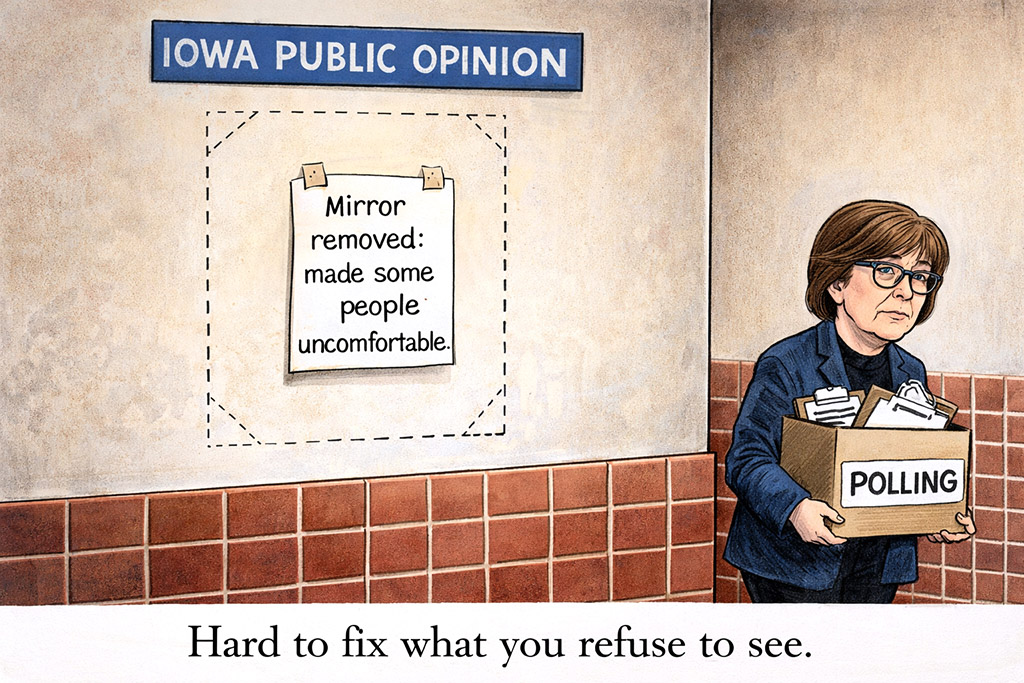
Even if the lawsuit goes nowhere, it has already succeeded in one major way: Iowa lost Ann Selzer’s polling. That loss is bigger than one election cycle.
Ann Selzer’s work mattered because it was widely respected, even by people who didn’t like what it showed. Her poll wasn’t “Democratic.” It wasn’t “Republican.” It was the closest thing Iowa had to a civic mirror: a rigorous, professional reflection of public opinion in a state where politics is often distorted by loud voices, national narratives, and partisan spin.
When a pollster steps away because the legal and political cost becomes too high, the message to others is clear.
Report at your own risk. That is the chilling effect, and it is corrosive to democratic transparency.
It’s Not Just About Trump. At first glance, this looks like a Trump story. But it’s also an Iowa story, and a national story.
This week, Iowa legislative Republicans moved to limit a governor’s powers in ways that appear designed not for today’s political conditions, but for tomorrow’s political fears. It’s a hedge; a structural advantage built in advance, just in case voters choose differently next time. North Carolina has seen similar maneuvers. Other states have, too.
This is a pattern. When political power feels threatened the response is often not persuasion, it is insulation. Insulation from voters, oversight, and consequences. And insulation from information.
Polling Is Not the Enemy. It’s the Warning System.
When we lose credible polling, we lose more than numbers. We lose a public feedback loop.
Without reliable polls, politicians can claim “the people support us” without evidence. They can dismiss dissent as fringe. They can push unpopular legislation while insisting it is “what Iowans want.” They can govern by assumption and ideology instead of accountability.
Polls don’t govern. They don’t vote. They don’t replace elections. But they do something essential in between elections, they tell the truth about the moment.
And in a healthy democracy, that truth matters.
The Irony: The Poll Could Have Helped Trump
There is also a delicious irony here. A poll that showed Trump weaker in Iowa may have motivated his supporters to turn out in higher numbers. It may have energized a base that assumed victory was automatic. If anything, the poll could have helped him.
But the lawsuit wasn’t about the practical function of polling. It was about punishment.
What Iowa Should Demand
Iowa should not accept a future where credible pollsters disappear because powerful people don’t like the answers.
We should demand the opposite. Stronger protections against lawsuits designed to intimidate public participation. A civic culture that defends independent journalism and independent data. And public recognition that disagreement with a poll is not grounds for litigation.
And yes, we should say it plainly: Iowa needs Ann Selzer back.
Not because she is always “right.” Not because polls are perfect. But because democracy requires independent institutions that measure reality, even when reality is inconvenient.
Because the Alternative Is Worse
When pollsters are silenced, we don’t get a cleaner political environment. We get a dirtier one.
We get politics where only the loudest voices count. Where elected officials can claim public support without proof. Where propaganda replaces measurement. Where transparency becomes optional.
And where fear, not accountability, shapes what information reaches the public.
Iowa has enough problems. We don’t need to add “information blackout” to the list.
We need the mirror back.

This Iowa411 editorial may be republished online or in print under the Creative Commons license CC BY-NC-ND 4.0. You may share our work (including editorial cartoons) with attribution and a link back to Iowa411, but you may not alter the content or use it for commercial purposes.