Summary
Across all three stories, a pattern emerges. Tuition is frozen. Public schools receive modest increases. Private institutions face new funding conditions. And the state maintains substantial fiscal control over allocations.
Iowa lawmakers are exercising spending restraint while advancing structural education reforms.
The unresolved question is whether these policies represent long-term fiscal discipline or incremental resource compression in education systems.
Time, and outcomes, will determine which narrative proves to be accurate.
House Passes 5-Year Tuition Freeze for Regents Universities
The Iowa House voted 86–5 to approve House File 2242, which would freeze tuition at the University of Iowa, Iowa State University, and the University of Northern Iowa through July 1, 2031. The measure now heads to the Senate.
Supporters say the freeze draws a “line in the sand” against steady tuition increases. Rep. Taylor Collins (R-Mediapolis) argued that universities must find efficiencies rather than rely on additional state funding.
Rep. Adam Zabner (D-Iowa City) supported the tuition freeze but cautioned that it must be accompanied by increased state investment to prevent further strain on institutions. He noted that decades ago, roughly two-thirds of university funding came from the state and one-third from tuition — a ratio that has largely reversed.
A nonpartisan Legislative Services Agency analysis estimates that the freeze would reduce university revenue over time. By year five, projected losses would total approximately $25 million at the University of Iowa, $27.9 million at Iowa State, and $11.5 million at UNI.
Whether lawmakers replace that lost revenue during the appropriations process remains uncertain.
Our Take
While there is no competing legislative bill to raise tuition, the tuition freeze follows ongoing discussions by the Iowa Board of Regents about the financial pressures facing public universities.
In effect, lawmakers are limiting the Regents’ future discretion to adjust tuition, shifting more responsibility to the appropriations process.
A tuition freeze is politically popular and financially meaningful for families. However, freezing tuition does not eliminate costs; it shifts the question to who absorbs them.
If state appropriations do not increase to offset projected revenue losses, universities may respond through program reductions, hiring freezes, deferred maintenance, or increased reliance on out-of-state tuition.
The policy question is not whether tuition should rise, it is whether Iowa will recommit to its historical funding model for public universities or continue shifting costs toward institutions themselves.
A freeze without funding clarity is a fiscal headline, not yet a fiscal plan.
House Bill Would Bar Iowa Tuition Grant Funds for Private Colleges with DEI Offices
House File 2488 passed 57–34 and would prohibit private colleges from receiving Iowa Tuition Grant funds if they maintain diversity, equity, and inclusion (DEI) offices.
The Iowa Tuition Grant provides need-based aid to students attending private Iowa colleges. In the 2025–26 school year, eligible students may receive up to $7,500. The state currently spends approximately $53.8 million annually on the program.
Rep. Steven Holt (R-Denison) said private colleges may continue DEI programs if they choose but would forfeit state tuition grant funds.
Opponents argue the legislation intrudes into private institutional governance. Drake University President Marty Martin called the Iowa Tuition Grant a form of school choice and warned the measure could chill speech and campus engagement. The bill now moves to the Senate.
Our Take
The core issue is not whether DEI programs exist. The issue is conditional funding.
The state is asserting leverage over private institutional policy in exchange for participation in a publicly funded aid program. That is legally defensible in structure, but politically contentious.
If enacted, the law would not ban DEI programs outright at private colleges. It would attach financial consequences.
The policy tension is clear. Is the Tuition Grant primarily about expanding student choice? Or is it a policy instrument to shape institutional behavior?
Both arguments are being advanced. Voters should understand the distinction.
Iowa Senate Sends K–12 Funding Package to Governor
The Iowa Senate approved Senate File 2201, setting a 2% State Supplemental Aid (SSA) rate for FY2027. The bill now heads to Gov. Kim Reynolds.
The final rate represents a compromise between the Senate’s original 1.75% proposal and the House’s 2.25% proposal.
Key elements include $7 million for paraeducator and support personnel pay, a $1 million cap on transportation equity payments, a revised twice-yearly enrollment count system, extension of property tax relief payments, and state assumption of $42.2 million in “budget guarantee” obligations.
The 2% SSA increase adds approximately $111.5 million in new funding and raises the per-pupil amount to $8,148 in FY2027.
Democrats and advocacy groups argue the increase is insufficient to keep pace with inflation and rising operational costs. Some school districts have cited program cuts, staffing reductions, and shortened school weeks.
Republican lawmakers argue the bill increases overall funding while adding structural changes that may benefit districts.
Our Take
The debate is less about whether funding increased (it did) and more about adequacy.
A 2% increase may trail inflation and rising personnel costs. If districts’ cost growth exceeds 2%, purchasing power effectively declines.
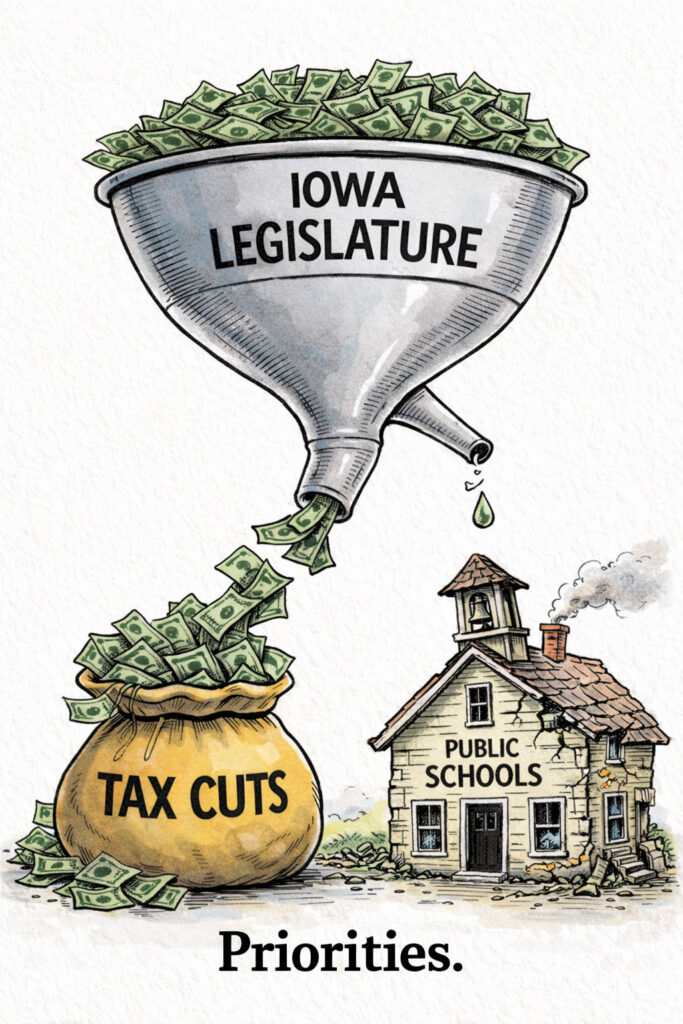
At the same time, the state has expanded its Education Savings Account (ESA) program, which is now universal and uncapped by income. Critics argue that growth in ESA expenditures competes with public school funding capacity. Supporters argue families deserve educational choice.
This is a strategic policy choice to prioritize controlled growth in public school funding while expanding school choice programs or significantly increase SSA to stabilize district budgets.
Both approaches have consequences. Voters should evaluate them based on measurable outcomes: class sizes, program availability, staffing levels, and long-term fiscal sustainability.